TRENDING

Thursday, 24 September 2026
----------------------
13 Rabi' Al-Thani 1448 AH
Russia plans to launch its Spectr-UV space telescope in 2031, aiming to succeed the Hubble Space Telescope and become the world's only dedicated ultraviolet observatory for a decade. This ambitious project underscores Russia's drive for technological sovereignty and scientific prestige amidst evolving global dynamics.
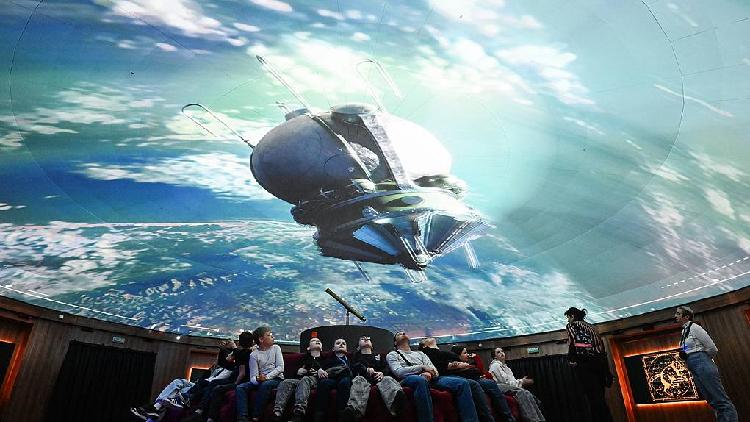
Russia has formally announced its intention to launch the Spectr-UV space telescope on October 24, 2031, positioning it as a significant successor to the aging Hubble Space Telescope. This ambitious project, spearheaded by Russia's state space corporation Roscosmos and its constituent entities like the Lavochkin Association and Energia Rocket and Space Corporation, signals Moscow's enduring commitment to advanced space exploration and its strategic pursuit of scientific and technological autonomy on the global stage.
The announcement, made by Alexander Shakhanov of the Lavochkin Association at the Ultraviolet Universe-2026 conference in Moscow, detailed that work on critical engineering documentation for launch systems and ground infrastructure is slated to commence in January 2027. The telescope is designed for a primary five-year mission, extending until October 23, 2036, with specialists anticipating a potential for an extended operational life. This timeline underscores a long-term vision for Russia's role in astrophysics.
The Spectr-UV project carries substantial geopolitical weight beyond its scientific objectives. In an era marked by shifting global alliances and heightened competition in critical technological domains, a robust national space program serves multiple strategic purposes for Russia:
National Prestige and Soft Power: Historically, achievements in space exploration have been powerful symbols of national prowess and technological sophistication. The successful deployment and operation of a cutting-edge observatory like Spectr-UV would significantly bolster Russia's international standing and soft power, demonstrating its capacity for complex scientific and engineering feats. This is particularly relevant as Russia seeks to project an image of a leading scientific and technological power amidst geopolitical challenges.
Technological Sovereignty: The reliance on an indigenous Angara-A5M launch vehicle, equipped with a Persei upper stage, highlights Russia's drive for self-sufficiency in space technology. This independence is crucial for national security and strategic autonomy, reducing reliance on external partners for critical infrastructure and launch capabilities, especially in a volatile international environment. The development and production of such advanced systems also foster domestic innovation and maintain a highly skilled workforce.
Scientific Leadership: Spectr-UV is projected to be the world's sole dedicated ultraviolet space telescope until at least 2041, orbiting at an impressive altitude of approximately 35,000 km—significantly higher than Hubble. This unique positioning would grant Russia a distinct advantage in ultraviolet astronomy, potentially leading to groundbreaking discoveries about the universe's origins, star formation, and exoplanet atmospheres. Such scientific leadership can attract international talent and foster collaborations, albeit potentially with non-traditional partners.
Dual-Use Capabilities: While Spectr-UV is explicitly a scientific endeavor, advanced space capabilities inherently possess dual-use potential. The infrastructure, expertise, and technologies developed for a sophisticated observatory can also contribute to military, intelligence, and communication satellite programs, reinforcing Russia's overall strategic space posture. This synergy between civilian and military space programs is a common feature of major spacefaring nations.
The operational framework for Spectr-UV leverages existing Russian space infrastructure, including tracking stations at Baikonur and Medvezhye Ozyora near Moscow, and scientific data reception stations at Simeiz and Zvenigorod observatories. Notably, the plan also includes the ESSTI observatory in Addis Ababa, Ethiopia, for data reception. This inclusion suggests a pragmatic approach to international cooperation, potentially strengthening scientific ties with countries outside traditional Western alliances. Such partnerships can be a subtle but effective tool of diplomatic engagement.
The project also benefits from past experiences, with engineers planning to draw on lessons learned from the Spectr-RG observatory for the ground control complex. Mikhail Sachkov, director of the Institute of Astronomy of the Russian Academy of Sciences, confirmed that testing of the telescope is nearing completion, indicating a mature stage of development for this complex instrument.
The successful launch and operation of Spectr-UV would not only mark a significant scientific achievement for Russia but also underscore its determination to remain a formidable player in the global space arena. By filling a critical observational niche in ultraviolet astronomy, Russia aims to contribute uniquely to humanity's understanding of the cosmos while simultaneously reinforcing its technological independence and national prestige. The project's long-term vision, coupled with its strategic implications, positions Spectr-UV as a key indicator of Russia's future trajectory in science, technology, and international relations. Its progress will be closely watched by the international scientific community and geopolitical analysts alike, offering insights into Russia's capacity for innovation and its evolving role in a multipolar world.