TRENDING

Thursday, 15 October 2026
----------------------
4 Jumada Al-Awwal 1448 AH
Thousands of Indians are protesting a massive voter roll revision, alleging that up to 130 million names have been purged to benefit the ruling party. The government insists the deletions are legitimate, but critics point to a potential erosion of democratic foundations.
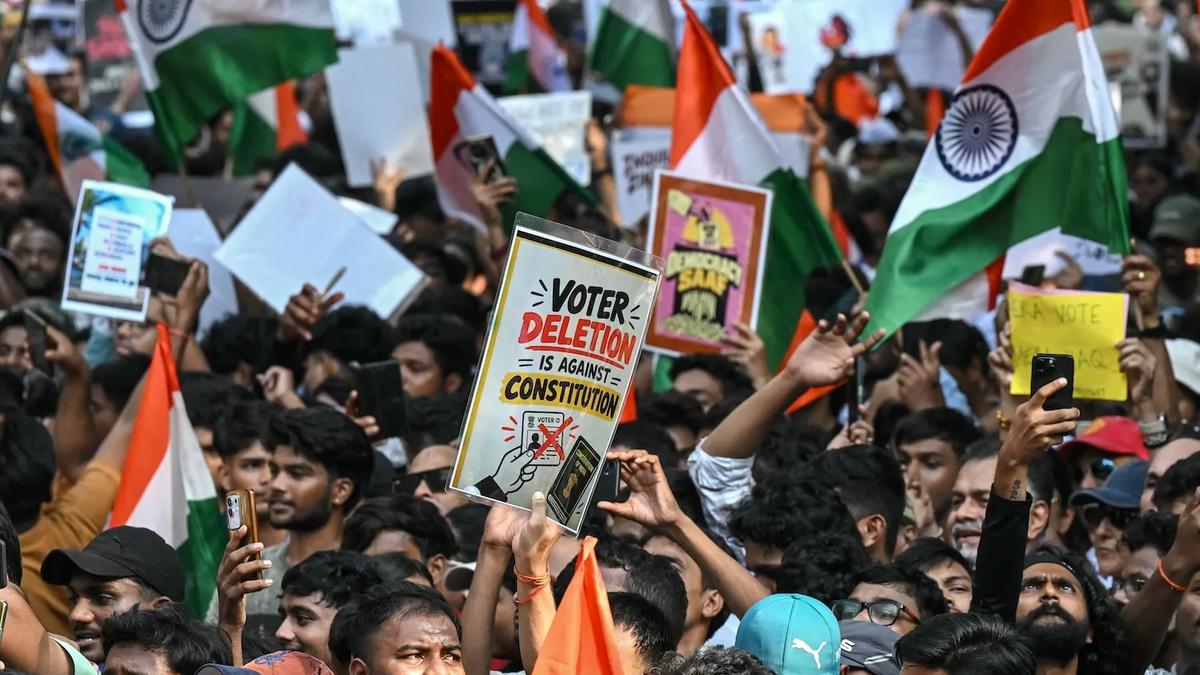
Thousands of Indian citizens have converged on major cities, including New Delhi, to protest a contentious revision of the nation's voter rolls. The movement, spearheaded by the Cockroach Janta Party, alleges that a staggering 130 million names have been removed from electoral lists. Protesters claim these deletions disproportionately target minority communities, particularly Muslims, and are designed to bolster the electoral prospects of the ruling Bharatiya Janata Party (BJP) in crucial state elections slated for 2027. The government, led by Prime Minister Narendra Modi, maintains that only ineligible voters were removed in a routine cleanup. However, authorities have responded to the demonstrations with a heavy hand, detaining as many as 7,000 people, shutting down metro stations, and imposing mobile internet blackouts in an attempt to quell the burgeoning dissent.
The core of the current unrest in India lies in the fundamental power dynamic of who gets to participate in democracy. Voter rolls are the bedrock of any electoral system, and their manipulation can fundamentally alter the balance of power. The alleged deletion of 130 million names, a figure that dwarfs the entire population of many nations, represents a significant potential shift in the electorate, particularly when viewed through the lens of upcoming state elections in seven key regions, including Uttar Pradesh and Gujarat, which together account for roughly 30 percent of the country's total voter base. For the BJP, which has steadily consolidated power under Prime Minister Modi over the past decade, securing these states is not merely about local governance; it is about reinforcing its national mandate and ensuring continued dominance.
The integrity of India's democratic process hinges on the perceived independence of its institutions, none more so than the Election Commission of India (ECI). Protesters' demands for the resignation of Chief Election Commissioner Gyanesh Kumar underscore a deep-seated concern about the ECI's impartiality. If the body responsible for safeguarding free and fair elections is seen as a tool of the ruling party, the legitimacy of the entire democratic exercise comes into question. This perception erodes public trust and can fuel widespread cynicism about the political system itself.
The government's robust response—mass detentions, communication blackouts, and deployment of security forces—is a classic demonstration of state power being leveraged to control dissent. While governments often justify such measures as necessary for maintaining law and order, they also serve as a potent deterrent, signaling that challenges to the ruling establishment will be met with force. This tactic aims to fragment protest movements, instill fear, and control the narrative by limiting the spread of information and coordination among activists. It reflects a broader trend in many democracies where ruling parties, once elected, seek to limit avenues for opposition and public criticism.
Despite the government's popularity, as noted by some analysts, the Cockroach Janta Party has proven its capacity to mobilize and achieve results. Their previous success in forcing the resignation of India's education minister earlier this year provides a crucial precedent, giving current protesters a sense of efficacy and momentum. This group represents a significant, albeit smaller, counter-power to the BJP's dominance, demonstrating that organized civil society can still exert pressure, even against a popular government. Their ability to galvanize public anger around a specific, tangible issue like voter deletion highlights the vulnerability of even strong governments to sustained, focused opposition.
The 2027 state elections are not isolated events; they are critical battlegrounds that shape the national political landscape. India's federal structure means that state-level victories can provide crucial leverage, resources, and momentum for national elections. By allegedly manipulating voter rolls at the state level, the BJP could be engaging in a form of electoral engineering designed to secure these regional strongholds, thereby solidifying its position at the center. This strategy reflects a sophisticated understanding of India's complex electoral geography and the long-term implications of state-level power for national governance.
The most immediate and profound human cost of the alleged voter roll manipulation is the disenfranchisement of millions of Indian citizens. Losing the right to vote is not merely a bureaucratic inconvenience; it is the loss of one's voice in a democracy, a fundamental erosion of civic identity and participation. For individuals, this means being denied the ability to choose their representatives, influence policy, and hold their government accountable.
The allegations that Muslim communities are disproportionately affected by these deletions point to a deeper, more insidious human cost: targeted marginalization. In a country with a rich tapestry of religious and ethnic diversity, any action that appears to systematically exclude a particular group from the democratic process sends a chilling message. It amplifies feelings of being a second-class citizen, fosters distrust in the state, and can exacerbate existing social divisions. For these communities, the right to vote is not just a political privilege but a vital tool for self-preservation and advocacy against discrimination.
The government's heavy-handed response to the protests—detaining thousands, shutting down metro stations, and cutting off mobile internet services—directly impacts fundamental human rights. Freedom of assembly, freedom of speech, and access to information are cornerstones of a democratic society. When these rights are curtailed, citizens are prevented from expressing their grievances, organizing collectively, and accessing vital information about the issues affecting them. This creates a climate of fear, where the act of peaceful protest becomes fraught with personal risk, chilling legitimate dissent and silencing critical voices.
Beyond the immediate impact on individuals, the voter roll controversy exacts a significant toll on the collective psyche of the nation. When the electoral process, the very mechanism through which democratic will is expressed, is perceived as compromised or manipulated, it erodes public trust in all democratic institutions. This erosion can lead to widespread cynicism, political apathy, and a sense of helplessness among the populace. In the long run, such a breakdown of trust can destabilize the political system, making it harder for any government to govern effectively and legitimately, irrespective of its electoral victories.
For those whose names are deleted, the human cost extends to the practical and psychological burden of re-registration. Navigating complex bureaucratic processes, often without clear guidance or accessible resources, can be a daunting task, especially for the elderly, the less educated, or those in remote areas. The sheer effort required to reclaim one's right to vote, coupled with the frustration of being arbitrarily removed, can lead to exhaustion and disengagement. This deliberate creation of hurdles effectively disenfranchises individuals without explicitly banning them, a subtle but powerful form of voter suppression that disproportionately affects vulnerable populations.
The official narrative from New Delhi frames the massive voter roll deletions as a purely technical exercise—a necessary cleanup of
Protesters allege that up to 130 million names have been removed from India's voter lists, disproportionately affecting minority communities like Muslims. They claim this is an attempt by the ruling BJP to gain an unfair advantage in upcoming state elections.
The Indian government asserts that the deletions are a legitimate administrative process to remove ineligible voters, such as deceased individuals or duplicate entries. They have also responded to protests with detentions and communication blackouts.
The 'Cockroach Janta Party' is a protest movement that has spearheaded the current demonstrations. They previously achieved success in forcing the resignation of India's education minister, demonstrating their capacity to mobilize and influence policy.
Editor's Note: Analysis is based on the provided raw intelligence and TGN editorial doctrine, focusing on power dynamics and human cost.
Source referenced: FOREIGNPOLICY
This brief was synthesized by our Editorial Engine and reviewed by The Ground Narrative team.