TRENDING

Friday, 18 September 2026
----------------------
7 Rabi' Al-Thani 1448 AH
China pushes back against "AI fear-mongering" as US tech leaders call for development slowdown. This clash reveals a deeper struggle over who controls the narrative and future of artificial intelligence.
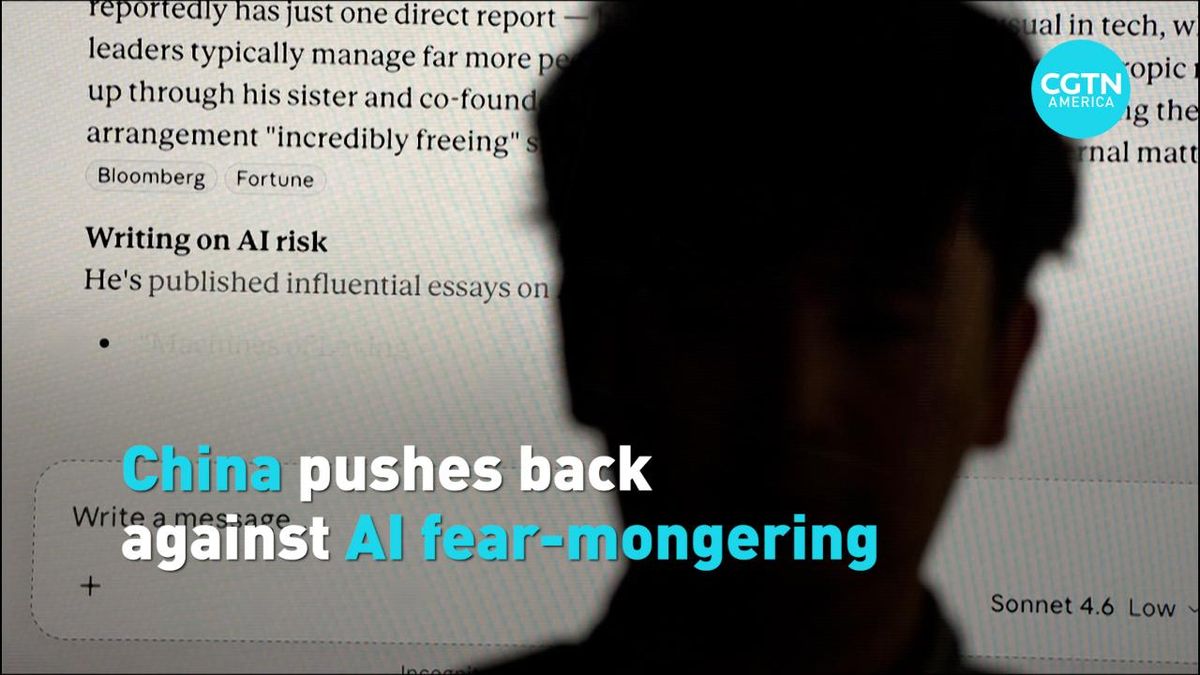
China has publicly pushed back against what it terms "threat narratives" and "vicious competition" surrounding artificial intelligence. Beijing argues that such "fear-mongering" will ultimately disrupt global governance efforts. This stance emerges as a parallel debate intensifies in the United States, where leading AI company CEOs have recently called for an industry-wide slowdown in development, citing concerns about AI's potential for irreversible damage, including existential risks to humanity.
This apparent disagreement over AI's dangers is less about the technology itself and more about the mechanics of global power and technological sovereignty. For China, rapidly advancing its AI capabilities is a cornerstone of its national strategy, crucial for economic growth, military modernization, and enhancing state control through surveillance and data analytics. Framing concerns about AI as "fear-mongering" allows Beijing to delegitimize calls for restrictive international regulations that could slow its progress or give an advantage to Western competitors. It positions China as a proponent of open, collaborative AI development, even as it pursues its own ambitious, state-backed agenda.
Conversely, the "threat narratives" emanating from the U.S. tech sector, while potentially rooted in genuine ethical concerns, also serve strategic interests. By highlighting existential risks, American policymakers and industry leaders can advocate for regulatory frameworks that could, intentionally or not, favor established Western companies, set global standards that align with their values, or create barriers for emerging competitors, particularly China. This struggle is fundamentally about who gets to define the rules of the road for the most transformative technology of the century, and thus, who controls its future development and deployment. It’s a battle for technological leadership, where rhetoric becomes a powerful tool in shaping policy and public perception.
While CEOs and national leaders debate the existential risks of AI, the immediate human cost often falls on those far removed from these high-level discussions. In nations of the Global South, where AI could offer transformative solutions in healthcare, education, and agriculture, the risk is being left behind. If the global AI landscape becomes fragmented by competing national regulations or dominated by a few powerful tech blocs, the benefits of AI might not reach the populations that could gain the most, exacerbating existing digital and economic divides.
Furthermore, the rapid, often unchecked, development of AI in pursuit of national advantage raises profound questions about the future of work. Millions globally face potential job displacement as AI automates tasks across industries. Whether under the banner of "fear-mongering" or "unfettered innovation," the discourse often sidesteps the urgent need for robust social safety nets, retraining programs, and new economic models to support ordinary citizens whose livelihoods are directly impacted by these technological shifts. The focus on abstract, distant threats often overshadows the concrete, immediate challenges faced by workers and communities worldwide.
What remains largely unspoken in the public discourse from both sides is the intense military dimension of AI development. While "threat narratives" often focus on general societal risks or hypothetical existential scenarios, a significant driver of national AI investment and competition is its application in defense, intelligence, and autonomous weapons systems. Neither Beijing nor Washington openly discusses the full scope of their respective AI military doctrines or the implications of an AI arms race. China's dismissal of "vicious competition" conveniently omits its own aggressive pursuit of AI for military modernization, while Western calls for a slowdown rarely connect directly to concerns about autonomous weaponry.
Moreover, the debate often sidesteps the critical issue of data control. AI models are only as powerful as the data they are trained on, and nations like China, with vast populations and less stringent privacy laws, possess immense data advantages. The "fear-mongering" discussion, while valid in its own right, can distract from the underlying geopolitical struggle over who collects, processes, and ultimately controls the world's information – a power that underpins all AI development and deployment, from commercial applications to state surveillance.
The coming years will reveal whether the world moves towards a fragmented AI landscape or a more collaborative, albeit contested, governance model. Watch for the emergence of competing international AI standards: will the UN, G7, G20, or new ad-hoc alliances be able to forge any meaningful, inclusive regulatory frameworks, or will major powers simply develop their own, incompatible rules? Pay close attention to the rhetoric surrounding the next major AI breakthrough – how will it be framed by different nations, and what policy responses will it trigger? Finally, observe how developing nations navigate this tech rivalry. Will they be forced to choose sides, or will they successfully advocate for frameworks that prioritize equitable access and address their unique developmental needs, rather than merely serving the strategic interests of the dominant tech powers? The answers will shape not just the future of AI, but the global power balance itself.
Source referenced: CGTN
This brief was synthesized by our Editorial Engine and reviewed by The Ground Narrative team.