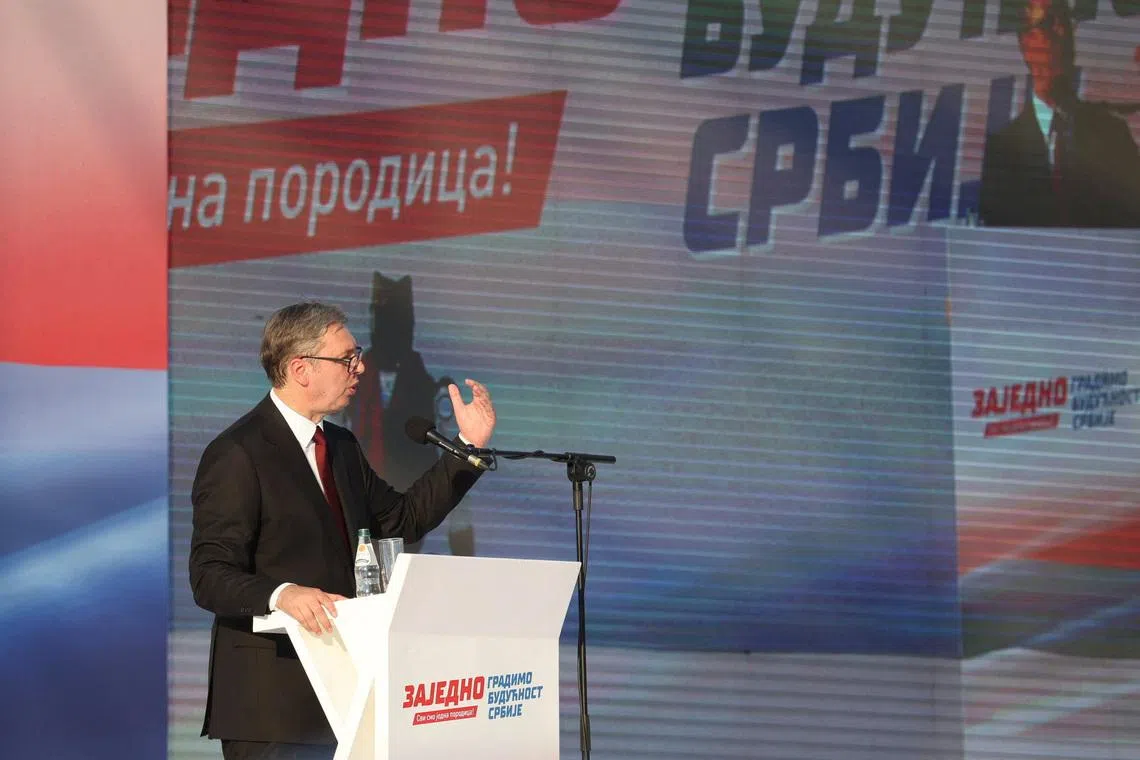
Serbian President Aleksandar Vucic's recent announcement to step down from his presidential mandate, potentially triggering early elections, marks a pivotal moment in the nation's political landscape. This move, declared at a pro-government rally in Belgrade on June 29, 2026, comes after 18 months of sustained anti-government protests, the largest since the fall of Slobodan Milosevic in 2000. While seemingly a concession to public discontent, analysts and even protestors widely interpret Vucic's decision as a strategic maneuver designed to consolidate or reconfigure his power, rather than a genuine withdrawal from the political arena.
The Strategic Maneuver
For over a decade, Aleksandar Vucic, 56, has been the dominant figure in Serbian politics, serving as prime minister from 2014-2017 and then as president since 2017. Despite the presidency traditionally being a largely ceremonial role, Vucic effectively centralized power, maintaining a firm grip on his ruling Serbian Progressive Party (SNS). His current resignation is widely anticipated to pave the way for him to run for the prime ministership, a position that holds more direct executive authority. This tactical shift would allow him to address the immediate pressure from protests, which were initially sparked by a deadly train station awning collapse in November 2024 that became a symbol of alleged widespread corruption and weak oversight. By transitioning roles, Vucic could seek to reset the political narrative, potentially presenting himself as responsive to public demands while ensuring his continued influence over the state apparatus. As Florian Bieber, Professor for Southeast European History and Politics at the University of Graz, notes, Vucic has a history of announcing political withdrawals only to reassert his power, indicating a system built around his personal control.
Economic Record vs. Democratic Concerns
Under Vucic's leadership, Serbia has indeed experienced significant economic growth. Since 2012, unemployment has fallen dramatically from approximately 26% to 8-9%, and nominal GDP has nearly tripled to around €90 billion. Foreign direct investment (FDI) inflows have also seen a substantial increase, reaching a record €5.2 billion in 2024. Vucic frequently highlights these achievements, asserting that his administration has "managed to achieve great things and change the face of our country."
However, this economic progress has been shadowed by persistent allegations of corruption and creeping authoritarianism. Critics, including opposition parties like the Democratic Party and the Green-Left Front, local media, and watchdogs, point to a lack of transparency in public procurement, citing the Novi Sad train station incident as a prime example where contracts were allegedly awarded without competitive tenders. Beyond corruption, human rights groups, such as Amnesty International, report a deteriorating environment for press freedom and free expression. Serbia's ranking in the World Press Freedom Index has fallen to 104th out of 180 in 2026, its lowest ever, reflecting concerns about intimidation, threats, and assaults against journalists. Protestors have also reported instances of beatings and unfair detentions, further fueling the narrative of a government increasingly intolerant of dissent.
Geopolitical Balancing Act
Vucic's tenure has been characterized by a complex and often contradictory foreign policy, attempting to balance Serbia's aspirations for European Union membership with its historical ties to Russia and burgeoning relations with China. While taking steps towards EU integration, Serbia has faced significant obstacles related to rule of law, judicial independence, and electoral fairness – precisely the issues raised by domestic critics. Simultaneously, Vucic has cultivated strong relationships with both Moscow and Beijing. He hosted Russian President Vladimir Putin in Belgrade multiple times and has engaged in frequent high-level visits with Chinese President Xi Jinping, notably in 2024. These ties have translated into substantial Chinese investments, including the turnaround of failing state-owned enterprises. This geopolitical tightrope walk allows Serbia to diversify its economic and political partnerships, but it also raises questions about its long-term strategic alignment and commitment to Western democratic norms, particularly given the EU's emphasis on rule of law and human rights.
Historical Echoes and Future Outlook
Vucic's political past, including his early career as a hardline nationalist and his role as information minister under Slobodan Milosevic during the 1999 NATO bombing campaign, continues to inform perceptions of his leadership. His controversial statements from that era, such as a 1995 remark about killing "100 Muslims" for every Serb, though later contextualized by Vucic, resonate with concerns about his commitment to democratic values and regional reconciliation. His forced retreat from a Srebrenica massacre commemoration in 2015 further underscores the deep historical wounds that remain sensitive in the Balkans.
Looking ahead, Vucic's anticipated shift to the prime minister's office suggests a continuation of his dominant influence over Serbian politics. While early elections might offer a superficial change, the underlying power structures and the system built around Vucic are expected to persist. The ongoing protests, even after his resignation announcement, signal that the public's demand for genuine systemic change, transparency, and democratic accountability remains strong. The future trajectory of Serbia's democracy, its path towards EU integration, and its delicate geopolitical balancing act will largely depend on how Vucic navigates this new political chapter and whether the calls for deeper reforms can translate into tangible institutional changes.