TRENDING

Monday, 12 October 2026
----------------------
1 Jumada Al-Awwal 1448 AH
A US Marine's arrest for murder in Okinawa has reignited calls for a fundamental review of the Japan-US Status of Forces Agreement (SOFA). This incident highlights decades of local grievances against the disproportionate US military presence.
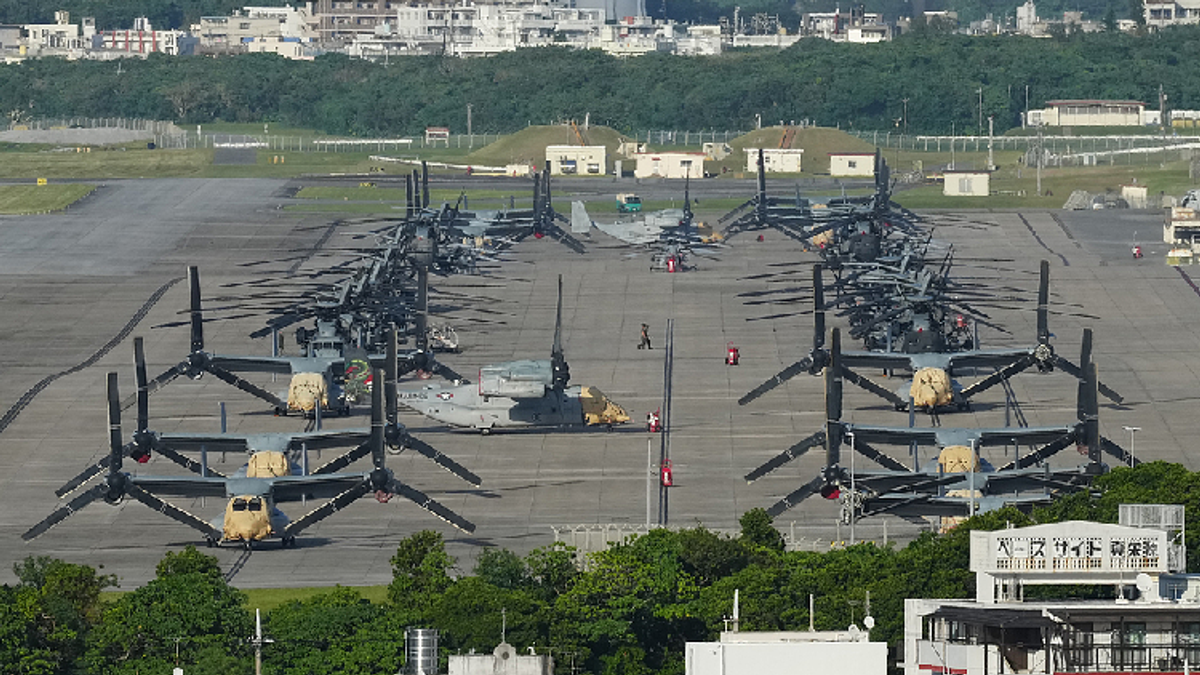
A US Marine was recently arrested in Okinawa, Japan, on suspicion of robbing and murdering a local woman. This incident swiftly prompted the Okinawa prefectural assembly to adopt a protest resolution and an opinion statement. The assembly's demands center on a fundamental review of the Japan-US Status of Forces Agreement (SOFA), the treaty governing the legal status of US military personnel in Japan. In response to the outcry, the US military in Okinawa temporarily suspended operations and imposed a curfew for its personnel, acknowledging the gravity of the situation. This event is not isolated, echoing similar protests and calls for SOFA reform following previous incidents involving US service members.
The recurring calls for a fundamental review of the Japan-US Status of Forces Agreement (SOFA) in Okinawa expose a deep structural imbalance of power, rooted in post-World War II geopolitics and the enduring strategic imperatives of the United States in the Indo-Pacific. SOFA, established in 1960, dictates the rights and responsibilities of US military personnel. Its most contentious clause grants the US primary jurisdiction over its service members for crimes committed while on duty, and often even for off-duty offenses until a formal indictment by Japanese authorities. This arrangement places US personnel beyond the full reach of Japanese law in many instances, creating a perception of impunity that fuels local resentment.
For the United States, Okinawa is an indispensable strategic asset. Hosting over 70% of US military facilities in Japan, the island serves as a critical forward operating base for power projection across the Western Pacific, vital for deterring aggression from China and North Korea. Washington's military doctrine prioritizes operational readiness, making any significant alteration to SOFA or base footprint a perceived compromise to strategic flexibility and alliance credibility.
The Japanese central government in Tokyo faces a perpetual bind. Its overarching priority is the robust US-Japan alliance, the cornerstone of Japan's national security. Tokyo relies heavily on the US security umbrella. Consequently, challenging Washington on SOFA reform or base relocation is a delicate diplomatic tightrope walk, as pushing too hard risks alienating its primary security guarantor. This creates an inherent incentive for Tokyo to manage rather than resolve the SOFA issue, often offering temporary concessions without committing to fundamental change.
Meanwhile, the Okinawan prefectural government and its citizens possess limited agency against these national and international power dynamics. Despite consistently electing officials who advocate for base reduction and SOFA reform, their demands frequently collide with the strategic realities perceived by Tokyo and Washington. Okinawa's unique history, having been under US administration from 1945 to 1972, has fostered a distinct political identity and a deep-seated desire for self-determination often overridden by mainland Japanese and American interests. The power differential is stark: a local population's democratic will pitted against the security architecture of two powerful nations.
The alleged murder of an Okinawan woman by a US Marine is a profound human tragedy, amplifying a decades-long burden borne by the people of Okinawa. For the victim's family, the cost is immeasurable – an irreversible loss compounded by the perceived injustice embedded within the Status of Forces Agreement (SOFA). The legal complexities and the potential for a foreign military justice system to take precedence often leave families feeling disempowered and denied full accountability.
Beyond individual tragedies, the omnipresence of US military bases casts a pervasive shadow over daily life. Noise pollution from aircraft, particularly MV-22 Ospreys, disrupts schools, homes, and hospitals. Traffic congestion, environmental concerns from base operations, and the constant threat of accidents involving military vehicles are daily realities. Children grow up in a landscape dotted with military installations, their playgrounds often adjacent to runways. This constant proximity to a foreign military, while framed as a guarantor of security, creates a persistent undercurrent of anxiety and a feeling of living in a perpetual state of occupation.
The core human cost lies in the perceived erosion of sovereignty and unequal application of justice. When serious crimes occur, SOFA provisions can create an opaque legal process. The agreement's clauses, granting the US military primary jurisdiction, mean alleged offenders may be tried under US military law rather than the Japanese civilian system. This can lead to different sentencing, lack of transparency, and a sense that justice is not fully served from a Japanese perspective. This jurisdictional divide fosters deep distrust towards the US military and the Japanese central government.
While bases provide some local employment, these benefits are often outweighed by opportunity costs and environmental degradation. Large tracts of land, often prime real estate, are occupied by military facilities, limiting Okinawa's potential for civilian economic development. Environmental impacts, including potential contamination, pose long-term health risks and ecological damage. The human cost extends beyond direct incidents to encompass daily infringements on quality of life, the psychological burden, and the systemic denial of full legal and territorial sovereignty.
In the aftermath of incidents like the alleged murder by a US Marine in Okinawa, the narratives presented by powerful actors—the Japanese central government and the United States—meticulously curate and downplay certain realities to preserve strategic interests. What frequently goes unsaid, or is subtly reframed, is the profound and disproportionate burden placed upon the Okinawan people, effectively treating the island as a geopolitical "sacrifice zone" in the broader Indo-Pacific strategy.
The Japanese central government consistently frames the US military presence in Okinawa as a necessary component of national security. While expressing "regret" and "sympathy," Tokyo rarely entertains a fundamental renegotiation of the Status of Forces Agreement (SOFA) or a significant reduction of the base footprint. The untold story here is the extent to which Tokyo prioritizes the US-Japan alliance above the democratic will and well-being of its Okinawan citizens. Public statements focus on "preventing recurrence" through minor adjustments like curfews, rather than addressing the root cause: the unequal legal framework and concentration of foreign military power. Tokyo's narrative often omits Okinawa's unique historical suffering during and after World War II, which fuels the local population's deep-seated desire for demilitarization.
From Washington's perspective, the US military presence in Okinawa is presented as crucial for regional stability and a shared responsibility with Japan. The narrative emphasizes strategic importance for protecting allies. What is downplayed is the direct human cost of this "forward presence." US official statements highlight "good neighbor" efforts but rarely address fundamental issues of jurisdiction, environmental impact, or the sheer scale of military operations. The underlying assumption, rarely articulated, is that strategic benefits for the region outweigh localized grievances. The US government tends to frame incidents as isolated acts by individuals rather than systemic issues arising from SOFA and the concentration of forces, deflecting calls for deeper structural reform. The idea that the US presence itself is a source of instability and resentment is largely omitted.
Perhaps the most significant untold story is the unspoken designation of Okinawa as a "sacrifice zone." Both Tokyo and Washington implicitly accept that the island will bear the brunt of the US-Japan alliance's strategic requirements—a disproportionate share of bases, associated social problems, and limitations on local autonomy. This narrative of sacrifice is never explicitly acknowledged or justified to the Okinawan people. Instead, their protests are often framed as local "nuisances" rather than legitimate expressions of a population demanding self-determination and equal justice. The powerful downplay the moral and ethical implications of asking one small island to bear such a heavy and continuous burden for geopolitical ambitions.
The latest incident and the renewed calls for SOFA review in Okinawa are not an endpoint but another inflection point in a long-running struggle. What happens next will reveal the true priorities of Tokyo, Washington, and the enduring resilience of Okinawan activism.
First, observe the Japanese central government's response. Will Prime Minister Fumio Kishida's administration move beyond expressions of regret and temporary measures? Any genuine commitment to a fundamental SOFA review would signal a significant shift in Tokyo's approach to the US-Japan alliance, potentially risking friction with Washington. More likely, look for continued diplomatic efforts to appease Okinawa with minor concessions, while maintaining the core SOFA framework.
Second, monitor US military actions. The immediate operational stand-down and curfew are standard responses. Will there be any deeper internal review of conduct or cultural training beyond these temporary measures? Any perceived leniency in the legal proceedings against the accused Marine, or a lack of transparency, will undoubtedly reignite protests and further erode trust.
Third, pay close attention to Okinawan political movements and public opinion. The prefectural assembly's resolution is a strong signal, but the sustained pressure from local civil society groups and the upcoming local elections will be crucial. If Okinawan voters continue to elect anti-base candidates, it will send an undeniable message to both Tokyo and Washington, even if direct policy changes remain elusive.
Finally, consider the broader geopolitical context. Escalating tensions in the Taiwan Strait or the South China Sea could paradoxically entrench the US military presence in Okinawa even further. If the region becomes more volatile, the strategic value of Okinawa to the US and Japan will be emphasized, potentially making any substantial SOFA reform or base reduction an even harder sell for Tokyo. The delicate balance between regional security imperatives and local human rights will continue to be tested.
The Japan-US SOFA is a treaty that defines the legal status of US military personnel stationed in Japan. It determines jurisdiction over crimes, taxation, and other legal matters, often granting the US primary jurisdiction for offenses committed by its service members.
Okinawa hosts the majority of US military facilities in Japan, leading to significant local grievances over crime, noise pollution, environmental impact, and the perceived lack of sovereignty. The island's history of US administration further fuels these sentiments.
US bases in Okinawa are strategically vital for projecting power in the Indo-Pacific, particularly in response to potential conflicts involving China or North Korea. They serve as a cornerstone of the US-Japan alliance, providing critical forward operating locations.
Editor's Note: The analysis is based on the provided news and extensive general knowledge of the Okinawa base issue and SOFA.
Source referenced: CGTN
This brief was synthesized by our Editorial Engine and reviewed by The Ground Narrative team.


