TRENDING

Sunday, 4 October 2026
----------------------
23 Rabi' Al-Thani 1448 AH
President Jimmy Carter's 1979 'Crisis of Confidence' speech, often misunderstood, offers a profound historical lens through which to analyze contemporary American societal and political fragmentation. His diagnosis of a nation grappling with eroded trust, consumerism, and institutional disillusionment finds striking parallels in today's deeply polarized landscape.
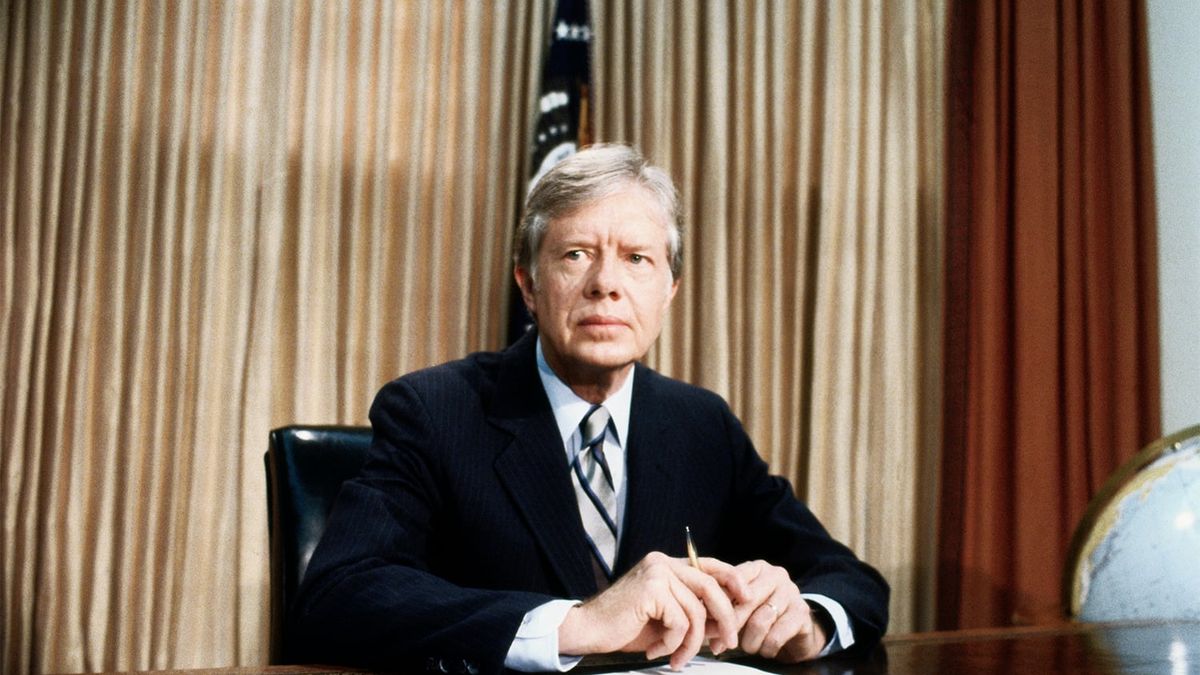
In the summer of 1979, President Jimmy Carter delivered a televised address to the American nation that would become one of the most analyzed and often mischaracterized speeches in U.S. history. Dubbed the 'Crisis of Confidence' speech, it emerged from a period of profound national introspection and external pressures. Carter, who had retreated to Camp David for ten days to consult with a diverse array of Americans, sought to articulate not just policy solutions but a deeper societal malaise.
The context for this address was extraordinarily turbulent. The 1960s and early 1970s had left the United States deeply scarred by the Vietnam War, the assassinations of prominent political figures like John F. Kennedy, Robert Kennedy, and Martin Luther King Jr., and the Watergate scandal, which culminated in President Richard Nixon's resignation. These events severely eroded public trust in government and national institutions. Economically, the nation was reeling from the second oil crisis, triggered by the Organization of the Petroleum Exporting Countries (OPEC), leading to high inflation and energy shortages. Internationally, the Iranian Revolution earlier in 1979, which brought Ayatollah Khomeini to power, underscored a sense of global instability and a perceived decline in American influence.
Carter's speech, delivered on July 15, 1979, to an audience of nearly 65 million Americans, was a candid and unconventional presidential address. He began by sharing the criticisms he had heard during his consultations, acknowledging a widespread feeling that the government was distant and unresponsive. The core of his message, however, was a diagnosis of a 'fundamental threat to American democracy': a 'crisis of confidence' that struck at the 'heart and soul and spirit of our national will.' He argued that the nation had become overly focused on 'self-indulgence and consumption,' defining worth by material possessions rather than collective purpose. This, coupled with the shattering of ideals regarding political integrity and military invincibility, had left Americans disillusioned and divided.
The insights from Carter's 1979 speech resonate with striking relevance in the contemporary United States. Today, the nation again grapples with deep political polarization, widespread distrust in institutions—including the news media and electoral systems—and a pervasive sense of uncertainty about the future. The article highlights how this environment has been exploited by political figures, such as President Donald Trump, who have leveraged public unhappiness to galvanize support and undermine perceived adversaries. This dynamic has fostered a 'culture of division, distrust, and disillusionment,' creating fertile ground for demagogic forces.
Many Americans today question the health of their democracy, observing with concern the rise of autocratic governments globally while internal divisions deepen. The article suggests that the challenges facing the U.S. extend beyond policy debates, requiring a fundamental re-evaluation of the 'habits, expectations, and responsibilities that sustain a healthy democratic culture.' This echoes Carter's call for a renewed 'faith in each other, faith in our ability to govern ourselves, and faith in the future of this nation,' rather than a reliance on quick fixes or government-led solutions alone.
The internal struggles of the United States have significant geopolitical implications. A nation deeply divided and lacking confidence in its own future is inherently less capable of projecting stable leadership on the global stage. The erosion of trust in democratic processes within the U.S. can embolden authoritarian regimes worldwide, providing them with rhetorical ammunition against democratic ideals and potentially undermining global efforts to promote human rights and rule of law. Allies may perceive a less reliable or predictable partner, while adversaries might see opportunities to challenge American influence.
Furthermore, a focus on internal strife can divert strategic attention and resources from pressing international challenges, ranging from climate change and global health crises to geopolitical rivalries and security threats. The ability of the U.S. to forge consensus on foreign policy, maintain robust alliances, and respond decisively to global events is intrinsically linked to its domestic cohesion and the confidence of its populace. Carter's speech, therefore, serves as a historical warning: the health of a nation's soul directly impacts its standing and effectiveness in the world.
Ultimately, the enduring relevance of Carter's 'Crisis of Confidence' speech underscores a persistent challenge for American democracy. The call for a deeper civic conversation, one that addresses the underlying psychological and spiritual dimensions of national unity, remains as pertinent today as it was over four decades ago. The failure to adequately address these foundational issues risks perpetuating a cycle of division and distrust, with profound consequences for both the American people and the nation's role in the global order.
Source referenced: FOREIGNPOLICY
This brief was synthesized by our Editorial Engine and reviewed by The Ground Narrative team.