TRENDING

Thursday, 15 October 2026
----------------------
4 Jumada Al-Awwal 1448 AH
Thousands gathered in Delhi to protest the removal of 130 million voter names, sparking a massive security crackdown. The episode reveals how political survival, economic strain, and institutional erosion are reshaping India's democratic landscape.
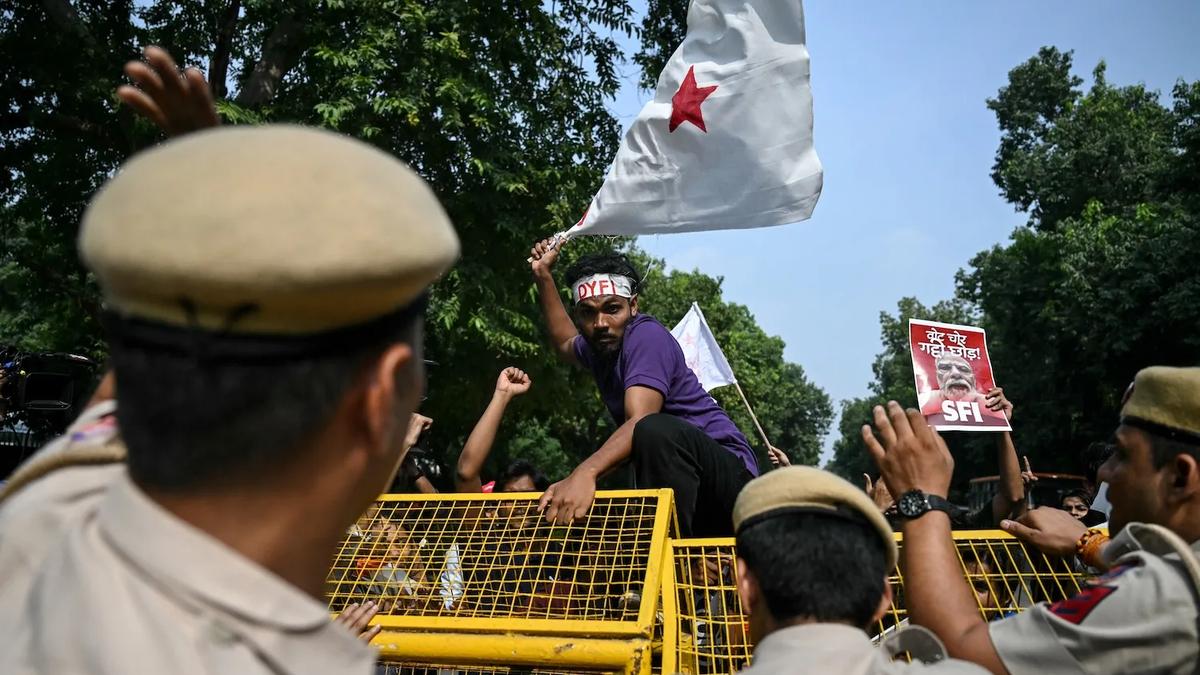
On October 10, 2026, security forces swept more than 7,000 demonstrators off the streets of Delhi as citizens protested the deletion of over 130 million names from voter rolls under the Election Commission's Special Intensive Revision (SIR). The protest, initially sparked by calls for the resignation of Chief Election Commissioner Gyanesh Kumar, quickly expanded into a broader challenge to Prime Minister Narendra Modi's government. Despite the shutdown of 57 metro stations, suspension of mobile internet, and deployment of 30,000 paramilitary troops, protesters continued to gather, with journalists and opposition politicians among those detained.
Modi entered his third term without the parliamentary dominance that characterized his first two governments. The 2024 election reduced the BJP to 240 seats, forcing a coalition that depends on regional partners and delicate vote‑share calculations. In this context, any perception of weakness—such as a mass removal of voters—poses an existential threat to the coalition's legitimacy. The crackdown serves a dual purpose: it signals to coalition partners that the central government can still command the state's coercive apparatus, and it attempts to deter further dissent that could fracture the fragile alliance.
India’s macro‑economic picture in 2026 is a paradox. Official data tout a 7.8 % quarterly growth rate, yet foreign portfolio investors have withdrawn a record $33 billion this year, and the rupee has depreciated over 6.5 % against the dollar. The voter‑roll purge is widely interpreted as a move to streamline the electorate in favor of constituencies that reliably support the BJP, potentially improving short‑term electoral calculations at the cost of investor confidence. The crackdown, by projecting an image of law‑and‑order, is meant to reassure markets, but the visible violence undermines that narrative, accelerating capital outflows.
The 2022 amendment granting the executive full control over the appointment of election commissioners effectively neutered the Election Commission's independence. By installing a loyal chief commissioner, the Modi administration can steer the SIR process, which critics argue targets opposition strongholds and marginalized communities. The crackdown reinforces the message that the state will not tolerate challenges to this new institutional arrangement, further consolidating executive power at the expense of democratic checks.
India’s foreign policy under Modi has become a balancing act between a strained relationship with the United States—marked by high tariffs and a stalled trade deal—and an uneasy rapprochement with China, which continues to dominate border disputes and trade imbalances. The domestic unrest weakens Modi’s bargaining position abroad; allies view internal instability as a risk factor for strategic cooperation. The crackdown, therefore, is also an attempt to project internal control to external partners, even as the reality on the ground suggests the opposite.
The protest movement is largely youth‑driven, with university students forming the backbone of the street demonstrations. Many have faced violent arrests, loss of academic credits, and intimidation. The psychological toll of confronting heavily armed paramilitary units—some of whom were filmed dragging demonstrators to police vans—has deepened a sense of alienation from the state.
The shutdown of metro stations and suspension of internet services crippled daily commuters, especially informal sector workers who rely on public transport to reach wage‑earning sites. Lost work hours translate directly into lost income, exacerbating already high unemployment rates among the under‑25 demographic. For families already struggling with rising food prices, the protest‑related disruptions push many closer to poverty.
At least 37 journalists were detained during the weekend protests, signaling an expanding crackdown on press freedom. Independent digital platforms, which have become the primary news source for many Indians, face increased surveillance and occasional throttling. Civil‑society groups reporting on the voter‑roll deletions risk being labeled as foreign‑influenced, limiting their ability to mobilize resources.
Analysts note that a disproportionate share of the 130 million deleted names belong to marginalized castes and tribal communities in states where the BJP’s vote share is weaker. The removal of these voters effectively dilutes the political voice of groups already underrepresented, deepening structural inequities.
Official statements portray the deployment of 30,000 paramilitary troops as a necessary response to “law‑less elements” threatening public order. What is omitted is the systematic targeting of opposition leaders, senior lawyers, and journalists—actors who are not typical violent agitators. By conflating peaceful protest with insurgency, the government seeks to legitimize the use of force while sidestepping accountability.
State‑aligned media continue to highlight the official GDP growth figure, downplaying the $33 billion capital flight and the rupee’s depreciation. The narrative of “economic resilience” masks the underlying investor anxiety that could translate into reduced foreign direct investment, job losses, and a longer‑term slowdown.
While the Modi administration emphasizes its firm stance against internal disorder, it quietly downplays the deteriorating public opinion in the United States—where a recent Pew survey shows 50 % of adults hold an unfavorable view of India. The administration’s diplomatic messaging focuses on strategic partnerships, ignoring the soft‑power damage caused by visible state violence.
- Legal challenges to the SIR: Courts may become the next arena for contesting the voter‑roll deletions, especially if civil‑society groups can mobilize strategic litigation.
- Coalition dynamics: Watch for statements from regional partners (e.g., the Samajwadi Party, Dravida Munnetra Kazhagam) that could signal a shift in support away from the BJP if the crackdown deepens.
- Capital flows and currency trends: Continued outflows or a sharp rupee depreciation would pressure the Modi government to adjust its economic narrative.
- International diplomatic cues: Any change in U.S. or EU trade policy toward India, especially regarding tariffs, could reflect how external actors interpret the domestic unrest.
- Grassroots mobilization: The persistence of youth‑led protests in other metros—Bengaluru, Kolkata, and Hyderabad—will indicate whether Delhi’s crackdown can contain the dissent or merely fuel a broader civic movement.
The trajectory of India’s democracy now hinges on whether the state chooses dialogue and institutional reform or doubles down on coercion. The next weeks will reveal which path gains traction, and with it, the real cost borne by ordinary Indians.
The Election Commission launched the Special Intensive Revision to clean up outdated entries, but critics argue the process was politicized to remove opposition‑leaning voters, especially from marginalized groups.
Visible police violence and the detention of journalists have lowered India's standing in democratic indices and contributed to unfavorable public opinion in key partners like the United States.
Sustained legal challenges, loss of coalition support, worsening economic indicators, or a surge in nationwide protests could compel the government to negotiate rather than rely on force.
Editor's Note: Analysis based on publicly available reports and expert commentary; ongoing developments may alter the dynamics described.
Source referenced: FOREIGNPOLICY
This brief was synthesized by our Editorial Engine and reviewed by The Ground Narrative team.