TRENDING

Monday, 5 October 2026
----------------------
24 Rabi' Al-Thani 1448 AH
The US Pentagon establishes a new Autonomous Warfare Command, tripling its investment in drone technology and bringing tech leaders into its strategic core. This move signals a fundamental shift in how America projects power, with profound implications for global conflict and the human experience of war.
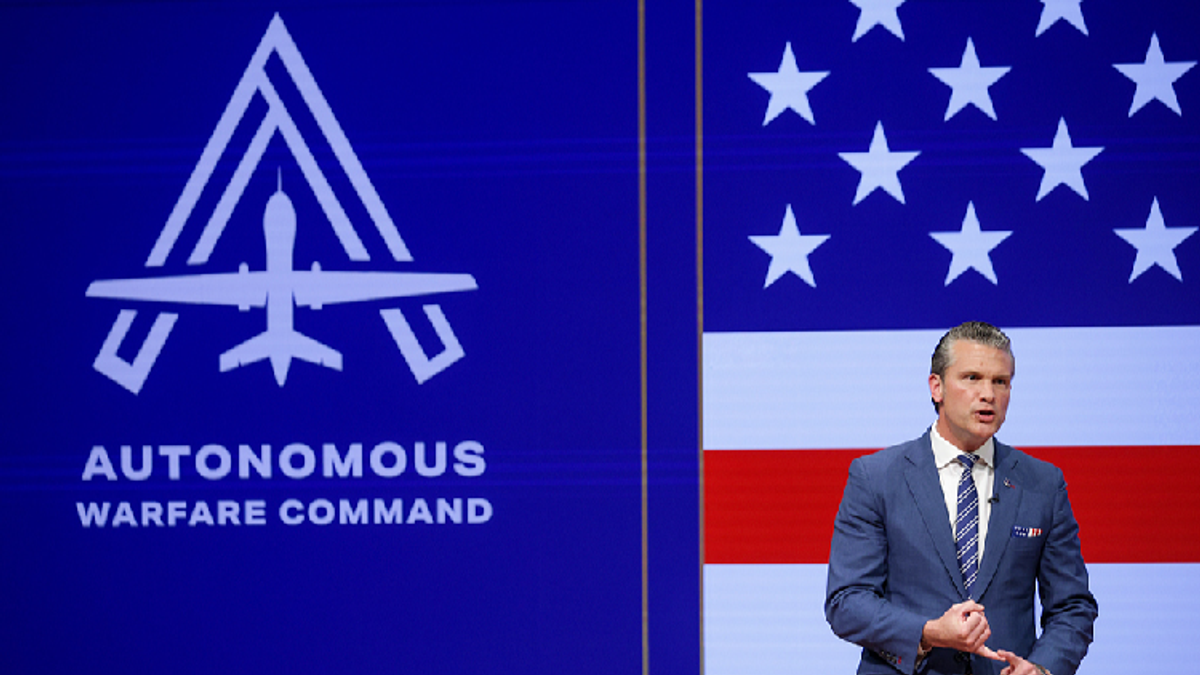
The US Secretary of Defense, Pete Hegseth, recently unveiled the creation of the "Autonomous Warfare Command" (AWC), a new four-star combatant command. Announced at Marine Corps Base Quantico, this command is designed to rapidly integrate and scale autonomous and robotic capabilities across the entire US joint force. Concurrently, the Pentagon has proposed tripling its spending on autonomous warfare, earmarking $74 billion for drone and counter-drone technologies, while also enlisting prominent tech figures like Elon Musk and Palmer Luckey to co-lead "Project Meridian," an initiative to study the future of warfare.
This move represents a significant strategic pivot for the United States, driven by several interlocking power dynamics. Firstly, it's a clear response to the perceived technological advancements of peer competitors, particularly China, in the realm of artificial intelligence and autonomous systems. The US military doctrine, historically reliant on overwhelming conventional force and technological superiority, sees autonomous warfare as the next frontier in maintaining its global military edge. By centralizing autonomous capabilities under a dedicated command, the Pentagon aims to streamline procurement, development, and deployment, cutting through bureaucratic inertia often associated with traditional defense acquisition. The involvement of tech billionaires like Elon Musk signals a deliberate effort to bridge the gap between Silicon Valley's rapid innovation cycles and the Pentagon's slower, more deliberate processes, effectively integrating private sector dynamism directly into military strategy. This also allows the US to project an image of technological leadership, potentially influencing allies and deterring adversaries by demonstrating a commitment to future-proof its military. The proposed cuts to general and admiral ranks, alongside the creation of a new large base, suggest an internal restructuring to adapt to this new, more technologically-driven warfare paradigm, aiming for a leaner, more agile command structure.
While the focus is on technological advancement and strategic advantage, the human cost of this shift is often obscured. The immediate beneficiaries are defense contractors, tech firms, and the engineers and developers who will secure lucrative government contracts. However, the human impact extends far beyond economic opportunity. The increasing reliance on autonomous systems fundamentally alters the nature of warfare for service members. It raises questions about the role of human judgment in lethal decision-making, potentially desensitizing combatants and the public to the realities of conflict. For populations in conflict zones, the proliferation of autonomous weapons means a greater likelihood of being targeted by machines, where the "human in the loop" becomes increasingly distant or even absent. The ethical implications of algorithms making life-or-death decisions, potentially without real-time human oversight, pose a profound challenge to international humanitarian law and the very concept of accountability in war. Furthermore, the shift could lead to a reduction in traditional troop deployments in some scenarios, but simultaneously increase the risk of conflicts escalating due to the perceived lower "cost" of deploying machines rather than human lives, making war a more abstract and perhaps more frequent occurrence.
What official statements downplay or omit is the profound shift in the *control* of warfare. By bringing tech titans directly into the strategic core via "Project Meridian," the lines between private corporate interests and national defense become increasingly blurred. This isn't just about buying technology; it's about integrating the philosophical and operational frameworks of Silicon Valley into military thinking. The emphasis on "scaling" and "efficiency" inherent in tech culture, when applied to warfare, risks reducing human lives and complex geopolitical situations to data points in an algorithm. There's also a significant downplaying of the *democratization of lethality* that autonomous warfare could bring. While the US aims to maintain its edge, the underlying technologies are becoming more accessible globally. This means that non-state actors or smaller nations could eventually acquire sophisticated autonomous capabilities, potentially destabilizing regional balances of power and making future conflicts even more unpredictable and brutal. The narrative focuses on US advantage, but the long-term global proliferation risk, and the ethical quandaries of autonomous lethal systems, receive far less public scrutiny from official channels.
Readers should closely watch the actual implementation timeline and budget allocations for the Autonomous Warfare Command. The speed at which this new command integrates and deploys technologies will indicate the true urgency and political will behind the initiative. Pay attention to the types of autonomous systems prioritized for development – whether they are primarily surveillance, logistics, or lethal platforms – as this will reveal the immediate operational focus. Furthermore, observe international reactions, particularly from China and Russia, regarding their own accelerated investments in AI and autonomous warfare, which could spark a new arms race. Finally, monitor public discourse and policy debates around the ethical frameworks and international regulations for autonomous weapons. The push for a new base and cuts to senior officer ranks will also signal the extent of the internal transformation within the US military, revealing how deeply this technological shift will reshape its very structure and culture.
Source referenced: CGTN
This brief was synthesized by our Editorial Engine and reviewed by The Ground Narrative team.