TRENDING

Monday, 5 October 2026
----------------------
24 Rabi' Al-Thani 1448 AH
Thousands of supporters of jailed former Prime Minister Imran Khan have launched a mass protest rally in Pakistan after negotiations with the government collapsed. This demonstration marks a critical escalation in the ongoing power struggle between Khan's populist movement and the country's entrenched political and military establishment.
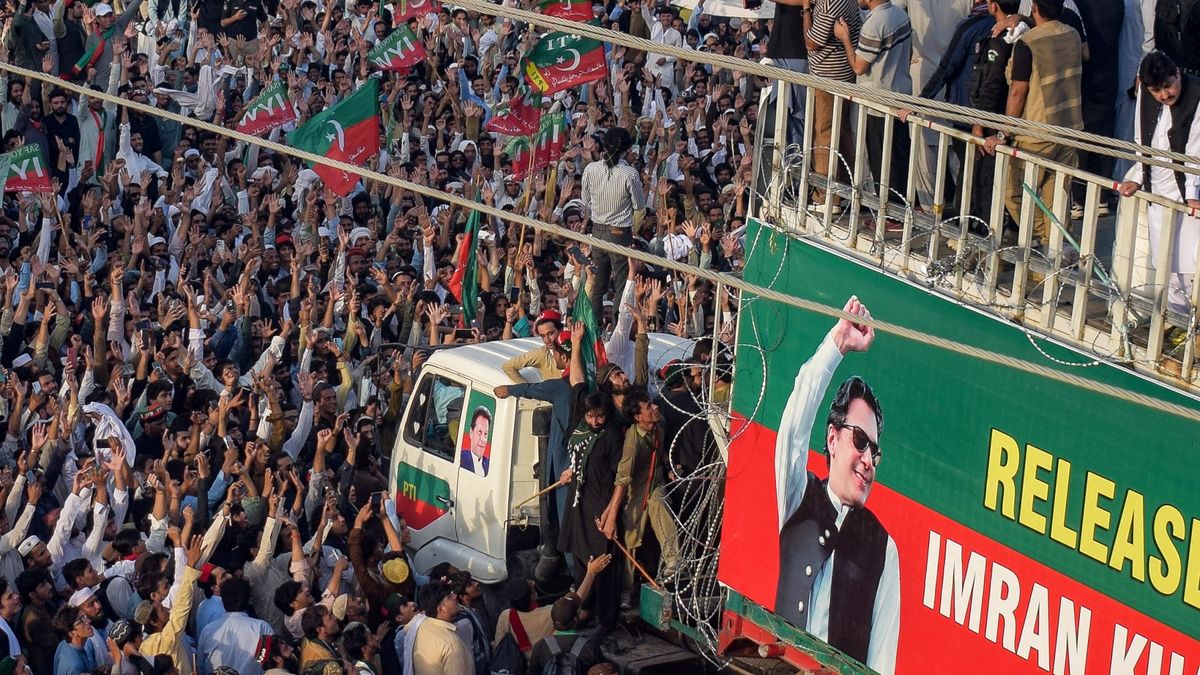
On October 4, 2026, thousands of supporters of Pakistan's jailed former Prime Minister Imran Khan initiated a mass protest march from the northwestern Khyber Pakhtunkhwa province. This demonstration, organized by Khan's Pakistan Tehreek-e-Insaf (PTI) party, commenced after two rounds of negotiations between PTI leadership and the government failed to reach a resolution regarding Khan's release. The march, reportedly involving over 5,000 participants, aims to pressure the current government, which has responded by erecting extensive barriers and warning of forceful action against any disruption in the capital, Islamabad.
The current political standoff in Pakistan is not merely a clash between a populist leader and a sitting government; it is a deep-seated struggle for control over the nation's political narrative and future, with the powerful Pakistani military often operating as the ultimate arbiter. Imran Khan, despite his imprisonment since August 2023 on what his party claims are politically motivated charges, remains a highly popular figure, according to various polls. His appeal stems from a populist platform that challenges traditional political dynasties and, crucially, has at times directly confronted the influence of the military establishment.
The government, led by a coalition that came to power following Khan's ouster in 2022, is driven by an imperative to maintain stability and assert its authority. For them, allowing a mass protest to paralyze Islamabad would not only be a significant loss of face but could also embolden other opposition movements and further destabilize an already fragile political landscape. The interior minister's stern warnings and the physical barricades around the capital underscore the government's determination to prevent a repeat of past disruptive demonstrations. They leverage legal pronouncements, such as the Islamabad High Court order against occupying public roads, to frame their actions as upholding the rule of law, rather than suppressing dissent.
At the heart of this struggle is the Pakistani military's enduring influence. Historically, the military has played a decisive role in Pakistan's politics, either through direct coups or by shaping civilian governments from behind the scenes. Khan's rise was initially seen by some as having the military's tacit approval, but a subsequent falling out led to his removal from power and a series of legal challenges. The current government is widely perceived as being more aligned with the military's interests. Therefore, the government's actions against Khan and the PTI can be understood as part of a broader effort by the establishment to neutralize a charismatic leader who has proven capable of mobilizing significant public opposition, even from behind bars. The numerous convictions against Khan, though many have been suspended or overturned on appeal, serve as a potent tool to keep him sidelined and to deter his supporters.
For PTI, the march is a calculated gamble. It aims to demonstrate the enduring strength of Khan's popular support, challenge the legitimacy of the current government, and force concessions, primarily Khan's release. The party's decision to proceed despite failed talks reflects a belief that street power is their most effective leverage against an entrenched system. They are banking on the sheer numbers and determination of their base to create a political crisis that the government cannot easily ignore or suppress without significant domestic and international backlash. The march from a PTI-ruled province, Khyber Pakhtunkhwa, also highlights the party's regional strongholds and its ability to mobilize resources and local government support for its agenda, creating a complex challenge for federal authorities.
The most immediate and profound impact of this political deadlock and the ensuing protests falls squarely on the ordinary citizens of Pakistan. The daily lives of millions are disrupted by the pervasive instability and the government's defensive measures. Blockades of major access routes into Islamabad, such as those using shipping containers, bring economic activity to a halt, affecting commuters, small businesses, and supply chains. This translates into lost wages, delayed goods, and increased prices, further burdening a population already grappling with high inflation and economic hardship.
Beyond the economic strain, the political crisis takes a significant toll on fundamental civil liberties. The government's warnings against
Source referenced: ALJAZEERA
This brief was synthesized by our Editorial Engine and reviewed by The Ground Narrative team.


