TRENDING

Friday, 16 October 2026
----------------------
5 Jumada Al-Awwal 1448 AH
President Donald Trump's repeated, unverified claims of vandalism at the Lincoln Memorial Reflecting Pool, coupled with a troubled renovation project, highlight critical issues of information integrity and public trust in official statements. This incident underscores broader challenges in political communication and the media's role in fact-checking high-level assertions.
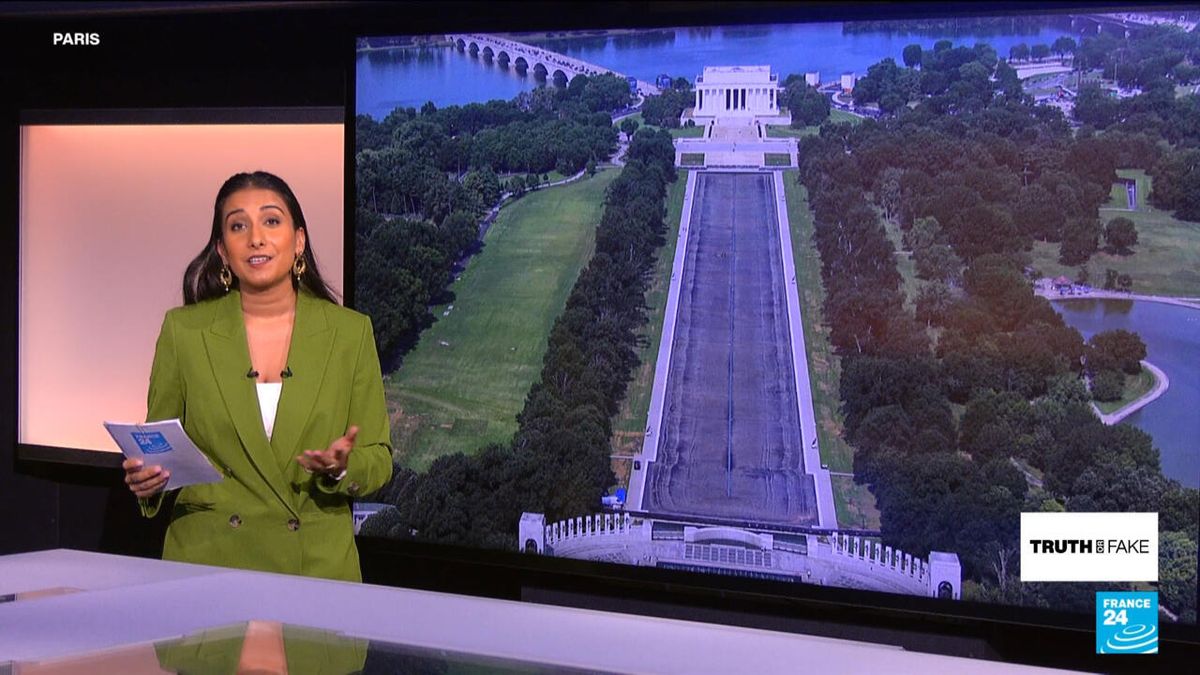
In a series of recent statements, U.S. President Donald Trump has repeatedly alleged that the Lincoln Memorial Reflecting Pool in Washington, D.C., was deliberately vandalized, claiming a significant 'gash' was carved into its liner. These assertions, made primarily via his Truth Social platform, have been met with scrutiny due to a consistent lack of corroborating evidence and shifting descriptions of the alleged damage. The controversy unfolds against the backdrop of a problematic renovation project at the iconic national landmark, raising questions about accountability, political narrative control, and the integrity of public information.
President Trump's claims regarding the Reflecting Pool's alleged damage have undergone several revisions. Initially, he described the 'slashes' as measuring 250 feet, then 300 feet, and later 350 feet. His most recent statement, issued on Monday, July 14, 2026, dramatically escalated the claim, asserting the 'slashes' stretched for 300 yards. If interpreted literally, 300 yards would equate to 900 feet, a measurement roughly three times his original claim and equivalent to the length of three American football fields. This significant discrepancy, coupled with the absence of any visual or physical evidence released by the administration, has fueled skepticism.
Despite the President's insistence that such images exist, independent media outlets and observers who visited the drained pool reported seeing no obvious signs of the extensive damage described. Photographs shared by Washington, D.C. photographer Joe Flood and observations by attorney Matt Rein, who spoke with a worker on site, indicated no visible large cuts. A prominent linear feature in the drained pool, initially mistaken by some social media users as evidence of a gash, was later identified as the pool's drainage channel.
The allegations of vandalism are intertwined with a broader, troubled renovation project at the Reflecting Pool. President Trump had ordered the pool to be painted 'American Flag blue' in preparation for the United States' 250th anniversary celebrations on July 4. However, the project quickly encountered significant issues. Heavy algae growth rapidly turned the water green, and chemicals used to combat the algae caused sections of the new blue coating to chip away and float to the surface, with residents reportedly retrieving flakes of paint from the water.
In response to these highly visible failures, President Trump has consistently rejected suggestions that the problems stemmed from the renovation itself or the contractor responsible for the work. Instead, he has attributed both the water contamination and the alleged damage to the pool's lining to unspecified 'vandals.' This narrative directly contradicts his earlier remarks from May, where he lauded the new coating's durability, stating it was so strong that 'if you had a knife you couldn't even cut it. So strong. So powerful.' The shift in explanation suggests an effort to deflect responsibility for the project's shortcomings.
While seemingly a domestic issue concerning a national landmark, the President's repeated dissemination of unverified claims carries significant geopolitical implications. In an era increasingly defined by information warfare and the proliferation of 'fake news,' the leader of a major global power making unsubstantiated assertions can have far-reaching effects:
* Erosion of Public Trust: When official statements from the highest levels of government lack verifiable evidence and contradict observable facts, it can significantly erode public trust in institutions, government communications, and the media tasked with fact-checking. This erosion can destabilize democratic discourse and make populations more susceptible to misinformation from various sources.
* Political Messaging and Narrative Control: The consistent blaming of 'vandals' for both the renovation failures and the alleged damage serves as a clear example of political messaging aimed at controlling a narrative. By externalizing blame, the administration attempts to shield itself from accountability for a failed public project, potentially mobilizing a political base through a perceived threat to national symbols.
* Challenges for Media and Information Environment: The incident highlights the ongoing struggle for traditional media to verify and counter unproven claims, especially when they originate from powerful political figures. This dynamic contributes to a complex global information environment where objective truth can be obscured by competing narratives.
* Symbolism and National Identity: The Lincoln Memorial Reflecting Pool is a potent symbol of American democracy and national unity. Claims of its desecration, even if unproven, can be used to evoke strong emotional responses and frame political discourse around themes of patriotism, order, and perceived threats to national heritage.
The controversy surrounding the Lincoln Memorial Reflecting Pool transcends a mere renovation mishap. It serves as a stark illustration of the challenges to information integrity in contemporary politics, where official narratives can diverge significantly from verifiable facts. The incident underscores the critical importance of evidence-based communication from public officials and the indispensable role of independent journalism in upholding transparency and accountability, both domestically and in shaping international perceptions of governance and truthfulness.
Source referenced: FRANCE24
This brief was synthesized by our Editorial Engine and reviewed by The Ground Narrative team.