TRENDING

Thursday, 15 October 2026
----------------------
4 Jumada Al-Awwal 1448 AH
Chinese Foreign Minister Wang Yi met with Solomon Islands Foreign Minister Rick Houenipwela in Beijing, reaffirming a 'comprehensive strategic partnership' and emphasizing the right of Pacific island nations to choose their development partners. This high-level engagement underscores China's continued efforts to expand its influence in the strategically vital South Pacific region, a move closely watched by traditional Western powers.
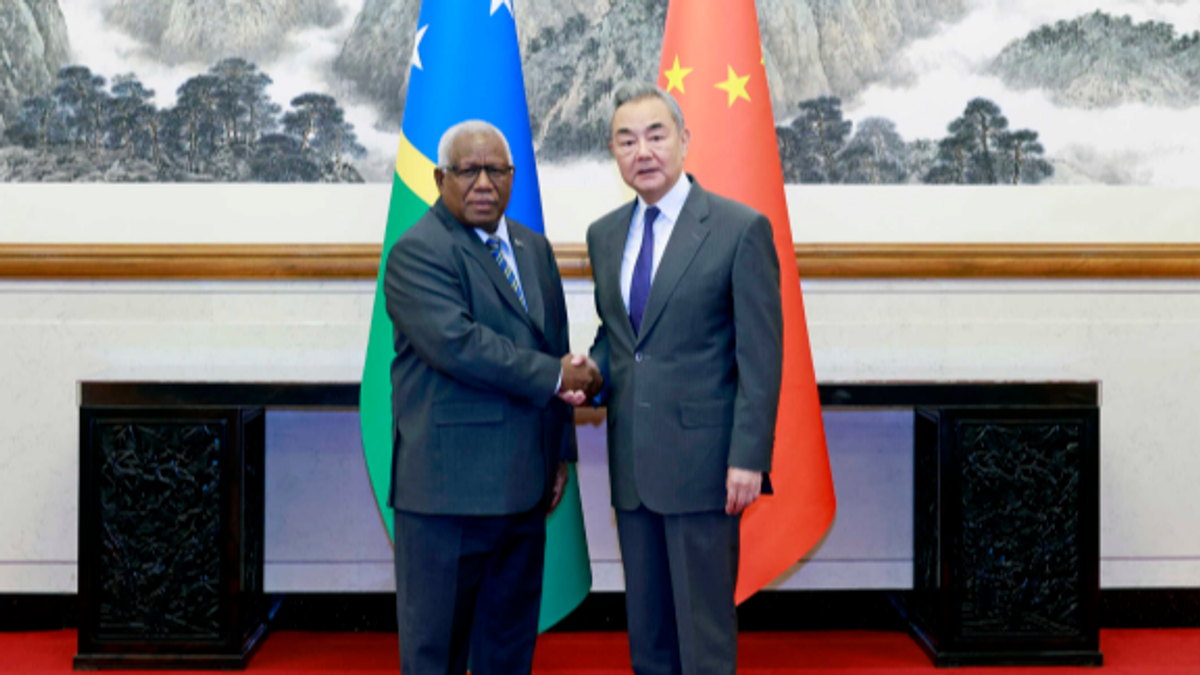
On July 14, 2026, Chinese Foreign Minister Wang Yi, a member of the Political Bureau of the Communist Party of China (CPC) Central Committee, held significant talks with Rick Houenipwela, the Minister for Foreign Affairs and External Trade of the Solomon Islands, in Beijing. The meeting served to reaffirm and deepen the 'comprehensive strategic partnership' between the two nations, which was established in 2019 when the Solomon Islands shifted its diplomatic recognition from Taiwan to Beijing. Both ministers highlighted the strong development of bilateral relations and the tangible results of cooperation across various fields, which they stated have benefited the people of the Solomon Islands.
Minister Wang Yi articulated China's commitment to working with the new government of the Solomon Islands to enhance communication at all levels and maintain robust cooperation. He emphasized that China's engagement with Pacific island countries is rooted in strengthening South-South cooperation and promoting common development, asserting that such relationships should not be 'disrupted by any third party.' This statement is a clear diplomatic signal directed at Western nations, particularly the United States, Australia, and New Zealand, which have expressed concerns over China's growing presence in the region. Wang Yi further underscored the sovereign right of Pacific island nations to independently choose their development partners, framing China's role as a partner in development rather than a geopolitical competitor.
For its part, the Solomon Islands, through Minister Houenipwela, expressed profound gratitude for China's 'long-term and positive assistance' to its economic and social development. Houenipwela reiterated the Solomon Islands' firm commitment to the 'one-China principle,' a cornerstone of Beijing's foreign policy that requires diplomatic partners to acknowledge Taiwan as an integral part of China. This commitment is crucial for Beijing, as it seeks to isolate Taiwan internationally. Furthermore, Houenipwela voiced support for China's 'vision of building a community with a shared future for humanity' and its 'four major global initiatives,' signaling a broader alignment with China's global governance agenda. The Solomon Islands also pledged to enhance coordination and cooperation with China within multilateral organizations, including the United Nations and the World Trade Organization.
This high-level meeting in Beijing is not merely a routine diplomatic exchange but a significant event within the broader context of escalating geopolitical competition in the Indo-Pacific. The Solomon Islands holds a strategically vital position in the South Pacific, and its deepening ties with China have been a source of considerable concern for Western powers. The establishment of diplomatic relations in 2019, followed by a controversial security pact in 2022, marked a pivotal shift in the regional balance of power. The security agreement, which allows for Chinese police and military personnel to be deployed to the Solomon Islands, raised alarms in Canberra, Wellington, and Washington, who fear the potential for a permanent Chinese military presence in the region.
China's motivations are multi-faceted. Beyond securing diplomatic recognition for the 'one-China principle,' Beijing seeks to expand its economic and political influence, secure access to resources, and project its power across the Pacific. By positioning itself as a reliable development partner, China aims to counter the long-standing influence of traditional Western allies and establish a more favorable regional order. The emphasis on 'South-South cooperation' and the right of nations to choose partners without 'third-party disruption' serves to legitimize China's engagement while subtly criticizing Western efforts to limit its expansion.
For the Solomon Islands, the relationship with China offers an alternative source of development aid, infrastructure investment, and trade opportunities, potentially reducing its reliance on traditional partners. This diversification aligns with a broader trend among some Pacific island nations to leverage great power competition to their own advantage, seeking the best terms for their national development. However, this strategy also carries risks, including potential debt dependency and the challenge of balancing relations with competing global powers without alienating traditional allies.
The talks between Wang Yi and Rick Houenipwela underscore the ongoing strategic importance of the Pacific Islands in global geopolitics. As China continues to expand its footprint, Western powers are likely to intensify their diplomatic, economic, and security engagement in the region to counter Beijing's influence. This dynamic ensures that the South Pacific will remain a critical arena for great power competition, with implications for regional stability, international maritime security, and the future of global governance. The trajectory of China-Solomon Islands relations will continue to be a key indicator of these broader geopolitical shifts.
Source referenced: CGTN
This brief was synthesized by our Editorial Engine and reviewed by The Ground Narrative team.


