TRENDING

Tuesday, 27 October 2026
----------------------
16 Jumada Al-Awwal 1448 AH
On the 55th anniversary of Resolution 2758, UN officials reiterated their commitment to China’s seat, a move that reverberates through global power structures and everyday lives. This analysis breaks down the mechanics, the overlooked costs, and the signals to watch.
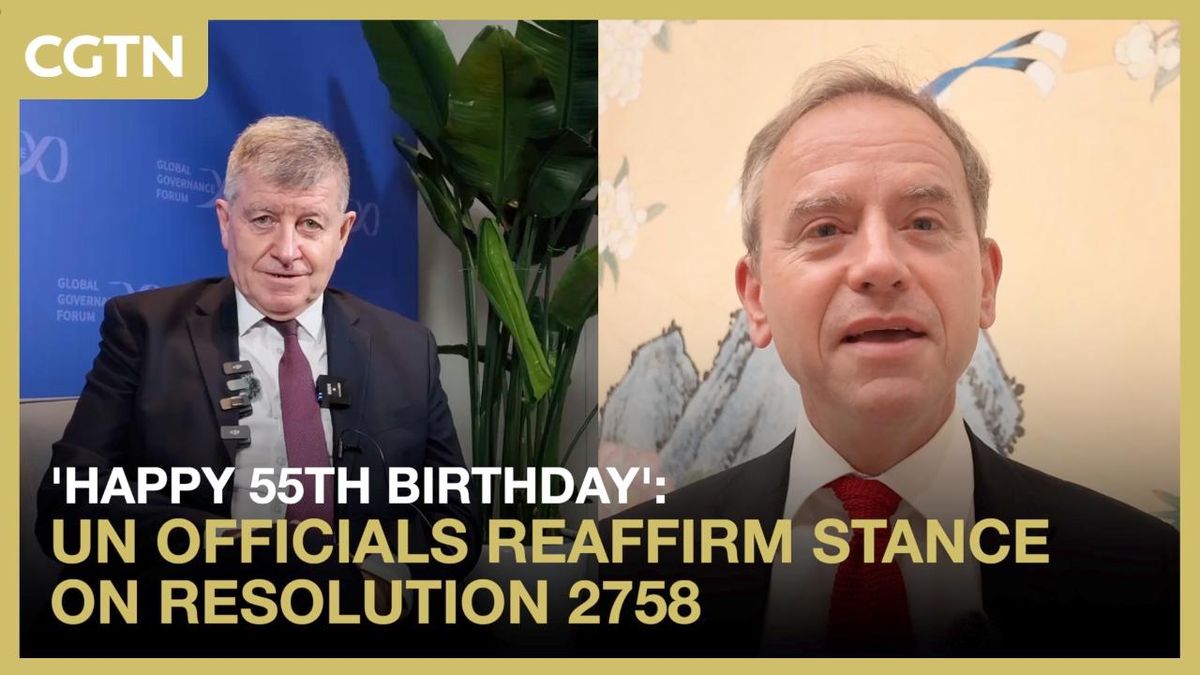
Senior officials of the United Nations marked the 55th anniversary of Resolution 2758, the 1971 General Assembly vote that restored the People’s Republic of China to the UN and its Security Council seat. On the sidelines of the 2026 Global Governance Forum in Xiongan, Under‑Secretary‑General for Policy Guy Ryder and Resident Coordinator Stephen Jackson told CGTN the organization remains "firmly adherent" to that historic decision, celebrating it as a "birthday" for the UN‑China partnership. The statements were largely ceremonial, reaffirming a status quo that has endured for more than half a century.
The reaffirmation is less about nostalgia than about cementing a set of institutional incentives that keep the current global order intact. Resolution 2758 eliminated the diplomatic ambiguity of “two Chinas,” granting Beijing a veto‑holding seat on the Security Council and a platform to shape agenda‑setting bodies such as the Human Rights Council and the Economic and Social Council. For the UN, the presence of the world’s most populous nation translates into financial contributions that underwrite the organization’s budget, especially the peace‑keeping and development funds. For Beijing, the seat offers a diplomatic shield: any proposal that threatens its core interests—most notably Taiwan’s status—can be blocked by a single veto.
The power calculus also involves the Global South. Many developing countries view China as a counterweight to Western dominance, and the UN’s continued alignment with Beijing helps secure Chinese investment, infrastructure loans, and technology transfers. In return, China leverages its UN platform to promote narratives of “shared development” and “common security,” which dovetail with its Belt and Road Initiative and its push for a new international development bank. The ritual of reaffirmation therefore re‑locks a set of reciprocal expectations: the UN gains fiscal stability and political legitimacy; China gains diplomatic insulation and a megaphone for its foreign policy.
While the ceremony is polished, the underlying dynamics impose tangible burdens on vulnerable populations. Taiwan remains the most immediate flashpoint; the UN’s strict adherence to the 1971 resolution means the island is excluded from most UN bodies, limiting its ability to participate in global health, climate, and disaster‑response coordination. This exclusion hampers Taiwan’s capacity to contribute to, and benefit from, international aid during crises such as the recent typhoon season.
Beyond Taiwan, the global South feels the pressure of debt‑laden infrastructure projects tied to China’s UN‑endorsed development narratives. Nations in Africa and Southeast Asia often accept loans with opaque terms, leading to debt distress that forces austerity measures affecting health, education, and public services. Moreover, the UN’s reliance on Chinese funding can dilute scrutiny of human‑rights abuses, as member states may shy away from condemning Beijing for fear of jeopardising financial support. The net effect is a dilution of accountability mechanisms that would otherwise protect marginalized communities.
Official statements gloss over the strategic calculus behind the reaffirmation. Western governments quietly monitor the ceremony, aware that any shift in the UN’s stance could open space for a more confrontational China. Yet they rarely vocalise concerns, preferring back‑channel diplomacy to avoid a public showdown that could fracture the multilateral system.
Simultaneously, Chinese state media amplifies the anniversary as evidence of Beijing’s moral leadership, framing the UN as a stage where China champions “civilisation dialogue” and “shared prosperity.” The narrative omits the fact that the same UN platform is used to shield China from investigations into issues ranging from the treatment of Uyghurs to maritime disputes in the South China Sea. By focusing on celebratory language, both sides sidestep the deeper question: how much of the UN’s agenda is being steered to accommodate Beijing’s geopolitical ambitions?
The next UN Secretary‑General election will be a litmus test for the balance of power. Candidates perceived as favorable to China could see smoother confirmation, while those advocating for a more independent UN may encounter coordinated opposition from Beijing‑aligned blocs. Additionally, watch for any shifts in the UN’s budgeting process; a move to diversify funding away from China could weaken Beijing’s leverage.
On the ground, civil‑society groups in Taiwan and debt‑burdened African nations are mobilising to demand greater inclusion and transparency. Their advocacy, if amplified through alternative media channels, could force the UN to confront the human costs it routinely downplays. Finally, the broader debate over UN reform—particularly proposals to limit veto power—will resurface as more states question whether a single permanent member should wield such decisive influence.
Stakeholders should monitor the language of upcoming UN General Assembly debates, the voting patterns of the Security Council on resolutions touching on China’s core interests, and the financial reports that reveal the proportion of the UN’s budget sourced from Beijing. These indicators will reveal whether the birthday toast is merely ceremonial or a signal of deeper entrenchment.
The resolution anchors China's legal status at the UN, securing its veto power and financial contributions, which are vital for the organization’s budget and legitimacy.
Taiwan is excluded from most UN bodies because the UN recognizes only the People’s Republic of China, limiting its ability to engage in global health, climate, and disaster‑response initiatives.
The election of a new Secretary‑General, reforms to veto power, and a diversification of UN funding away from Chinese contributions could shift the current dynamics.
Source referenced: CGTN
This brief was synthesized by our Editorial Engine and reviewed by The Ground Narrative team.