TRENDING

Monday, 5 October 2026
----------------------
24 Rabi' Al-Thani 1448 AH
President Donald Trump has launched a comprehensive strategy ahead of the November 2026 midterm elections, combining domestic economic initiatives like 'Trump Accounts' for children and price controls with assertive foreign policy demands on NATO allies. These efforts aim to address voter concerns and bolster Republican prospects amidst a polarized political landscape and the economic fallout from the recent 'Iran war'.
President Donald Trump has launched a multi-pronged strategy encompassing significant domestic economic initiatives and assertive foreign policy maneuvers, all aimed at bolstering his administration's standing and the Republican Party's prospects ahead of the crucial November 3 midterm elections. These efforts, unveiled in early July 2026, reflect a concerted push to address key voter concerns regarding economic stability and national security, while simultaneously reinforcing the "America First" foreign policy doctrine. The initiatives include the introduction of a novel investment scheme for children, direct intervention in market pricing, and a forceful push for increased defense spending among NATO allies, set against the backdrop of a recent "Iran war" and its economic repercussions.
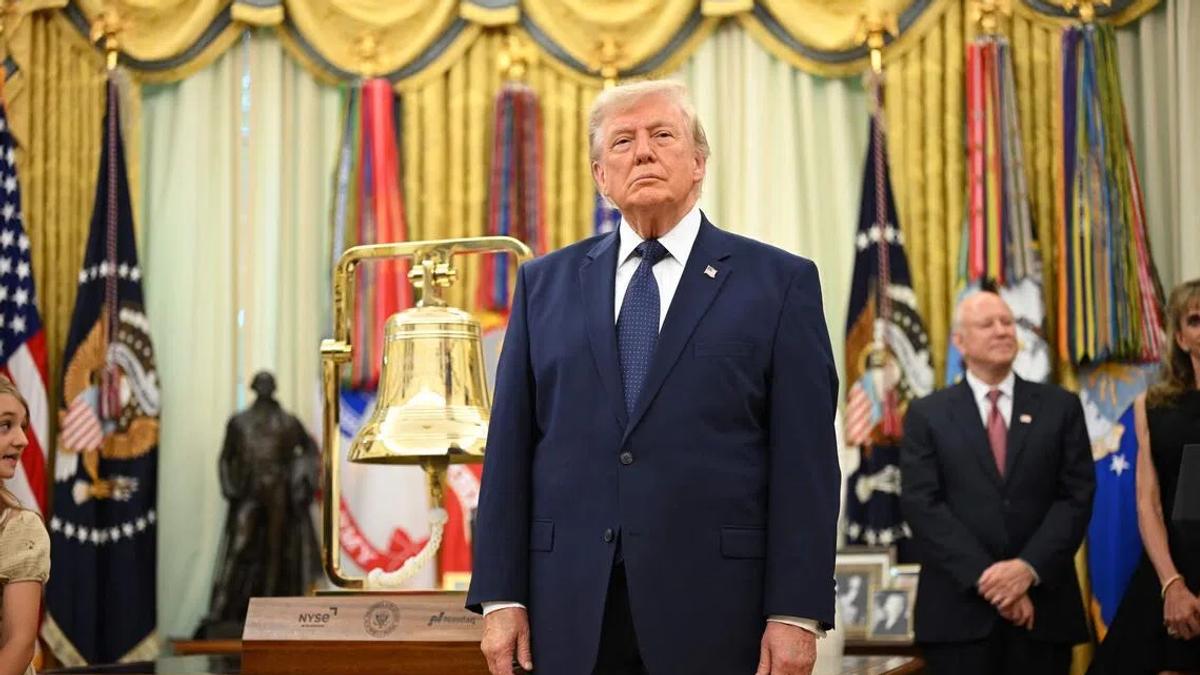
A cornerstone of President Trump's domestic agenda is the introduction of the "Trump Accounts," a groundbreaking investment scheme designed to provide American children with a financial foundation. Launched on July 6, 2026, with the symbolic ringing of the stock market's opening bell from the Oval Office, the program aims to foster long-term savings and give "every child a stake in the American Dream." Under the scheme, any child born during President Trump's second term automatically receives a US$1,000 government deposit upon account opening. Additionally, children aged 18 and under are eligible to sign up, with specific provisions for those aged 10 and under in lower-income areas receiving US$250 in seed money from philanthropic contributions, notably from tech billionaire Michael Dell and memory chip maker Micron. Family and employers can contribute up to US$5,000 annually, with projections suggesting significant growth potential, potentially reaching US$243,000 by age 55 with only the initial government deposit, or US$13 million with consistent annual contributions. Funds are invested in US stock funds and can be withdrawn without penalty for major life milestones such as higher education, a first home down payment, or small business investment after age 18.
While Republicans champion the "Trump Accounts," funded through tax revenues via the "One Big Beautiful Bill Act," as a means to democratize wealth and address criticisms that the working class is excluded from Wall Street gains, the initiative has drawn sharp criticism from Democrats. Opponents argue that the program is a distraction from significant cuts to social safety nets, including health insurance and food stamps, enacted under the same legislation. Concerns have also been raised about the potential to exacerbate wealth inequality, as wealthier families are more likely to maximize annual contributions. Furthermore, despite six million children already enrolled, this represents less than 10 percent of the eligible population, suggesting potential issues with awareness, trust, or even the scheme's direct affiliation with President Trump.
In parallel, the administration has actively sought to alleviate immediate economic pressures on American households by targeting the rising costs of everyday goods. On July 6, President Trump announced that Walmart, the nation's largest grocer, had agreed to lower prices on various products, including a significant reduction in ground beef prices. This move, framed by the President as a patriotic act, was a direct response to voter concerns about grocery inflation. Concurrently, the administration has focused on petrol prices, which surged following the "Iran war" that commenced on February 28, 2026. Despite a truce on June 14, prices have not fallen to the administration's desired levels of US$2.25-$2.50 per gallon. The Justice Department has initiated investigations into oil companies, probing potential price inflation, with President Trump asserting that prices should return to pre-war lows. These interventions underscore a direct governmental approach to market forces, aiming to tangibly improve the economic outlook for voters ahead of the midterms.
Beyond domestic economic policy, President Trump has leveraged foreign policy to project strength and fulfill key campaign promises. A significant focus has been on NATO, where he is preparing to declare victory at the July 7-8 summit in his long-standing campaign to compel European allies to increase their defense spending. Under direct pressure from the Trump administration, NATO members have reportedly agreed to ramp up their defense commitments towards 5 percent of their Gross Domestic Product over the next decade. This development is presented by Republicans as a triumph of the "America First" foreign policy, demonstrating that a confrontational, transactional approach can succeed where traditional diplomacy has faltered. However, this strategy has generated concern among Democrats and moderate voters, who view it as potentially straining or even permanently rupturing America's traditional alliances and partnerships.
The broader geopolitical context for these maneuvers includes the recent "Iran war," which began on February 28 and saw a truce on June 14. While the article does not detail the conflict itself, its impact on global oil prices and, consequently, domestic petrol costs in the car-dependent United States, is explicitly cited as a major economic pain point for American consumers. The "paused war" is reportedly "darkly regarded" by most Americans, with polls indicating a widespread belief that it was not worth the cost. This sentiment likely fuels the administration's urgency to demonstrate control over economic factors like petrol prices, attempting to mitigate the political fallout from the conflict. The tentative progress in peace negotiations, however, leaves open the possibility of renewed price volatility.
President Trump's comprehensive strategy, integrating domestic economic relief with assertive foreign policy, is a clear attempt to consolidate voter support and improve the Republican Party's standing ahead of the November 3 midterm elections. With narrow majorities in both houses of Congress and the possibility of a Democratic victory leading to an impeachment push, the stakes are exceptionally high. The President's approval rating hovers around 40 percent, with public opinion polls often showing dissatisfaction with his handling of the economy.
The effectiveness of these initiatives remains uncertain. While the "Trump Accounts" aim for long-term financial security and the price interventions target immediate economic pain, their reception is highly polarized. The "America First" approach to NATO, while celebrated by some, risks alienating traditional allies. The historical trend of the president's party losing seats in midterm elections adds another layer of challenge. Despite a reported similar level of unfavorable views towards both Republican and Democratic parties, the political landscape is fraught with uncertainty, making the outcome of these strategic maneuvers critical for the future trajectory of US domestic and foreign policy.
Source referenced: STRAITSTIMES
This brief was synthesized by our Editorial Engine and reviewed by The Ground Narrative team.


