TRENDING

Sunday, 4 October 2026
----------------------
23 Rabi' Al-Thani 1448 AH
Finnish President Alexander Stubb and Chinese Foreign Minister Wang Yi met in Finland, pledging enhanced cooperation amidst a complex international landscape. The discussions highlighted Finland's pragmatic foreign policy and China's efforts to promote its global governance initiatives.
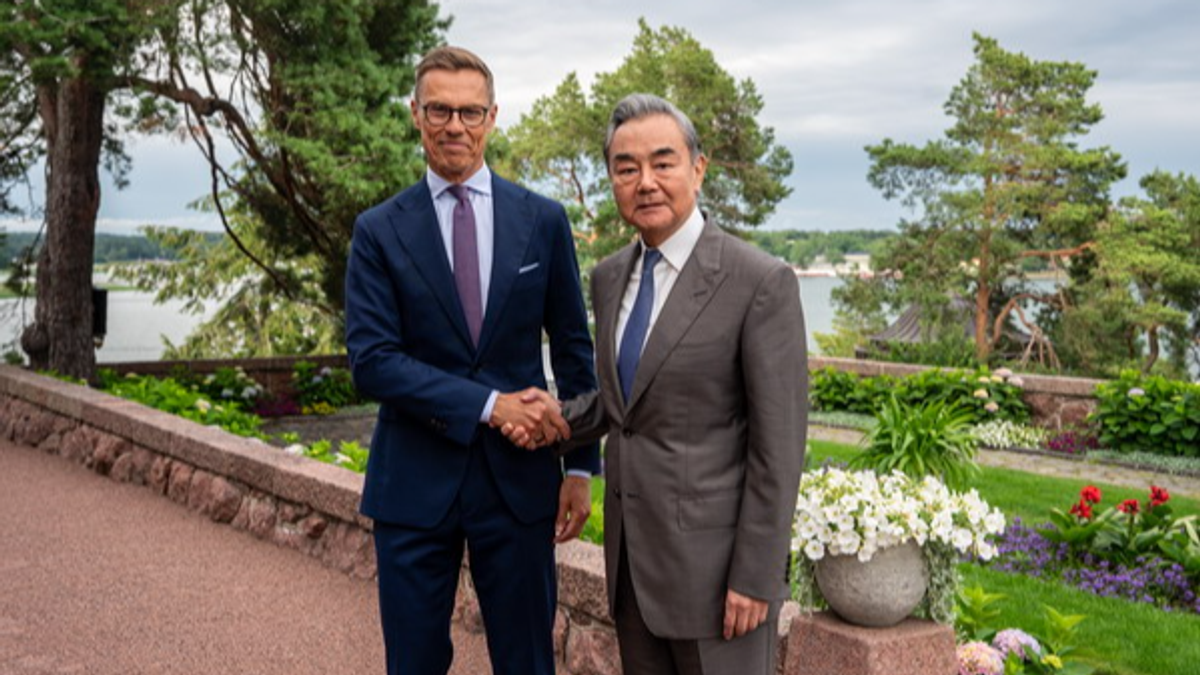
On July 5, 2026, Finnish President Alexander Stubb hosted Chinese Foreign Minister Wang Yi in Turku, southwest Finland, for a significant diplomatic exchange. The meeting underscored a mutual commitment to strengthening bilateral cooperation and coordination, particularly in addressing shared global challenges. This high-level interaction, occurring in a period described by both sides as a "critical crossroads" for international relations, offers a lens into the evolving dynamics of global power and the nuanced foreign policy approaches of smaller states navigating great power competition.
Finland's engagement with China, particularly following its recent accession to NATO, reflects a pragmatic and multi-vector foreign policy. President Stubb's remarks during the meeting were notably positive, acknowledging China's "remarkable achievements" in political, economic, social stability, and scientific innovation. More significantly, Stubb praised China for injecting "valuable stability into today's world" and highlighted the comprehensive nature of President Xi Jinping's four global initiatives: the Global Development Initiative (GDI), Global Security Initiative (GSI), Global Civilization Initiative (GCI), and Global Governance Initiative (GGI). He described these as offering an "insightful assessment of the international situation" and carrying "landmark significance."
This commendation from a leader of a European Union and NATO member state is noteworthy. It suggests Finland's interest in maintaining open channels with major global players, even those with differing geopolitical alignments from its primary Western partners. For Finland, a nation sharing a long border with Russia, stability and predictable international relations are paramount. Engaging with China on areas like the green economy and artificial intelligence, as stressed by Stubb, also aligns with Finland's economic and technological development goals, seeking to leverage China's vast market and technological advancements while diversifying its international partnerships.
From Beijing's perspective, Foreign Minister Wang Yi's visit to Finland serves multiple strategic objectives. It provides an opportunity to reinforce bilateral ties with a European nation that holds a unique geopolitical position. Engaging a NATO member like Finland allows China to project an image of a responsible global power capable of fostering cooperation across different political blocs. Wang's reiteration of China's commitment to being an "important force for peace, stability and development" resonates with Beijing's broader narrative of offering an alternative to what it often portrays as a chaotic Western-dominated order.
The emphasis on President Xi's global initiatives is central to China's long-term strategy for reshaping global governance. By securing acknowledgment, and even praise, for these initiatives from a European leader, China gains a degree of international legitimacy for its vision. These initiatives collectively aim to establish a framework for international relations that prioritizes development, security, and governance principles aligned with China's state-centric approach, potentially challenging existing multilateral institutions and norms. The focus on "future-oriented new-type cooperative partnership" signals China's desire for sustained, strategic engagement.
The dialogue between Finland and China highlights the complex and often contradictory nature of contemporary international relations. While many Western nations, including the EU, are pursuing strategies of "de-risking" from China and strengthening alliances to counter its growing influence, individual states like Finland demonstrate a more nuanced approach. This involves balancing security concerns and alliance commitments with pragmatic economic interests and a desire for broader international stability.
This interaction also underscores the ongoing competition between different visions for the global order. China's active promotion of its global initiatives in Europe indicates its ambition to expand its diplomatic footprint and influence beyond traditional spheres. For Europe, such engagements present a challenge: how to maintain a unified stance on critical issues like human rights, trade imbalances, and geopolitical competition, while allowing member states the flexibility to pursue their national interests through bilateral diplomacy. The Turku meeting, therefore, is not merely a bilateral event but a microcosm of the larger geopolitical shifts and the intricate dance of diplomacy in a multipolar world.
Source referenced: CGTN
This brief was synthesized by our Editorial Engine and reviewed by The Ground Narrative team.