TRENDING

Saturday, 3 October 2026
----------------------
22 Rabi' Al-Thani 1448 AH
In the occupied West Bank, Palestinian homes in Jericho are being systematically demolished under the guise of 'waste clearing,' revealing a disturbing fusion of settler ambition and state authority.
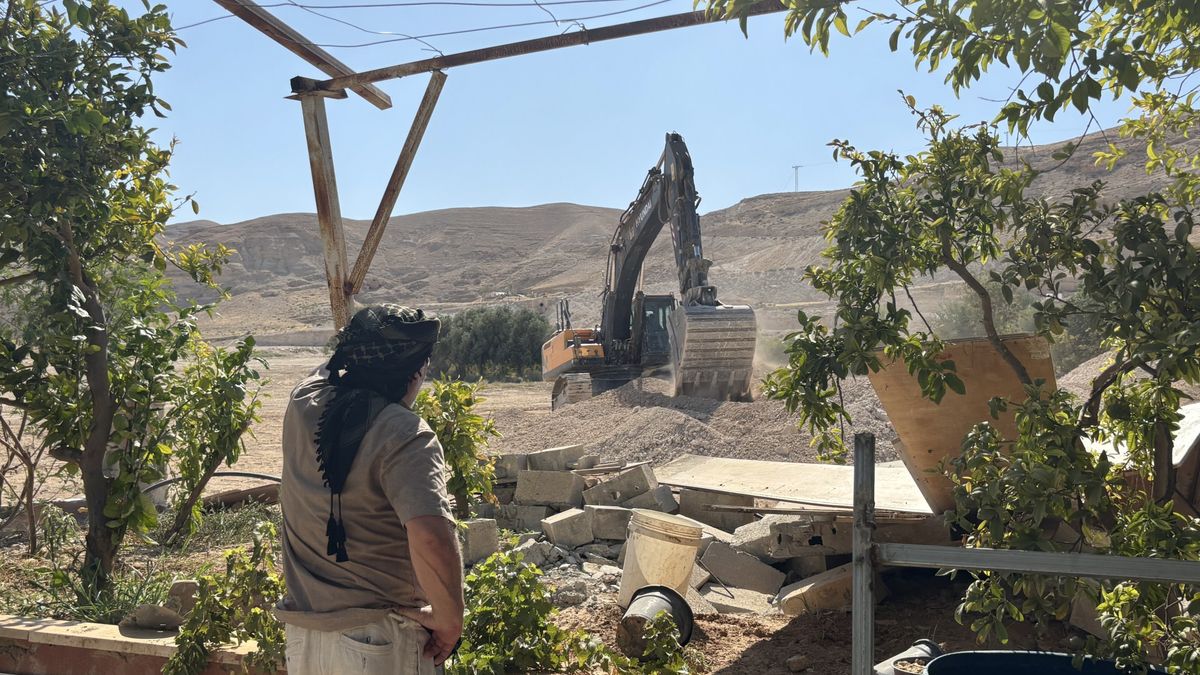
In the Palestinian communities of Ein al-Duyuk and Stih, on the southwestern edge of Jericho, what once stood as homes, orchards, and livelihoods are now flattened earth and buried rubble. Since February, and intensifying in July, Israeli settler-operated excavators, escorted by Israeli soldiers, have systematically destroyed Palestinian property. This campaign, initially marked by a violent 'pogrom' and now framed as 'clearing waste,' has seen entire houses dumped into pits, fences torn down, and residents' access to their own homes blocked, all without official demolition orders presented to those affected.
The events in Jericho lay bare a critical shift in the mechanics of occupation: the explicit deputization of settlers by the Israeli state to execute policies of land appropriation and displacement. The settler, Hanan Herbst, operating from the previously unauthorized Armonot Farm (now formally recognized as Daya settlement), is not acting in isolation. Israeli court filings reveal a March 2025 agreement between Herbst and the Settlement Division of the World Zionist Organization for agricultural use of the land. Following the initial demolitions in February, the Binyamin Regional Council requested the Civil Administration to allow Herbst to 'clear building waste,' a request approved despite the demolitions being the settlers' own making. Crucially, the Jordan Valley Brigade commander, Colonel Gilad Shriki, then authorized a military escort for Herbst. This intricate web demonstrates how state institutions—military, civil administration, and even the World Zionist Organization—are actively facilitating and shielding settler actions, effectively circumventing their own legal processes, including existing court injunctions protecting some Palestinian homes.
The human cost is borne directly by families like Mohammad Salah's and Khalil al-Razim's, who have seen their homes destroyed and their lives upended. Bedouin communities, such as the Kaabneh tribe, have been particularly devastated, with 13 homes demolished, 150 sheep scattered, and a licensed tractor stolen during the February attack. These communities, living in the ruins or without shelter, face not only the physical loss of their property but also the psychological trauma of being subjected to what residents describe as 'thuggery' and a 'state with no law.' They are denied basic legal recourse, with no official orders to challenge and soldiers actively preventing documentation or intervention. The systematic destruction of their homes and livelihoods is a direct assault on their ability to remain on their land, forcing a choice between displacement and living under constant threat.
What official Israeli statements omit or downplay is the strategic intent behind these actions. The narrative of 'clearing waste' or individual settler initiative obscures a deliberate, state-backed policy aimed at consolidating Israeli control over the West Bank. The area in question, near the Hasmonean and Herodian winter palaces, has been designated a flagship for a planned network of 'Judeo-centric' heritage parks. Heritage Minister Amichai Eliyahu's public statement, made hours before the February 'pogrom,' explicitly linked the destruction of Palestinian presence to the assertion of Jewish heritage. This reveals that the demolitions are not random acts but an integral part of a broader strategy to establish 'facts on the ground,' erase Palestinian presence, and expand settlement infrastructure under the guise of historical preservation and agricultural development. The state's willingness to bypass its own court injunctions by using settlers as proxies is a profound subversion of legal norms, effectively rendering Palestinian legal protections meaningless.
Readers should closely watch the expansion of the 'Judeo-centric' heritage park network across the West Bank, as this initiative is likely to be a significant driver of further land appropriation and displacement. The model of state-backed settler demolitions, where official bodies provide legal cover and military protection for settler actions, could become a more prevalent tactic in other vulnerable Palestinian communities. Furthermore, the international community's response, or lack thereof, to this explicit erosion of legal protections and direct displacement will be critical. The effectiveness of Palestinian legal challenges and grassroots resistance in the face of this increasingly integrated state-settler apparatus will determine the immediate future of these communities.
Source referenced: ALJAZEERA
This brief was synthesized by our Editorial Engine and reviewed by The Ground Narrative team.