TRENDING

Monday, 5 October 2026
----------------------
24 Rabi' Al-Thani 1448 AH
An Israeli barrier in the occupied West Bank's Jordan Valley has cut off vital water access for a Bedouin community, exposing a broader strategy of displacement and control. This move, ahead of Israeli elections, highlights the quiet redrawing of the region's demographics.
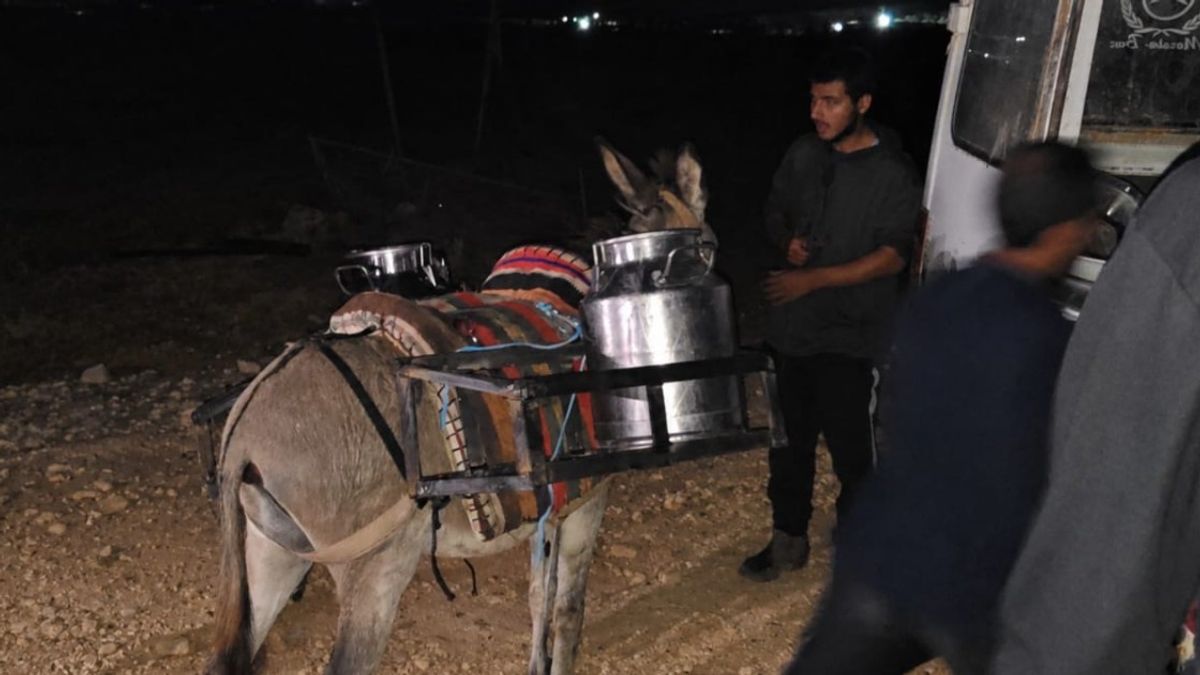
In the occupied West Bank's Jordan Valley, Israeli forces have intensified the construction of a military barrier, dubbed "Crimson Thread," effectively besieging the Ras al-Ahmar Bedouin community. This 20-kilometer-long, 50-meter-wide barrier, which includes military patrol roads, trenches, and embankments, has cut off all access to the community. For weeks, the 300 residents, comprising 50 families and their 15,000 head of livestock, have been deprived of essential water, food, and medical supplies, forcing them to transport necessities by donkey under the cover of darkness to evade detection by Israeli soldiers and settlers. The blockade has also prevented 51 schoolchildren from attending classes and left livestock vulnerable to disease and death, with veterinary teams unable to reach them.
The construction of the "Crimson Thread" barrier is not an isolated incident but a clear manifestation of Israel's long-term strategy to consolidate control over the Jordan Valley. This region is considered by Israel to be its eastern security border, a vital buffer zone, and a significant source of water resources. The current actions leverage military and administrative power to create irreversible "facts on the ground," strategically timed just weeks before Israeli elections on October 27.
The mechanics at play are multi-layered. First, there is the direct exercise of military power through the construction of physical barriers and the enforcement of blockades. This is coupled with the systematic seizure of Palestinian land, with nearly 115 hectares—85 percent of which is privately owned—bulldozed for the barrier's expansion. This land seizure is often justified under broad "security pretexts," a common rhetorical device used to legitimize actions that serve broader political and demographic goals.
Second, the actions reflect a deliberate policy of demographic engineering. By restricting access to vital resources and services, and by facilitating settler violence, the aim is to make life untenable for Palestinian Bedouin communities, compelling them to abandon their ancestral lands. This creates a vacuum that can then be filled by expanding Israeli settlements, further fragmenting Palestinian presence and ensuring Israeli contiguity in the valley.
Third, the timing of these intensified measures, ahead of national elections, points to domestic political incentives. Hardline actions against Palestinians often resonate with a significant segment of the Israeli electorate, particularly those on the right. By demonstrating a firm hand and advancing annexationist policies, political leaders can shore up support and appeal to voters who prioritize security and territorial expansion. This creates a cycle where the immediate suffering of Palestinians becomes a tool for political gain within Israel.
Finally, the actions demonstrate a critical aspect of Israeli control: the ability to redefine the legal and moral landscape within the occupied territories. While international law considers Israeli settlements illegal and actions like collective punishment prohibited, Israel operates with a different internal framework. Within this framework, Palestinians are increasingly framed primarily as a security threat, and any action, including cutting off water or seizing land, can be rationalized as a necessary "security measure." This allows the state to effectively bypass international scrutiny and continue its policies of expansion and displacement.
The immediate and most devastating impact of the Israeli barrier falls squarely on the Palestinian residents of Ras al-Ahmar and similar Bedouin communities in the Jordan Valley. For the 300 individuals in Ras al-Ahmar, life has become a daily struggle for basic survival. Their primary livelihood, herding, is being systematically dismantled as 15,000 livestock face starvation and disease due to lack of water and fodder. This isn't merely an economic blow; it's an attack on a way of life that has sustained these families for generations since the 1970s.
The blockade has created a humanitarian crisis. Water, a fundamental human right, has been weaponized, forcing residents to risk detection by Israeli soldiers and settlers to secure meager supplies under the cover of darkness. This constant fear and the physical exertion of transporting goods by donkey add immense psychological and physical strain. The elderly and the sick are particularly vulnerable, with restricted access to medical care posing a direct threat to their lives. Children, too, are paying a heavy price, with 51 students unable to attend school for weeks, disrupting their education and sense of normalcy.
Beyond the immediate deprivations, the long-term human cost is the forced displacement and the destruction of cultural identity. The United Nations Office for the Coordination of Humanitarian Affairs (OCHA) has identified Bedouin and herding communities as among the most vulnerable to displacement in the West Bank. The tactics employed—settler violence, demolition of structures, and the closure of roads—are designed to make continued residence impossible. Since January 2023, 130 Palestinian communities have experienced full or partial displacement, with 48 completely uprooted. In 2026 alone, over 2,500 Palestinians were displaced due to settler attacks and access restrictions, highlighting the scale of this quiet exodus.
The human cost extends beyond physical suffering and displacement. There is the profound psychological trauma of living under constant threat, of seeing one's home and livelihood systematically dismantled, and of feeling abandoned by the international community. The confiscation of essential equipment, like a village council tractor delivering supplies, further demonstrates the deliberate intent to cripple community infrastructure and self-sufficiency. For these communities, the barrier is not just a physical obstruction; it is a symbol of their diminishing space and eroding future in their own land.
What is routinely downplayed or entirely omitted by official Israeli statements, and often overlooked in mainstream narratives, is the true intent behind the "security" justifications for projects like the "Crimson Thread" barrier. While Israel frames these actions as necessary for safeguarding its citizens, the reality on the ground reveals a far more expansive agenda: the systematic annexation of Palestinian land and the demographic restructuring of the West Bank.
The narrative of "security" serves as a powerful veil. It allows for the seizure of privately owned Palestinian land, the destruction of agricultural infrastructure, and the displacement of entire communities without acknowledging the underlying political and territorial ambitions. The barrier's path, its width, and its impact on Palestinian access to resources suggest a design not merely for defense, but for creating new, permanent boundaries that effectively isolate Palestinian enclaves and integrate the Jordan Valley more deeply into Israel's control. This is not just about protecting settlers; it is about expanding the territory under Israeli de facto sovereignty.
Another critical untold story is the deliberate effort to normalize the presence of Israeli settlements and the occupation itself. As observers like Adel Shadid note, there's a concerted shift in perception, both within Israel and internationally, to view the West Bank not as occupied or even disputed territory, but as an area where Jews have a right to live securely. This reframing is crucial because it redefines the very nature of the conflict. Within this framework, Palestinians are no longer seen as an occupied population with rights, but primarily as a "security threat" to the "legitimate" presence of settlers.
This redefinition extends to the role of the Israeli army and police in the West Bank. Their primary function is increasingly perceived as protecting settlers against this perceived "Palestinian threat," rather than upholding international law or even restraining settler aggression against Palestinians. This subtle but profound shift means that actions like cutting down a Palestinian tree or blocking a road are viewed as legitimate security measures, rather than acts of aggression or collective punishment. The military becomes an enforcer of settlement expansion and Palestinian containment, rather than a neutral arbiter of security.
Perhaps the most significant untold story is the long-term, irreversible nature of these "facts on the ground." Palestinian analysts and rights advocates emphasize that these measures are not tied to the current Israeli government or the upcoming elections. Instead, they are designed to create a "new reality" that will persist regardless of political shifts in Jerusalem. The fragmentation of Palestinian territory into tiny, isolated pockets, coupled with Israeli control over security, economy, and daily life, is entrenching a one-state reality where Palestinians have limited autonomy and no clear path to self-determination. This quiet, incremental annexation is a slow-motion transformation that often escapes the urgency of breaking news cycles, yet fundamentally alters the future of the region.
As the Israeli elections approach and pass, the focus will shift to how the newly formed government, regardless of its composition, will continue to manage and potentially accelerate the "new reality" being forged in the Jordan Valley and across the West Bank. Readers should closely monitor several key indicators.
First, observe the pace and scope of barrier construction and land seizures. Will the "Crimson Thread" project expand to other areas, and will similar initiatives be launched elsewhere in the Jordan Valley? Any acceleration would signal a heightened commitment to the current strategy of demographic engineering and territorial consolidation.
Second, pay attention to settler activity and its coordination with Israeli security forces. Will settler attacks intensify, and will the Israeli army's role continue to be primarily seen as protecting settlers, even when their actions are aggressive towards Palestinians? This dynamic is a critical barometer of the state's implicit support for settlement expansion.
Third, watch for international reactions and their effectiveness. While human rights organizations have condemned these actions, their ability to break the siege on communities like Ras al-Ahmar has been limited. Will international bodies or key states exert meaningful diplomatic or economic pressure, or will the current pattern of condemnations without significant consequences persist? The level of international engagement will indicate the perceived legitimacy and future trajectory of these Israeli policies.
Finally, observe the resilience and adaptive strategies of Palestinian communities. Despite immense pressure, these communities often find ways to resist, adapt, and survive. How will they continue to navigate the severe restrictions on movement, water access, and livelihoods? Their ongoing struggle will be a testament to their determination and a critical element in shaping the future of the West Bank.
Source referenced: ALJAZEERA
This brief was synthesized by our Editorial Engine and reviewed by The Ground Narrative team.