TRENDING

Monday, 5 October 2026
----------------------
24 Rabi' Al-Thani 1448 AH
In the devastated landscape of Khan Younis, displaced Palestinians found a moment of defiant normalcy, gathering for a football match amidst the rubble and tents. This act, seemingly simple, lays bare the complex power dynamics and profound human cost of a conflict that continues to reshape lives.
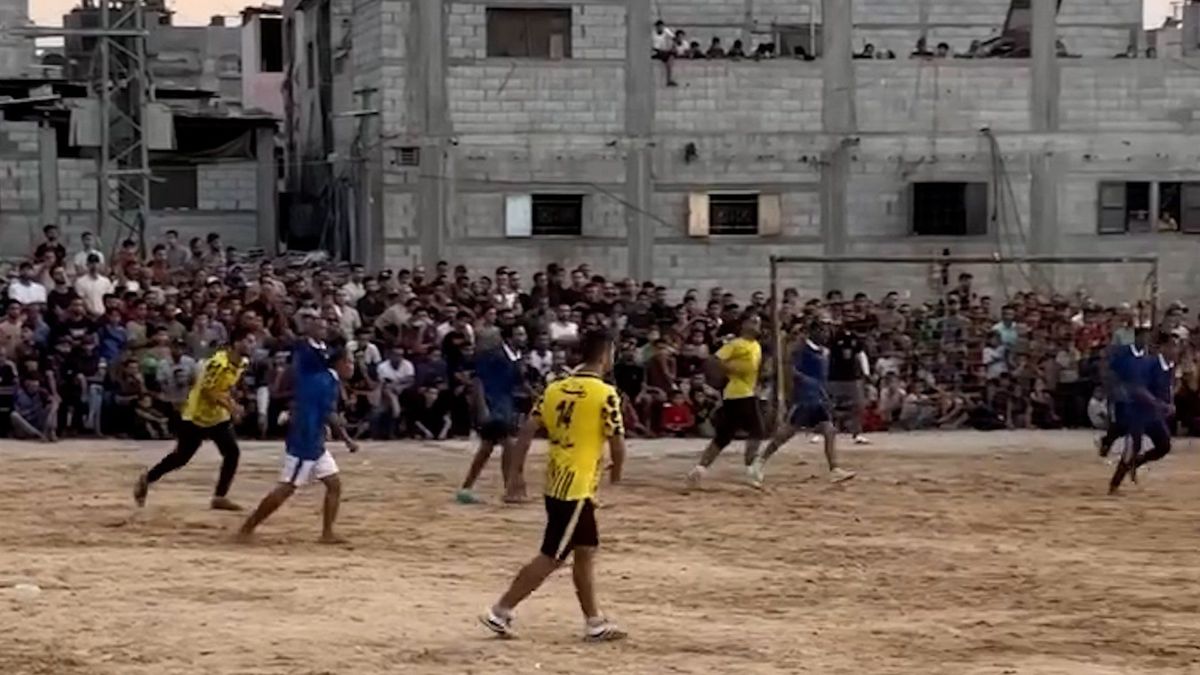
Displaced Palestinians in Khan Younis, southern Gaza, recently gathered for a friendly football match. The game unfolded on a makeshift field, carved out amidst the sprawling tent encampments housing thousands of displaced families and the extensive ruins of buildings destroyed by ongoing Israeli attacks. This event, captured on video, offered a stark visual of life attempting to assert itself in a landscape of profound destruction and displacement, even as the broader conflict in Gaza continued unabated.
The scene of a football match played in the shadow of war in Gaza is a potent symbol of the asymmetrical power dynamics at play. At its core, this conflict is defined by the overwhelming military dominance of Israel and its capacity to conduct sustained aerial and ground operations. This power is not merely about security; it is about the ability to shape the physical and demographic landscape of Gaza, leading to widespread destruction and mass displacement. The doctrine of deterrence often employed by Israel, coupled with its advanced military technology, allows for operations that fundamentally alter the environment in which Palestinians live, or try to live.
Crucially, the power dynamic extends to the control of territory and movement. The long-standing siege of Gaza, the strict control of its borders, and the severe restrictions on the entry of goods and people create a profound state of dependency. This blockade has, for years, crippled Gaza's economy, making reconstruction and self-sufficiency nearly impossible. It ensures that even in periods of relative calm, the population remains vulnerable, reliant on external aid, and unable to freely rebuild or develop. This economic strangulation reinforces a cycle of dependency and vulnerability, ensuring that the population remains under immense pressure, impacting everything from infrastructure to individual livelihoods.
Against this backdrop of immense pressure, the act of Palestinian agency and resistance, even in its most mundane forms, becomes significant. Playing football, building temporary communities, and attempting to maintain cultural practices are forms of non-violent resistance. These acts are assertions of life, identity, and community against attempts to erase them. They challenge the totalizing narrative of despair and victimhood, signaling a refusal to be completely defined by the conflict. This resilience, while often celebrated, is also a heavy burden, a necessity born of extreme circumstances.
The role of international political leverage is also critical. The varying degrees of support or condemnation from global powers, particularly the United States' consistent vetoes at the UN Security Council regarding resolutions critical of Israel, significantly influence the conflict's duration and intensity. Statements from the European Union, the Arab League, and other international bodies often represent a delicate balance of geopolitical interests, humanitarian concerns, and strategic alliances. These external actors, through their actions or inactions, play a substantial role in either enabling or constraining the conflict, shaping the diplomatic space for any potential resolution.
Finally, the battle for narrative control is a fundamental aspect of this power struggle. Both sides actively shape the global perception of the conflict. Israel consistently emphasizes its security concerns and right to self-defense, often framing its actions as responses to aggression. Palestinians and their advocates highlight the context of occupation, the humanitarian crisis, and their right to self-determination. The football match itself, while a human story, becomes a potent symbol in this narrative battle, used by different groups to convey messages of resilience, suffering, or even defiance.
The human cost of the ongoing conflict in Gaza is immeasurable, extending far beyond immediate casualties to fundamentally alter the lives and futures of millions. The most immediate and visible cost is the mass displacement and homelessness. Millions of Palestinians have been forced from their homes, often multiple times, living in overcrowded temporary shelters or tents, frequently in areas already devastated by conflict. The loss of homes means not only the loss of shelter but also the loss of stability, privacy, personal history, and the very fabric of community life. Entire neighborhoods, once vibrant, are now reduced to rubble, erasing years of development and collective memory.
The direct toll of loss of life and limb is a tragic constant. Civilian casualties, including a disproportionate number of women and children, are a stark reality of the conflict. Injuries often lead to long-term disability, placing immense strain on an already collapsed healthcare system that lacks basic supplies, personnel, and functioning infrastructure. For those who survive, the physical scars are often compounded by deep psychological wounds.
Psychological trauma permeates every aspect of life in Gaza. Generations are growing up with the constant sounds of war, witnessing unimaginable destruction, and experiencing profound loss of family members, friends, and their sense of security. Children, in particular, suffer from post-traumatic stress disorder (PTSD), anxiety, depression, and significant developmental setbacks. The football match, while a vital coping mechanism and a fleeting moment of childhood reclaiming itself, is also a stark reminder of the abnormal circumstances they endure, a fragile attempt at normalcy in a world turned upside down by adult failures.
The erosion of basic services is another devastating cost. Access to clean water, sanitation, electricity, food, and medical supplies is severely limited or non-existent due to infrastructure destruction and the ongoing blockade. This creates a pervasive public health crisis, with outbreaks of disease, malnutrition, and a constant struggle for daily survival. The lack of these fundamental necessities strips away dignity and exacerbates suffering, making every day a battle for existence.
Furthermore, the destruction of social fabric is a long-term wound. Schools, universities, cultural centers, and community spaces have been destroyed, hindering education, cultural expression, and the ability to rebuild civil society. The informal football game, in its own way, is an attempt to reconstruct a semblance of this lost social infrastructure, a spontaneous gathering that momentarily fills the void left by systematic destruction.
Children in Gaza are disproportionately affected by the conflict, losing not just their homes but also their sense of safety, their educational opportunities, and their future prospects. They are forced to mature rapidly, often becoming caregivers for younger siblings or navigating dangerous environments. The resilience they display, like playing football amidst the ruins, is often celebrated, but it is a resilience born of necessity and suffering. It highlights their incredible spirit but also underscores the profound injustice of a world that has failed to protect their childhoods, forcing them to find joy and connection in the most desolate of landscapes. This forced resilience can, in fact, be a burden, masking the deep, unaddressed trauma that will affect them for years to come.
Behind the immediate headlines of conflict and humanitarian crisis, several critical narratives are often downplayed, omitted, or framed away by powerful actors. One significant untold story revolves around the long-term strategy of
Source referenced: ALJAZEERA
This brief was synthesized by our Editorial Engine and reviewed by The Ground Narrative team.


