TRENDING

Monday, 12 October 2026
----------------------
1 Jumada Al-Awwal 1448 AH
A major offensive against Houthi forces near the Bab al-Mandeb strait highlights the strategic importance of this global chokepoint and the deeply fragmented allegiances among Yemen's southern fighters.
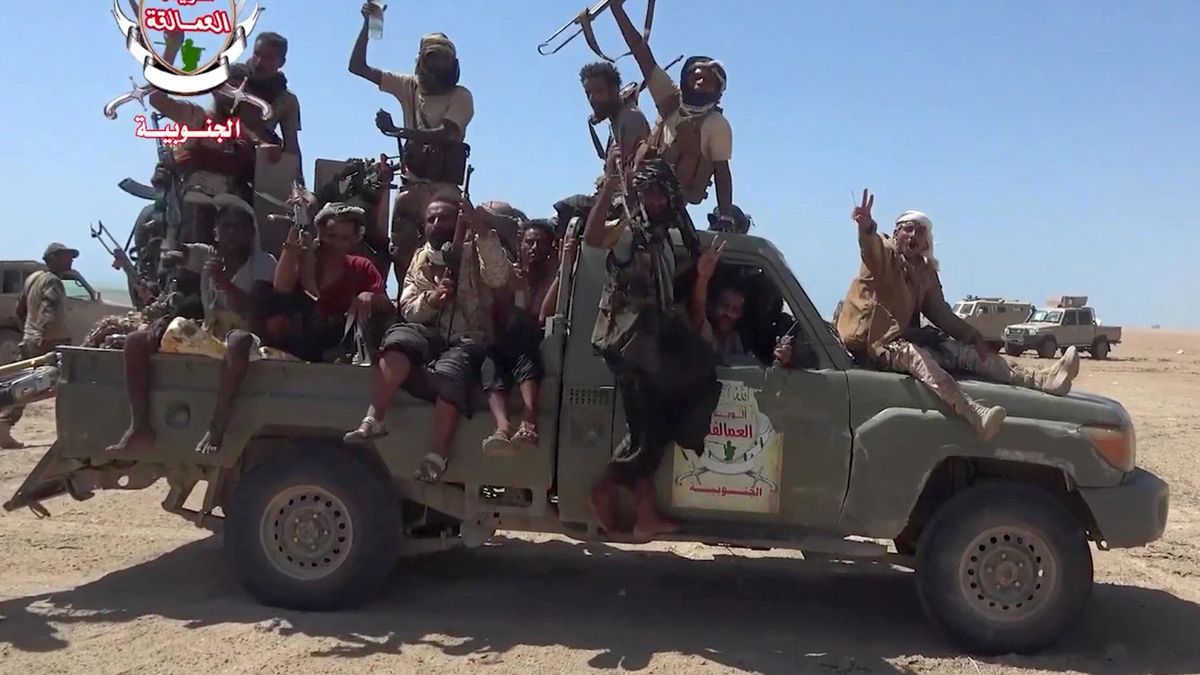
On October 5, 2026, a coalition of forces, prominently featuring the powerful Southern Giants Brigades alongside units of the internationally recognized Yemeni government, launched a significant military offensive against Houthi forces. The primary objective was to reclaim the strategically vital Bab al-Mandeb strait and its surrounding coastline, a region recently seized by the Houthis. Within days, the anti-Houthi coalition claimed a major success, announcing they had cut the main road linking the Red Sea port city of Mocha to the strait, marking one of their most substantial military gains in years.
The current offensive near the Bab al-Mandeb strait is a stark illustration of Yemen's deeply fragmented power landscape, where no single actor holds undisputed control. This complexity is further amplified by the heavy involvement of external powers, turning the conflict into a multi-layered proxy struggle.
The conflict's trajectory is heavily influenced by regional patrons. The United Arab Emirates (UAE) has historically armed, trained, and funded the Giants Brigades and the Southern Transitional Council (STC), aligning with their separatist ambitions for southern Yemen. Conversely, Saudi Arabia is the primary backer of the internationally recognized Yemeni government and its Presidential Leadership Council (PLC), aiming for a unified, Saudi-aligned Yemen to counter Iran's growing influence through the Houthis. This creates a delicate balance where allies often pursue divergent long-term goals, even when fighting a common enemy. The Houthis, for their part, are linked to Iran, receiving support that allows them to maintain their hold on significant territories and pose a threat to regional maritime security.
Bab al-Mandeb is not merely a piece of territory; it is a global trade artery, a narrow waterway connecting the Red Sea to the Gulf of Aden and the Indian Ocean. An estimated 12% of global trade and a significant portion of the world's oil transits through this strait. Control over this chokepoint grants immense leverage over international energy supplies and maritime commerce, making it an irresistible prize for all factions and their external backers. For the Houthis, controlling the strait offers a potent bargaining chip and a means to project power regionally. For the anti-Houthi coalition, securing it is essential to re-establish control over vital economic lifelines and deny the Houthis a critical strategic advantage.
The current alliance between the Giants Brigades (with their southern separatist roots) and the Yemeni government (committed to national unity) is a fragile, temporary arrangement. Their common enemy, the Houthis, serves as the primary glue. For the PLC and its chairman, Rashid al-Alimi, demonstrating military success against the Houthis is crucial for legitimacy, consolidating power, and proving their efficacy, especially after the internal conflicts that saw Saudi-aligned forces defeat UAE-backed STC units in January 2026. For the Giants Brigades and the broader STC movement, participating in this offensive allows them to assert their military prowess, secure territory they consider part of a future independent south, and claim a stake in any future power arrangements, even if their ultimate goal remains secession.
The Giants Brigades' origins in Salafi fighters and their commander Abd al-Rahman Abu Zaraa al-Muharrami's background in an ultraconservative religious school add another layer of complexity. This indicates a religious dimension to their motivation and potential future political agenda, which may not align perfectly with either secular separatist aspirations or the internationally recognized government's vision for a unified state. This ideology can be a powerful, enduring force, shaping societal norms and governance in areas under their control.
The renewed fighting in the coastal region around Bab al-Mandeb is not just a strategic maneuver; it carries a profound and immediate human cost, exacerbating an already catastrophic humanitarian crisis in Yemen.
Yemen is widely recognized as one of the world's worst humanitarian disasters. Any escalation of conflict, particularly in densely populated coastal areas, inevitably leads to new waves of displacement. Families are forced to abandon their homes, livelihoods, and what little stability they have, seeking refuge in already overcrowded and under-resourced camps. The disruption of supply routes and the targeting of infrastructure further impede the delivery of desperately needed humanitarian aid, pushing more people into severe food insecurity and starvation. For ordinary Yemenis, the fight for a strategic chokepoint often translates into a chokehold on their very survival.
The conflict over key ports and trade routes, such as those around Mocha and Bab al-Mandeb, directly cripples Yemen's already devastated economy. The disruption of commercial shipping, the imposition of blockades, and the destruction of infrastructure drive up the prices of essential goods, making basic necessities like food, fuel, and medicine unaffordable for the majority. Fishing communities along the coast, once a vital source of income and sustenance, find their livelihoods destroyed by naval blockades, mines, and the dangers of active combat zones. The long-term economic consequences mean generations will struggle to rebuild, even if the fighting eventually ceases.
Fighting in and around urban centers and coastal towns inevitably leads to civilian deaths and injuries. The use of heavy weaponry, airstrikes, and ground engagements in populated areas puts non-combatants directly in harm's way. Beyond immediate casualties, the psychological toll on the population, especially children, is immense. Constant exposure to violence, displacement, and deprivation leaves deep, lasting trauma, contributing to a lost generation that has known nothing but war and instability.
The re-emergence of symbols like the former South Yemen flag and the explicit separatist rhetoric from some fighters deepen the internal divisions within Yemeni society. While the immediate focus is on defeating the Houthis, these underlying ideological and political fissures make future reconciliation and the rebuilding of a cohesive state incredibly challenging. Ordinary Yemenis, caught between competing visions for their country, find their national identity fractured, making the path to lasting peace even more elusive.
Behind the official narratives of national unity and strategic victories, several critical dimensions of the Yemen conflict remain downplayed or omitted by powerful actors, revealing deeper complexities and unresolved tensions.
Official statements from the Presidential Leadership Council (PLC) and its Saudi backers will invariably emphasize the imperative of national unity against the Houthi threat. However, the actions and explicit statements from Southern Transitional Council (STC) leaders and fighters on the ground — such as raising the former South Yemen flag and declaring their objective to secure
Source referenced: ALJAZEERA
This brief was synthesized by our Editorial Engine and reviewed by The Ground Narrative team.


