TRENDING

Thursday, 15 October 2026
----------------------
4 Jumada Al-Awwal 1448 AH
Retired US General Mark Kimmitt warns that renewed attacks in the Strait of Hormuz could push the United States and Iran back towards a wider regional conflict. This assessment follows recent Iranian attacks on US military bases and retaliatory US strikes, highlighting the volatile security landscape in the Persian Gulf.
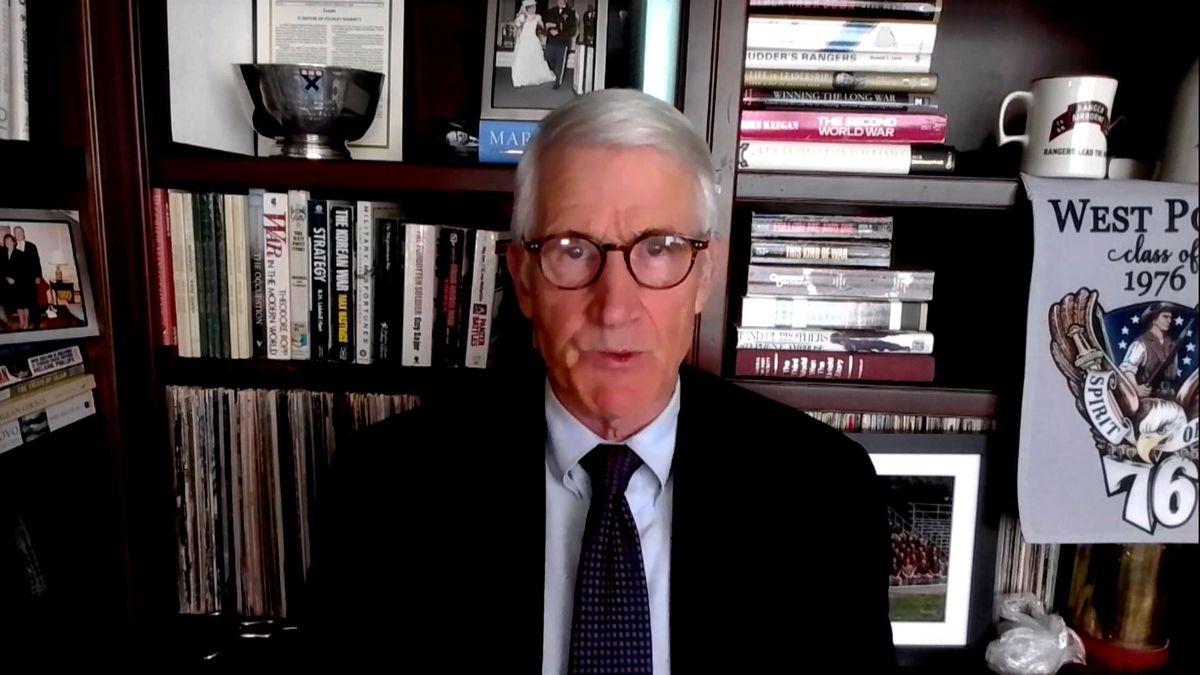
The Persian Gulf region is once again at a critical juncture, with retired US General Mark Kimmitt issuing a stark warning regarding the potential for renewed US-Iran fighting to ignite a wider regional conflict. This caution, articulated on July 13, 2026, underscores the persistent volatility stemming from a series of recent escalations, particularly around the strategically vital Strait of Hormuz.
The immediate context for General Kimmitt's warning includes reports of Iranian attacks on US military bases located in Bahrain, Kuwait, and Jordan. These actions represent a significant escalation, directly targeting US personnel and assets in allied nations. In response, the United States has reportedly launched more strikes on Iran, indicating a tit-for-tat dynamic that risks spiraling out of control. The deepening standoff in the Strait of Hormuz serves as the primary flashpoint, a narrow maritime chokepoint that is central to global energy security.
The Strait of Hormuz is arguably the world's most critical oil transit chokepoint, connecting the Persian Gulf to the Arabian Sea and beyond. Approximately one-fifth of the world's total oil consumption, and a significant portion of its liquefied natural gas (LNG), passes through this waterway daily. Any disruption, whether through direct military action, mining, or blockades, would have immediate and severe repercussions on global energy markets, leading to soaring oil prices and potential economic instability worldwide. For Iran, the ability to threaten or disrupt shipping in the Strait of Hormuz is a key strategic leverage point, often employed as a deterrent or a retaliatory measure against international pressure, particularly sanctions.
Historically, the US has maintained a robust military presence in the Persian Gulf, primarily to ensure freedom of navigation, protect its regional allies, and deter Iranian aggression. The recent Iranian attacks on US bases in Bahrain, Kuwait, and Jordan challenge this presence directly, signaling Tehran's willingness to expand the geographical scope of its confrontation with Washington. These actions could be interpreted as Iran's attempt to demonstrate its capacity for asymmetric warfare and to impose costs on the US for its regional policies or military posture.
From a geopolitical perspective, the renewed hostilities reflect a complex interplay of strategic motivations. Iran's actions are likely driven by a desire to assert its regional influence, challenge the perceived US hegemony, and potentially retaliate against economic sanctions or other pressures. By targeting US bases, Iran aims to demonstrate its reach and commitment to defending its interests, potentially seeking to compel a reduction in US military presence or a shift in US policy towards the region.
The United States, conversely, is motivated by the imperative to protect its personnel and assets, uphold its security commitments to regional allies, and safeguard international maritime commerce. The US retaliatory strikes are intended to deter further Iranian aggression and reinforce the principle of freedom of navigation. However, each retaliatory cycle carries the inherent risk of miscalculation, potentially leading to an unintended but rapid escalation.
For regional actors, particularly US allies like Bahrain, Kuwait, and Jordan, the situation is fraught with peril. Their territories are becoming battlegrounds in a broader US-Iran confrontation, raising concerns about their own security and stability. A wider conflict would inevitably draw in these nations, potentially destabilizing the entire Middle East and creating new humanitarian crises. The economic implications for the region, heavily reliant on oil and gas exports, would be catastrophic, impacting development and social stability.
General Kimmitt's warning highlights several pathways through which the current standoff could evolve into a wider conflict. Continued attacks in the Strait of Hormuz, such as targeting commercial vessels or naval assets, could trigger a more forceful US military response. Similarly, sustained attacks on US bases or personnel could cross a threshold that necessitates a broader military engagement. The involvement of proxy groups, a hallmark of US-Iran rivalry, could also complicate de-escalation efforts, making it difficult to attribute actions and control the narrative.
Preventing a full-scale conflict requires robust diplomatic efforts and clear communication channels, which have historically been strained between Washington and Tehran. The absence of direct diplomatic engagement increases the risk of misinterpretation and unintended escalation. The international community watches with apprehension, recognizing that a major conflict in the Persian Gulf would have profound global consequences, extending far beyond the immediate belligerents.
In conclusion, the escalating tensions in the Strait of Hormuz and the broader Persian Gulf represent a critical geopolitical challenge. The warnings from experienced military analysts like General Kimmitt underscore the urgent need for de-escalation and a renewed focus on diplomatic solutions to avert a potentially devastating regional conflict with global ramifications for energy security, economic stability, and international peace. The current trajectory suggests a dangerous path where strategic miscalculations could quickly lead to an irreversible confrontation.
Source referenced: ALJAZEERA
This brief was synthesized by our Editorial Engine and reviewed by The Ground Narrative team.


