TRENDING

Tuesday, 20 October 2026
----------------------
9 Jumada Al-Awwal 1448 AH
A recent confrontation between Chinese and Philippine vessels at the disputed Second Thomas Shoal has triggered a diplomatic crisis, with both nations summoning ambassadors. The incident underscores escalating geopolitical tensions in the South China Sea, drawing international condemnation and highlighting the strategic rivalry between major powers.
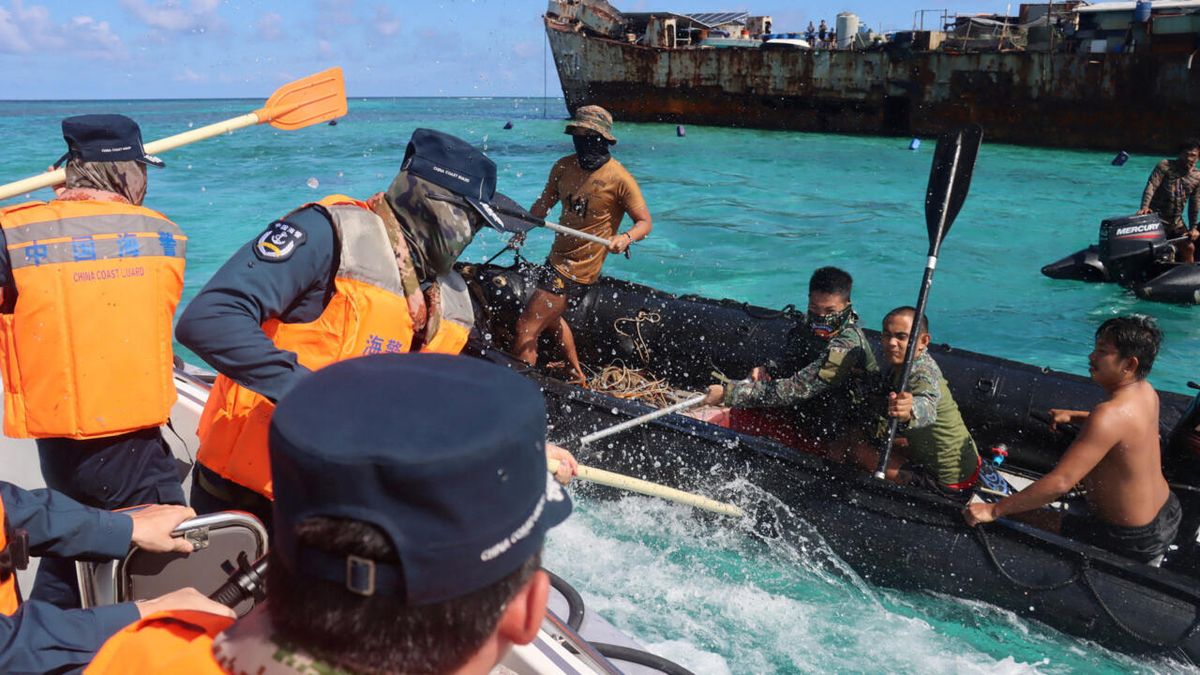
A recent confrontation between Chinese and Philippine vessels at the disputed Second Thomas Shoal (known as Ren'ai Reef in China) has significantly heightened geopolitical tensions in the South China Sea, prompting a flurry of diplomatic condemnations and reciprocal ambassadorial summons. The incident, which occurred on July 20, 2026, underscores the persistent volatility in a region critical for global trade and strategic influence.
The clash unfolded as Philippine Navy personnel attempted to resupply the BRP Sierra Madre, a deliberately grounded Philippine warship that serves as a military outpost at Second Thomas Shoal. The Philippine military accused the China Coast Guard (CCG) of employing aggressive tactics, including clubbing a Filipino sailor with a baton. Conversely, the CCG asserted that two Philippine rubber boats rammed a Chinese patrol vessel and accused Philippine personnel of initiating "malicious attacks" with oars and sticks. Both nations have vehemently denied the other's account, with China's foreign ministry labeling the Philippine actions as "deliberate provocation and attack" and the Philippines denying its troops initiated the confrontation.
In the immediate aftermath, Beijing "urgently summoned" the Philippine ambassador to lodge formal protests. In a reciprocal move, Philippine President Ferdinand Marcos Jr. announced his intention to summon the Chinese ambassador. This tit-for-tat diplomatic exchange highlights the deep-seated mistrust and the escalating nature of the dispute.
The Second Thomas Shoal incident is not an isolated event but rather the latest flashpoint in a long-running and complex territorial dispute over the South China Sea. China claims sovereignty over nearly the entire waterway, asserting its historical "nine-dash line" claim, despite a 2016 international arbitral ruling that found these claims to have no legal basis under the United Nations Convention on the Law of the Sea (UNCLOS). Multiple Southeast Asian nations, including the Philippines, Vietnam, Malaysia, and Brunei, have overlapping claims, leading to frequent altercations in the heavily patrolled waters.
For the Philippines, maintaining its presence at the BRP Sierra Madre is a crucial assertion of its sovereign rights within its Exclusive Economic Zone (EEZ). The vessel, intentionally grounded in 1999, symbolizes Manila's resolve against Beijing's expansive claims. For China, the resupply missions are perceived as attempts to solidify a permanent presence in what it considers its sovereign territory, prompting assertive interdiction tactics by the CCG.
The incident quickly drew international condemnation, particularly from key Philippine allies. Australian Foreign Minister Penny Wong criticized China's "destabilising and dangerous conduct," echoing earlier remarks from Washington. The United States, a treaty ally of the Philippines, condemned Beijing's "dangerous and aggressive actions," reaffirming its commitment to freedom of navigation and its defensive umbrella in the region.
Significantly, US Secretary of State Marco Rubio arrived in Manila on the same day as the diplomatic fallout, for a summit of the 11-member Association of Southeast Asian Nations (ASEAN). While open to a meeting with his Chinese counterpart, Wang Yi, Rubio's presence and his published op-ed in Philippine media outlets underscored Washington's unwavering commitment to regional security. In his op-ed, Rubio explicitly warned against any power using trade as a "geopolitical weapon" and emphasized the importance of safeguarding freedom of navigation, a clear allusion to China's growing assertiveness. This demonstrates the US strategy of reinforcing alliances and international norms in the face of China's expanding influence.
The escalating tensions at Second Thomas Shoal carry significant implications for regional stability and international law. The use of physical force and the reciprocal diplomatic actions suggest a dangerous trajectory where miscalculation or accidental escalation could have severe consequences. The incident further complicates efforts by ASEAN to forge a unified approach to the South China Sea disputes, as member states balance their economic ties with China against their security concerns.
The continued friction also highlights the broader geopolitical competition between China and the US in the Indo-Pacific. Washington's vocal support for the Philippines and its emphasis on freedom of navigation signal a robust commitment to counter China's territorial expansion. As China continues to assert its claims and the Philippines, backed by its allies, resists these pressures, the South China Sea is likely to remain a critical flashpoint, demanding careful diplomatic management to prevent a more serious confrontation. The international community will closely watch how these dynamics evolve, particularly concerning the adherence to international maritime law and the preservation of peace in a vital global waterway.
Source referenced: FRANCE24
This brief was synthesized by our Editorial Engine and reviewed by The Ground Narrative team.