TRENDING

Monday, 19 October 2026
----------------------
8 Jumada Al-Awwal 1448 AH
The European Union, spurred by France and Germany, is proposing new mechanisms to counter market distortions, implicitly targeting China's economic practices. This marks a significant pivot in Europe's trade strategy, driven by growing deficits and industrial competition.
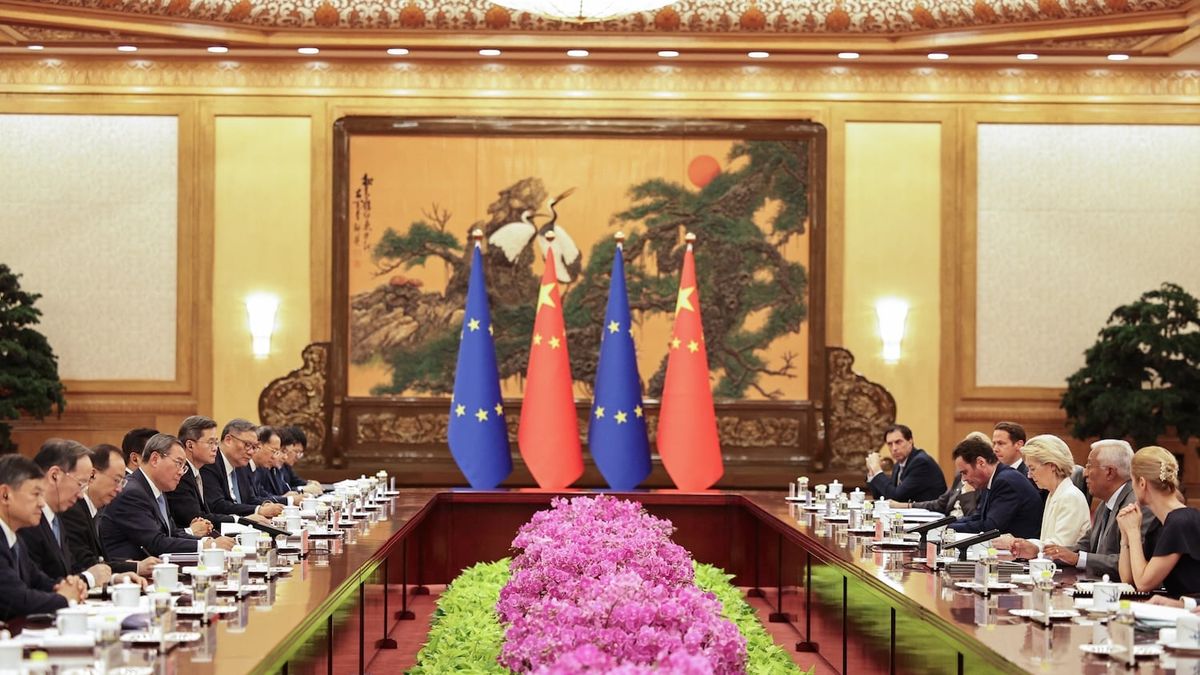
In a notable shift in European Union trade policy, France and Germany have jointly proposed a new mechanism to the European Commission aimed at swiftly countering persistent market distortions. Led by President Emmanuel Macron and Chancellor Friedrich Merz, the initiative seeks to empower the EU to restrict access to its vast single market for entities engaged in unfair practices. While not explicitly named, the unspoken target of these measures is China, signaling a more assertive stance from Europe's two largest economies against what they perceive as imbalanced trade relations and threats to their industrial base.
For decades, Europe has struggled to translate its immense economic weight into proportional geopolitical leverage. The continent, home to 450 million affluent consumers and an integrated regulatory space, possesses what is often called the "Brussels effect" – its standards de facto shaping global corporate behavior. Yet, this power has historically been underutilized, particularly in confronting economic challenges from major global players.
This new Franco-German proposal marks a significant evolution in the EU's approach, driven by shifting economic realities. For much of the past two decades, Germany's trade policy with China was anchored in the belief that expanding economic relationships were, on balance, favorable. This led to China becoming a major source of growth for German industries like cars, machinery, and chemicals, with German companies investing heavily in Chinese production. However, this calculus has become unsustainable. German exports to China plummeted by 9.7 percent in 2025 and an additional 14.5 percent in the first five months of 2026, while imports from China rose by 8.8 percent in 2025, resulting in a staggering bilateral deficit of 89.3 billion euros. This data reveals an uncomfortable truth: China has moved from being a primary customer to a formidable competitor in industries crucial to the German economy.
France, on the other hand, has long advocated for a more assertive European stance, concerned about a lack of reciprocity, threats to industrial sovereignty, and strategic dependencies. The current proposal represents a convergence of these perspectives, with Berlin finally accepting Paris's long-held proposition that interdependence, when unbalanced, creates vulnerabilities that the EU must actively counter using its market power.
The proposed mechanism aims to streamline decision-making within the EU. Economic measures put forward by the Commission could take effect unless a qualified majority of governments oppose them, effectively reversing the default position and accelerating the EU's ability to respond. This mirrors the United States' Section 301 powers, indicating a desire for rapid, decisive economic statecraft. This move builds upon the EU's 2023 adoption of the Anti-Coercion Instrument, which demonstrated a willingness to use economic tools even against traditional allies, such as in the deterrence of US President Donald Trump's tariff threats.
The urgency is underscored by the recognition that Europe's
The EU is shifting its policy due to growing trade imbalances, with a significant deficit with China, and concerns that China is moving from a customer to a competitor in key European industries, threatening jobs and industrial sovereignty.
The 'Brussels effect' refers to the EU's ability to set global standards due to the size and integration of its single market. The new policy aims to leverage this market power more assertively to defend European economic interests against unfair competition.
The human costs could include job losses in industries facing disruption, potential higher consumer prices due to restricted access to cheaper goods, and social or political instability if economic transitions are not managed effectively across Europe.
Editor's Note: Analysis is based on comprehensive interpretation of provided intelligence, adhering to TGN's editorial doctrine and structural requirements.
Source referenced: FOREIGNPOLICY
This brief was synthesized by our Editorial Engine and reviewed by The Ground Narrative team.


