TRENDING

Thursday, 15 October 2026
----------------------
4 Jumada Al-Awwal 1448 AH
Recent concerns over the politicization of the U.S. military under President Trump echo historical precedents, notably the 1951 clash between President Truman and General MacArthur. This analysis explores the profound implications for civilian control, public trust, and the nation's global standing.
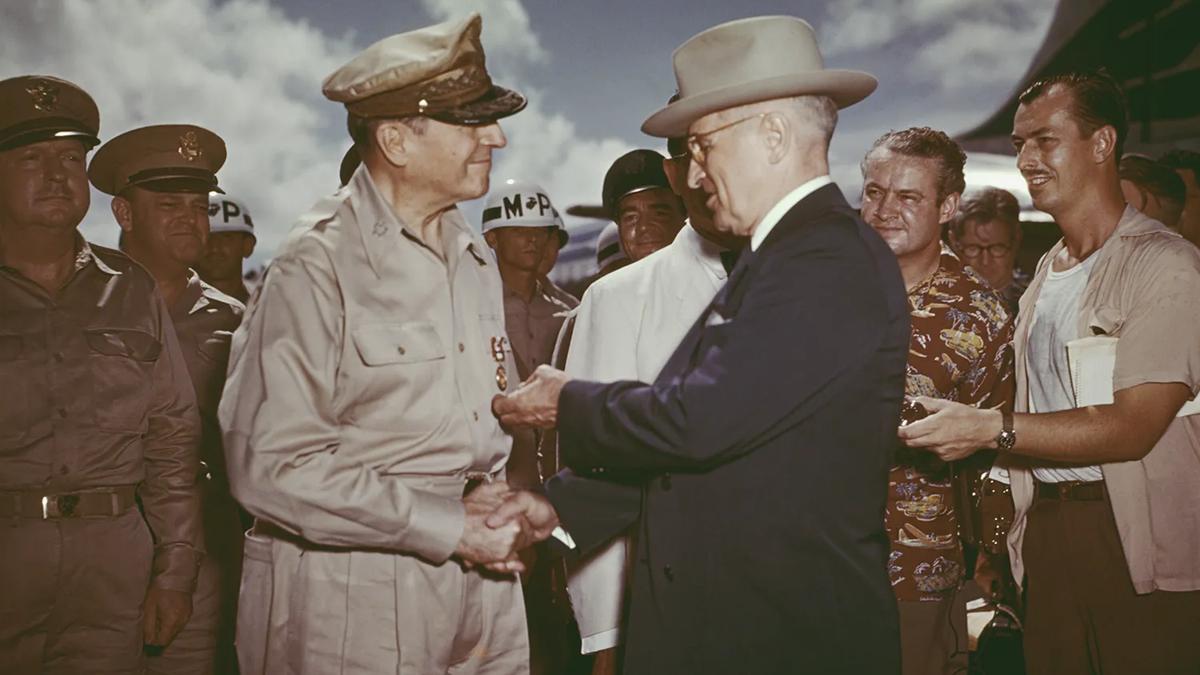
The politicization of the United States military, a critical institution designed to operate above partisan fray, has emerged as a significant concern in recent years. While contemporary criticisms often center on actions by President Donald Trump, historical analysis reveals that the tension between military command and political leadership is a recurring challenge to the bedrock principles of American democracy. This dynamic, which fundamentally questions the apolitical nature of the armed forces, carries profound implications for domestic stability, public trust, and international perceptions of U.S. leadership.
Since 2025, President Trump has faced bipartisan scrutiny for actions perceived as leveraging the military for partisan political gain. These include using military installations for overtly political rallies and addressing the West Point graduating class while wearing a campaign hat. Furthermore, his administration's calls to deploy the National Guard and reserves to predominantly Democratic cities for a deportation program, despite opposition from state governors, and the removal of top military officials to install those aligned with his political vision, have fueled fears about the military becoming an instrument of partisan conflict. Secretary of Defense Pete Hegseth has also contributed to these concerns through explicitly political statements. Senator Jack Reed, a veteran and Democrat, warned in October 2025 that such actions systematically dismantle the principle of an apolitical military, a foundation upon which republics depend.
The current anxieties, however, are not unprecedented. A pivotal historical moment illustrating the dangers of military politicization occurred in 1951, involving President Harry Truman and General Douglas MacArthur during the Korean War. This episode provides crucial context, demonstrating that the struggle to maintain civilian control over the military is a long-standing feature of American governance.
The seeds of this conflict were sown in 1949 with the fall of China to communism, an event for which Republicans vehemently blamed President Truman and his administration, coining the rallying cry, "Who lost China?" This political pressure created a volatile environment as the U.S. entered the Korean War in June 1950, deploying troops under United Nations Security Council resolutions rather than a formal congressional declaration of war. Truman appointed General MacArthur, a highly decorated World War II commander, to lead the UN Command.
MacArthur, known for his strong will and adept use of public relations, quickly became a formidable figure. Tensions escalated when MacArthur publicly challenged Truman's foreign policy. In August 1950, a statement from MacArthur to the Veterans of Foreign Wars, advocating for increased support for Chiang Kai-shek's nationalists in Formosa (Taiwan) against the communists, was suppressed by Truman. The President feared it would undermine his pledge of neutrality and jeopardize Korean War negotiations. Despite a tense meeting on Wake Island in October 1950, where MacArthur apologized for the statement, disagreements persisted.
As the Korean War stalled following China's entry in October 1950, and MacArthur's confident predictions of a swift victory proved false, the stalemate became a central issue for Republicans in the midterm elections. MacArthur further exacerbated the situation by publicly criticizing Truman's refusal to authorize direct attacks on communist China or the use of atomic weapons, claiming it placed an "enormous handicap" on his forces. This insubordination reached a critical point in March 1951 when MacArthur issued a statement threatening China, directly undermining Truman's efforts to negotiate a peace deal. House Minority Leader Joseph W. Martin Jr. then released a letter from MacArthur to the press, in which the general again charged Truman with endangering U.S. soldiers and obstructing a resolution, famously stating, "There is no substitute for victory." Faced with rank insubordination and international speculation about who held authority in the United States, Truman, despite low approval ratings, made the difficult decision to relieve MacArthur of his command, asserting the fundamental principle of civilian control over the military.
The historical precedent of Truman and MacArthur, alongside contemporary concerns, underscores the profound strategic implications of military politicization. The core principle of civilian control over the military is a cornerstone of democratic governance, ensuring that military power serves the will of the elected government rather than becoming an independent political force. When this principle is eroded, it can lead to several critical consequences:
Firstly, it undermines public trust in both government officials and military leaders. If the military is perceived as a partisan instrument, citizens may question the motives behind deployments, statements from military command, and even the use of lethal force, whether abroad or domestically. This erosion of trust can destabilize national cohesion and make it harder for the government to garner support for critical national security initiatives.
Secondly, it can impact international standing and alliances. When internal divisions within the U.S. government manifest as public clashes between political and military leadership, or when the military is seen as a tool for domestic political maneuvering, it can project an image of instability and divided authority. Allies may question the reliability and strategic coherence of U.S. foreign policy, while adversaries might seek to exploit perceived weaknesses.
Finally, the long-term consequence of a politicized military is the potential for internal instability. A military that is not strictly apolitical risks becoming a player in domestic political struggles, which could have severe repercussions for the rule of law and the democratic process itself. The deliberate construction of an apolitical military was a safeguard against such dangers, understood by past leaders as essential for the survival of the republic.
The historical record demonstrates that the challenge of maintaining an apolitical military is not new, but its resurgence in contemporary politics highlights an enduring vulnerability within democratic systems. The events surrounding President Trump's administration, viewed through the lens of the Truman-MacArthur conflict, serve as a stark reminder of the critical importance of upholding civilian control and insulating the armed forces from partisan politics. The health of American democracy and its credibility on the global stage depend on the unwavering commitment to this fundamental principle, ensuring that the military remains a trusted institution dedicated to national security, not political advantage.
Source referenced: FOREIGNPOLICY
This brief was synthesized by our Editorial Engine and reviewed by The Ground Narrative team.


