TRENDING

Wednesday, 21 October 2026
----------------------
10 Jumada Al-Awwal 1448 AH
Myanmar's Shan State has emerged as the world's largest producer of methamphetamine, with its illicit trade now eclipsing other regional crimes. This booming industry is deeply intertwined with the nation's civil conflict, funding warring factions and spreading addiction globally.
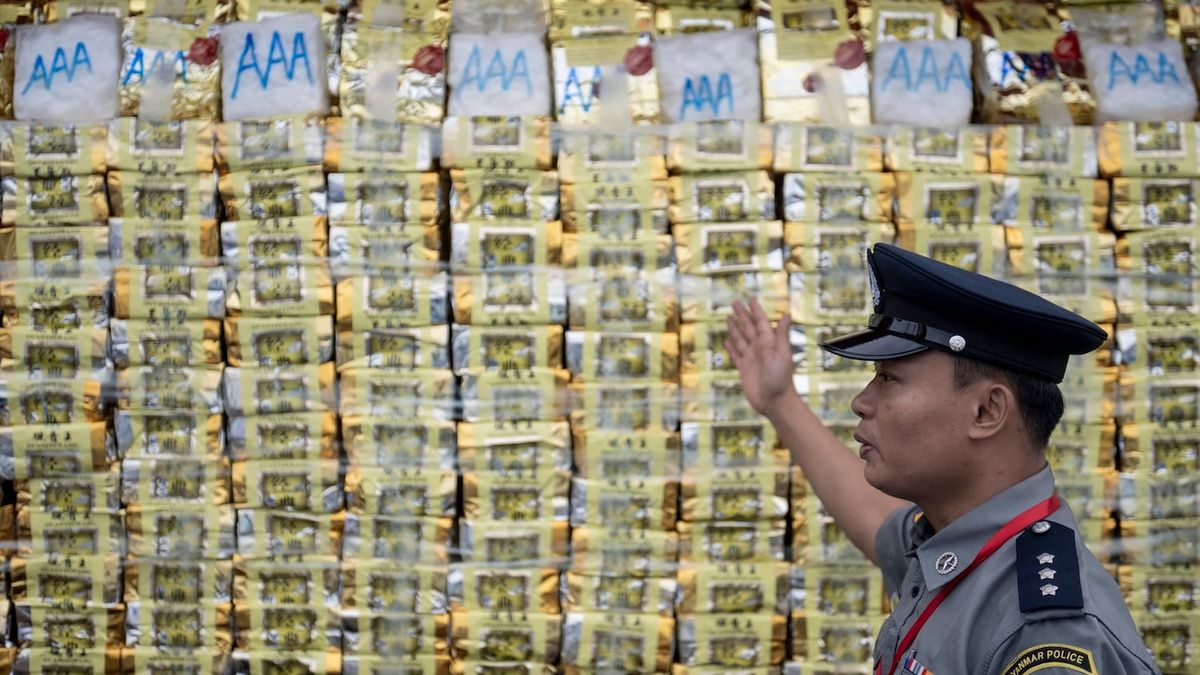
Myanmar's Shan State, a region fractured by decades of conflict, has solidified its position as the world's primary hub for methamphetamine production. Recent intelligence, underscored by a half-ton meth bust on a private jet in Laos bound for the Philippines, reveals the immense scale and sophistication of this illicit trade. Valued by the United Nations Office on Drugs and Crime (UNODC) at an estimated $48.1 billion to $74.8 billion annually within Southeast Asia alone, the meth business now significantly dwarfs other regional criminal enterprises, including the widely publicized scam centers.
The transformation of Shan State into a global meth laboratory is a direct consequence of Myanmar's profound political instability and the intricate web of power struggles that define its borders. Control of the province is not monolithic; it is a patchwork shared between the Myanmar military junta and numerous ethnic armed groups (EAGs). For both sides, the production and sale of synthetic drugs, primarily methamphetamine (known as yaba or shabu), have become an indispensable revenue stream, funding their respective war machines and maintaining their grip on power.
This economic imperative is stark. In a nation ravaged by civil war, where legitimate economic opportunities are scarce, the illicit drug trade offers a perverse form of stability for those who control it. For the junta, tolerating or actively participating in the trade provides a critical source of foreign currency, bypassing international sanctions and sustaining its brutal campaign against resistance forces. For EAGs like the United Wa State Army, the National Democratic Alliance Army, and the Shan State Progress Party/Shan State Army-North, drug profits are essential for arms procurement, troop salaries, and maintaining autonomy from the central government. This creates a self-perpetuating cycle where conflict fuels the drug trade, and drug money fuels conflict.
China's role in this dynamic is complex and often contradictory. While Beijing has reportedly squeezed northern drug routes directly into its territory, it is also accused of tacitly tolerating foreign criminal syndicate activity in Shan State, particularly as long as its own citizens are not directly affected by the drug outflow. Crucially, many of the precursor chemicals required for industrial-scale meth production originate from China, flowing across its porous border into Shan State. This gives Beijing significant, albeit indirect, leverage over both the Myanmar military and key EAGs involved in the drug trade. This pragmatic approach prioritizes border stability and influence over a full-scale crackdown on the illicit economy that underpins regional power structures.
The global demand for cheap, potent synthetic stimulants further drives this engine of illicit production. Manufacturers in Shan State have adapted, establishing industrial-scale labs and diversifying their raw materials to use precursor chemicals not subject to strict legal controls. The drugs are then smuggled through a sophisticated network that extends beyond the traditional Golden Triangle routes into Thailand and Laos, reaching India to the west and, crucially, the global market via the port of Yangon. This international reach highlights the interconnectedness of regional instability with global consumption patterns, making the problem far more than a localized issue.
Moreover, the drug trade in Shan State is not an isolated phenomenon. It is deeply entangled with other criminal enterprises, including the burgeoning scam centers, human trafficking, and extensive money laundering operations. The same corrupt officials, smuggling routes, and financial networks facilitate multiple illicit activities, creating a resilient and adaptable super-criminal economy that thrives on state weakness and systemic corruption across Southeast Asia. The recent talks between the United States and the Myanmar junta in Tokyo, facilitated by Japan, further complicate this picture, as international engagement with a regime implicated in such vast illicit economies raises questions about the prioritization of stability over accountability for the human cost of these power mechanics.
The staggering profits generated by Shan State's meth labs come at an immense and often invisible human cost, borne primarily by the most vulnerable populations within Myanmar and across the wider region.
At the forefront of this suffering is the devastating impact of addiction. Methamphetamine, known for its energizing qualities, is particularly popular among those working long hours in physically demanding jobs. This includes farmers, factory workers, and laborers across Myanmar, Thailand, Laos, and India, who turn to the drug to cope with grueling conditions and poverty. The widespread availability and low cost of locally produced meth create an epidemic that saps human potential, destroys families, and overwhelms already fragile public health systems. Entire communities are trapped in cycles of dependence, with little access to treatment or support, perpetuating a generational burden of addiction.
The drug trade directly fuels the ongoing civil war in Myanmar. The vast sums of money generated empower both the junta and ethnic armed groups, allowing them to procure weapons, recruit fighters, and sustain conflict. This perpetuates a cycle of violence that displaces millions, destroys infrastructure, and prevents any semblance of development or peace. Civilians in Shan State are caught in the crossfire, enduring arbitrary violence, forced conscription, and the constant threat of instability. Their homes are often situated near drug production sites or smuggling routes, making them unwitting participants in a dangerous economy and targets for warring factions.
The pervasive corruption necessary for the drug trade to flourish further erodes the rule of law and governance structures. Local officials, police, and even military personnel are often complicit, creating a climate of impunity where criminal syndicates operate with little fear of reprisal. This undermines any efforts to build legitimate economies or provide public services, leaving communities to fend for themselves in a lawless environment. The focus on illicit profits diverts resources and attention away from sustainable development, trapping regions like Shan State in a state of perpetual underdevelopment and reliance on illegal activities.
Beyond meth, the production of other synthetic drugs like ketamine, MDMA, etomidate, and "happy water" – cocktails of various synthetic drugs – introduces even more complex health crises. These new substances, often consumed by younger populations, pose unknown long-term health risks and further deepen the addiction crisis. The experimental nature of these drug cocktails means that users are often unaware of the exact chemicals they are consuming, leading to unpredictable and often fatal consequences. The lack of regulation and oversight turns Shan State into a dangerous testing ground for new psychoactive substances, with its own people as the unwitting subjects.
Neighboring countries bear a significant human cost as well. Border communities in Thailand, Laos, and India become transit points, leading to increased crime, violence, and drug addiction within their own populations. The influx of cheap drugs strains their law enforcement and public health resources, creating regional security challenges that extend far beyond Myanmar's borders. The international nature of the busts, involving multiple nationalities, underscores how this crisis destabilizes the entire region, impacting ordinary citizens far removed from the production sites.
What often remains unsaid or downplayed by powerful actors—governments, international bodies, and even some regional partners—is the profound complicity and the selective narratives that allow Shan State's meth empire to flourish.
Governments, particularly those engaging with the Myanmar junta like the United States and Japan, frequently frame their interactions around the need for
Source referenced: FOREIGNPOLICY
This brief was synthesized by our Editorial Engine and reviewed by The Ground Narrative team.


