TRENDING

Monday, 5 October 2026
----------------------
24 Rabi' Al-Thani 1448 AH
Recent Israeli strikes in Gaza have drawn international condemnation, threatening a fragile ceasefire agreement. As mediators push for peace, the reality on the ground remains one of escalating violence and human cost.
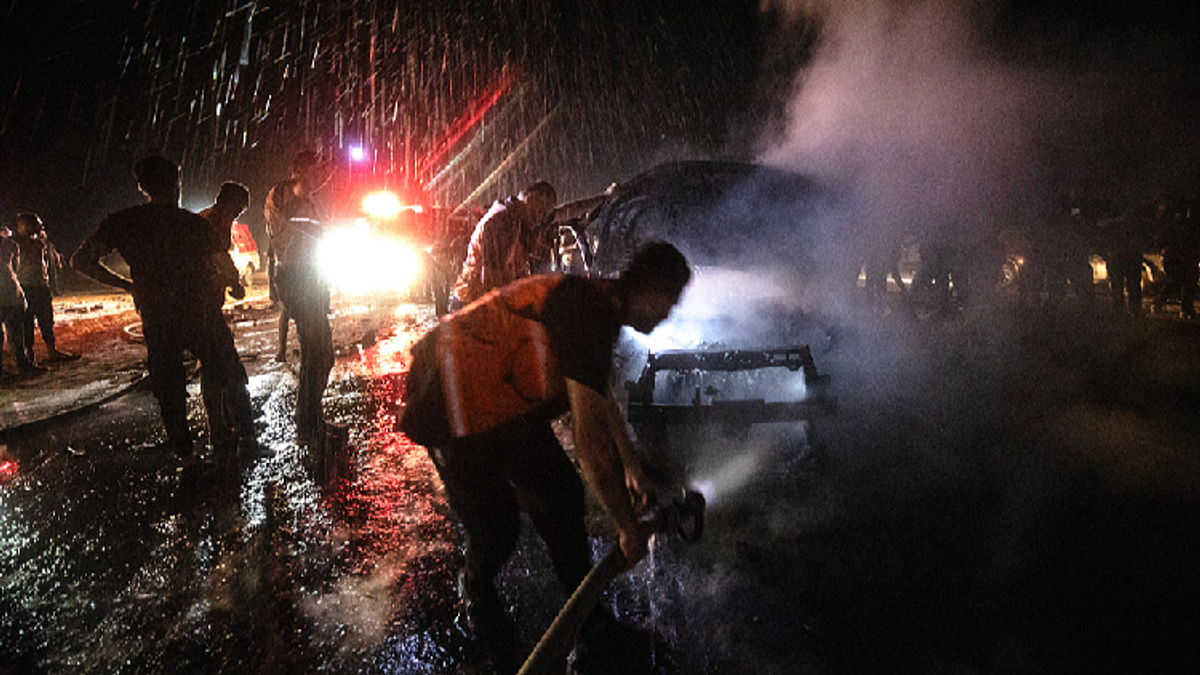
Israeli airstrikes recently targeted areas across the Gaza Strip, including residential apartments, displacement tents, and civilian vehicles, reportedly killing dozens, including children. These actions immediately drew strong condemnation from mediator countries Qatar, Egypt, and Türkiye, who stated the attacks undermined efforts to implement the second phase of a ceasefire agreement and violated international law. Simultaneously, a newly formed 'Board of Peace' announced discussions with Israeli Prime Minister Benjamin Netanyahu regarding a proposed deal for Hamas disarmament and a transition to civilian governance, a plan Hamas claimed to have agreed to after 'fierce' negotiations.
The ongoing strikes, despite a declared ceasefire roadmap, reveal a fundamental disconnect between diplomatic frameworks and the realities of power. For Israel, the continued military operations are framed as a security imperative, aimed at degrading Hamas's capabilities. However, these actions also serve internal political dynamics, where Prime Minister Netanyahu faces pressure to demonstrate strength and may find a prolonged conflict useful for his political survival. By delaying a full withdrawal and maintaining military pressure, Israel asserts its dominant position, pushing for a disarmament outcome that fundamentally alters the power balance in Gaza. Hamas, while publicly agreeing to a 'roadmap,' operates from a position of diminished but not eradicated power, using negotiations to secure its political future and maintain some leverage, even as its population bears the brunt of the conflict. The mediating countries, alongside the 'Board of Peace' (which includes US representation), are attempting to impose a post-conflict structure, driven by a desire for regional stability and the containment of armed groups, but their leverage remains limited when one party continues to act militarily in defiance of agreements.
The most immediate and devastating cost of this cycle falls on the ordinary citizens of Gaza. The UN reports dozens of fatalities, including children, adding to an already staggering toll. Healthcare facilities, critical for a population already on the brink, have been targeted. Families, many already displaced multiple times, continue to live in makeshift tents, now under renewed threat of aerial bombardment. The constant fear, the lack of basic necessities, and the destruction of what little infrastructure remains create an unbearable existence. For these individuals, a 'ceasefire agreement' or a 'roadmap for disarmament' are abstract concepts when their homes are destroyed and their loved ones are killed. Their lives are the currency in a geopolitical game where their voices are rarely heard, and their safety is often secondary to the strategic objectives of powerful actors.
What is often downplayed by all parties is the deep-seated mistrust that renders any 'agreement on paper' fragile. Israeli statements emphasize security needs, often omitting the disproportionate civilian casualties and the long-term impact of its actions on the viability of Palestinian life in Gaza. Conversely, Hamas's agreement to a 'roadmap' for disarmament, while presented as a concession, glosses over the complex realities of its armed wing and its political survival strategy. The 'Board of Peace' and its proposed 'International Stabilization Force' are presented as neutral solutions, but their composition and mandate will inevitably reflect the interests of the powerful states behind them, potentially imposing a governance structure that lacks genuine Palestinian legitimacy or popular support. The core issue of self-determination and the underlying causes of the conflict are often sidelined in favor of technical discussions about disarmament and transitional governance, which may only address symptoms, not the root disease.
Watch for the practical implementation, or lack thereof, of the 'Board of Peace' proposals. The devil will be in the details of the 'International Stabilization Force' and the 'Implementation Verification Committee' – specifically, who controls them and whose interests they truly serve. Observe whether Israel's military operations intensify or genuinely de-escalate, and how this correlates with internal Israeli politics. Crucially, monitor the humanitarian situation on the ground: any significant deterioration could trigger broader international pressure or localized resistance, further complicating diplomatic efforts. The true test of any agreement will not be its signing, but its ability to translate into tangible safety and stability for the people of Gaza.
Source referenced: CGTN
This brief was synthesized by our Editorial Engine and reviewed by The Ground Narrative team.