TRENDING

Wednesday, 14 October 2026
----------------------
3 Jumada Al-Awwal 1448 AH
Chinese Vice Premier He Lifeng recently met with US business representatives, urging greater stability in economic ties. This signals Beijing's strategic move to leverage business interests in calming turbulent US-China relations.
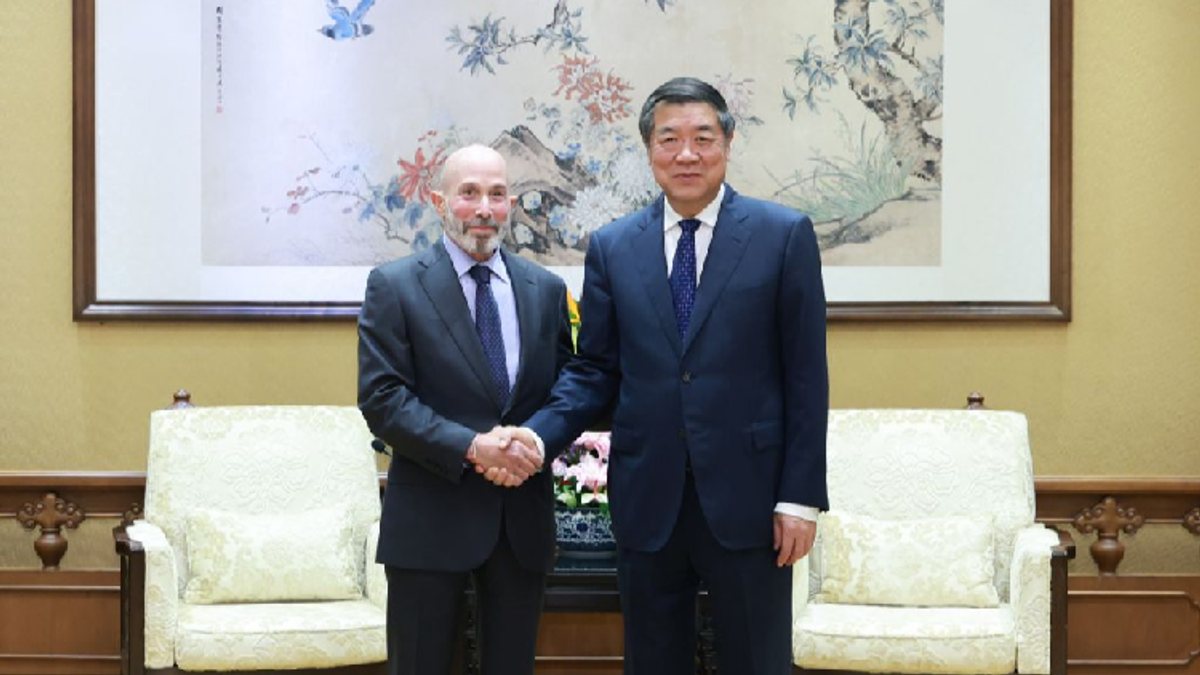
On October 12, 2026, Chinese Vice Premier He Lifeng, a member of the Political Bureau of the Communist Party of China Central Committee, held a meeting with Evan Greenberg, the executive vice chair of the National Committee on US-China Relations (NCUSCR), in Beijing. This high-level engagement followed a recent state visit by Chinese President Xi Jinping to the United States, where both heads of state reportedly agreed to pursue a "constructive China-US relationship of strategic stability based on respect, fairness and reciprocity." Vice Premier He emphasized the critical need for both nations to implement this consensus, aiming to inject "more certainty and stability into China-US economic and trade cooperation and the world economy." The US side, represented by Greenberg, affirmed the significance of stable US-China relations and expressed a commitment to continue acting as a bridge for enhanced economic exchanges.
The meeting between Vice Premier He Lifeng and Evan Greenberg is not merely a diplomatic courtesy; it is a calculated maneuver within the intricate power dynamics of US-China relations. Beijing's overt appeal for "stability" through a business conduit reveals several underlying strategic imperatives.
First, China's domestic economic landscape provides a powerful incentive for de-escalation. Facing persistent challenges in its real estate sector, fluctuating consumer confidence, and the long-term implications of a shrinking workforce, the country's leadership is acutely aware that sustained economic growth remains paramount for its internal legitimacy. Foreign direct investment, particularly from the United States, plays a crucial role in job creation, technological transfer, and market access. The ongoing "de-risking" rhetoric from Washington, which encourages companies to diversify supply chains away from China, directly threatens these economic pillars. By engaging influential US business leaders, Beijing seeks to cultivate a powerful lobby within the United States that can advocate for continued engagement and temper more hawkish policy elements. This "track two" diplomacy aims to bypass official government stalemates and tap into the pragmatic interests of corporations whose balance sheets are directly impacted by bilateral tensions.
Second, the concept of "strategic stability" itself is a carefully crafted diplomatic instrument. For China, stability often implies maintaining the existing economic order to facilitate its continued rise, particularly in critical technological sectors. It seeks an environment where it can continue to attract investment, access global markets, and advance its indigenous innovation without being unduly hampered by sanctions or export controls. This stability is not necessarily about abandoning long-term strategic competition but rather about managing it to prevent direct confrontation and allow China to consolidate its economic and technological gains. The call for "respect, fairness and reciprocity" from President Xi Jinping's earlier visit underscores Beijing's desire for a relationship where its growing power is acknowledged and accommodated.
From the perspective of US businesses like those represented by the NCUSCR, the motivation for engaging with Beijing is equally pragmatic. American corporations have invested trillions in China, built extensive supply chains, and depend on the vast Chinese consumer market. Tariffs, export controls, and the general unpredictability of bilateral relations translate directly into increased costs, reduced profits, and operational complexities. These businesses act as a powerful voice within the United States, often advocating for a more measured approach to China than some politicians might prefer. Their willingness to "play a bridging role" is driven by a desire to protect their investments and ensure a predictable operating environment, even if it means navigating complex political sensitivities. They are, in essence, trying to insulate their commercial interests from the broader geopolitical rivalry.
The US government's implied position in this scenario is one of delicate balance. While committed to national security concerns, particularly regarding technological competition, human rights, and regional stability in areas like Taiwan, it also recognizes the deep economic interdependence with China. Allowing channels for business-led engagement can serve as a pressure valve, managing the relationship without appearing to concede on core strategic issues. It provides a means to communicate and de-escalate without the political costs associated with direct, high-level government concessions. This strategy allows both sides to signal a desire for stability while continuing to pursue their respective long-term strategic objectives, creating a complex dance between cooperation and competition.
While high-level meetings between vice premiers and business executives might seem distant from daily life, the ebb and flow of US-China trade relations carry profound human costs that ripple through global economies and individual livelihoods. The pursuit of "stability" or the continuation of "strategic competition" directly impacts millions of people, often far removed from the negotiating tables.
For factory workers in both China and the United States, the uncertainty of trade relations translates into job insecurity. When tariffs are imposed, or supply chains are "de-risked," factories can scale back production, relocate, or close down entirely. In China, a significant portion of the workforce relies on export-oriented manufacturing, and any disruption to trade with the US can lead to mass layoffs, particularly in coastal industrial hubs. Similarly, in the United States, industries dependent on Chinese components or markets face volatility, affecting jobs in manufacturing, logistics, and retail. These workers, often without significant savings or alternative skills, bear the immediate brunt of geopolitical tensions, experiencing lost wages, health benefits, and a diminished sense of economic security.
Ordinary consumers on both sides of the Pacific also pay a price. Tariffs, while intended to protect domestic industries, often result in higher prices for imported goods, from electronics to clothing. This inflationary pressure reduces purchasing power, especially for low-income households, effectively acting as a hidden tax. Furthermore, restrictions on trade and technology transfer can limit product choices and slow down innovation, as companies become more cautious about investing in new technologies or collaborating across borders. The promise of cheaper, more diverse goods, a hallmark of globalization, is eroded by the pursuit of national self-sufficiency and strategic competition.
Small and medium-sized enterprises (SMEs) are particularly vulnerable to the unpredictability of US-China relations. Unlike multinational corporations with vast resources to adapt, SMEs often lack the capital or expertise to navigate sudden changes in trade policy, supply chain disruptions, or increased regulatory burdens. A small American business relying on a specific component from China might face crippling delays or cost increases if trade routes are disrupted or tariffs imposed. Conversely, a small Chinese exporter might lose its primary market overnight. These businesses, which are often the backbone of local economies, can fail, leading to job losses and reduced economic vibrancy in their communities.
Beyond the two primary actors, developing nations often find themselves caught in the geopolitical crosscurrents. Many rely on trade with both the US and China for their own economic development. As the two giants jockey for influence and attempt to reconfigure global supply chains, these smaller nations can be pressured to align with one side or the other, potentially losing access to vital markets or investment. The broader global economic slowdown caused by US-China friction also reduces overall demand, impacting commodity prices and investment flows to the developing world, exacerbating poverty and hindering progress on sustainable development goals.
While the public statements from Beijing and the NCUSCR emphasize "stability" and "cooperation," several critical dimensions of the US-China relationship remain downplayed or omitted from official narratives. These unspoken elements reveal the deeper structural forces at play and the inherent limitations of business-led diplomacy.
The term "strategic stability," while appearing benign, is laden with different interpretations for Washington and Beijing. For China, it likely means a stable environment that allows its continued economic and technological ascent without direct military confrontation or crippling economic sanctions. It implies a recognition of China's growing power and a move away from what Beijing perceives as containment. For the United States, "strategic stability" might mean managing competition to prevent it from spiraling into conflict, particularly over flashpoints like Taiwan or the South China Sea, while still pursuing policies aimed at maintaining its technological edge and global influence. Neither side fully articulates the boundaries of this stability, leaving ample room for future disagreements. The underlying reality is that both nations are still engaged in a profound, long-term competition for global leadership, which "stability" merely seeks to manage, not resolve.
Beneath the calls for economic cooperation lies an intense and arguably irreconcilable technological competition. The United States views China's advancements in areas like artificial intelligence, semiconductors, quantum computing, and biotechnology as direct challenges to its national security and economic dominance. Its export controls, investment restrictions, and efforts to "de-risk" supply chains are fundamentally aimed at slowing China's technological progress and preventing the transfer of critical dual-use technologies. Beijing, in turn, views these measures as an attempt to stifle its development and is pouring massive resources into achieving technological self-sufficiency. This tech race is not just about trade; it's about who controls the next generation of power and influence. Official statements about "economic cooperation" often gloss over this fundamental strategic rivalry, which continues to drive policy decisions regardless of business interests.
Both the Chinese Communist Party and the US administration operate under significant domestic political pressures. In China, the narrative of national rejuvenation and standing up to foreign pressure is crucial for the Party's legitimacy. While seeking stability, Beijing cannot appear weak or overly conciliatory to the United States, especially on issues perceived as core national interests. Similarly, in the United States, politicians often find it electorally advantageous to adopt a tough stance on China, appealing to voters concerned about job losses, national security, or human rights. These domestic political imperatives often dictate public rhetoric, which can contradict the more pragmatic, behind-the-scenes efforts to stabilize relations. The public is rarely privy to the full extent of this internal balancing act, instead receiving carefully curated messages that align with nationalistic or protectionist sentiments.
The call for "more certainty and stability" is a signal, not a solution. To understand the true trajectory of US-China relations, observers should look beyond the rhetoric and focus on concrete actions and underlying trends.
First, monitor the frequency and substance of follow-up engagements. Will the dialogue between US business leaders and Chinese officials continue, and will it translate into tangible policy adjustments, such as reduced tariffs, eased market access restrictions, or more predictable regulatory environments? A one-off meeting is symbolic; sustained engagement with measurable outcomes is what truly indicates a shift towards stability.
Second, pay close attention to investment patterns and supply chain decisions. Despite calls for stability, are US companies continuing to "de-risk" by diversifying their manufacturing away from China? Look for data on foreign direct investment flows, factory relocations to countries like Vietnam, India, or Mexico, and corporate earnings calls for commentary on their long-term strategies regarding China. The actions of businesses, driven by economic realities, often speak louder than diplomatic pronouncements.
Third, observe the evolution of technological competition. Will the United States continue to tighten export controls on advanced semiconductors and AI-related technologies, and will China accelerate its efforts towards technological self-sufficiency? The intensity of this tech race will be a key indicator of the underlying strategic rivalry, regardless of any temporary economic de-escalation. Any major breakthroughs or setbacks in either nation's indigenous tech capabilities will have profound implications.
Finally, watch for how both governments manage domestic narratives and regional flashpoints. Will the public rhetoric remain conciliatory, or will it revert to more confrontational tones, especially during election cycles or in response to events in Taiwan, the South China Sea, or other areas of contention? The stability sought by business leaders is fragile and can quickly unravel if geopolitical tensions flare up, demonstrating the limits of economic interdependence when confronted with national security imperatives. The interplay between economic pragmatism and strategic rivalry will define the coming years.
China's push for trade stability is driven by domestic economic challenges, including a need for foreign investment and market access, and a desire to counter US de-risking efforts. Engaging US business leaders is a strategic move to cultivate a lobby for continued engagement.
US business leaders, like those from the NCUSCR, act as a bridge, advocating for stability and predictability due to their significant investments and supply chains in China. They aim to protect commercial interests from geopolitical tensions and influence policy towards engagement over confrontation.
The human cost falls on workers in both countries facing job insecurity, consumers dealing with higher prices and limited choices, and small businesses struggling with supply chain disruptions. Developing nations are also impacted, caught between the two economic giants.
Source referenced: CGTN
This brief was synthesized by our Editorial Engine and reviewed by The Ground Narrative team.


