TRENDING

Wednesday, 14 October 2026
----------------------
3 Jumada Al-Awwal 1448 AH
Beijing recently convened a major international forum on counter-terrorism, bringing together delegates from dozens of countries. This gathering signals China's growing ambition to shape global security narratives and frameworks.
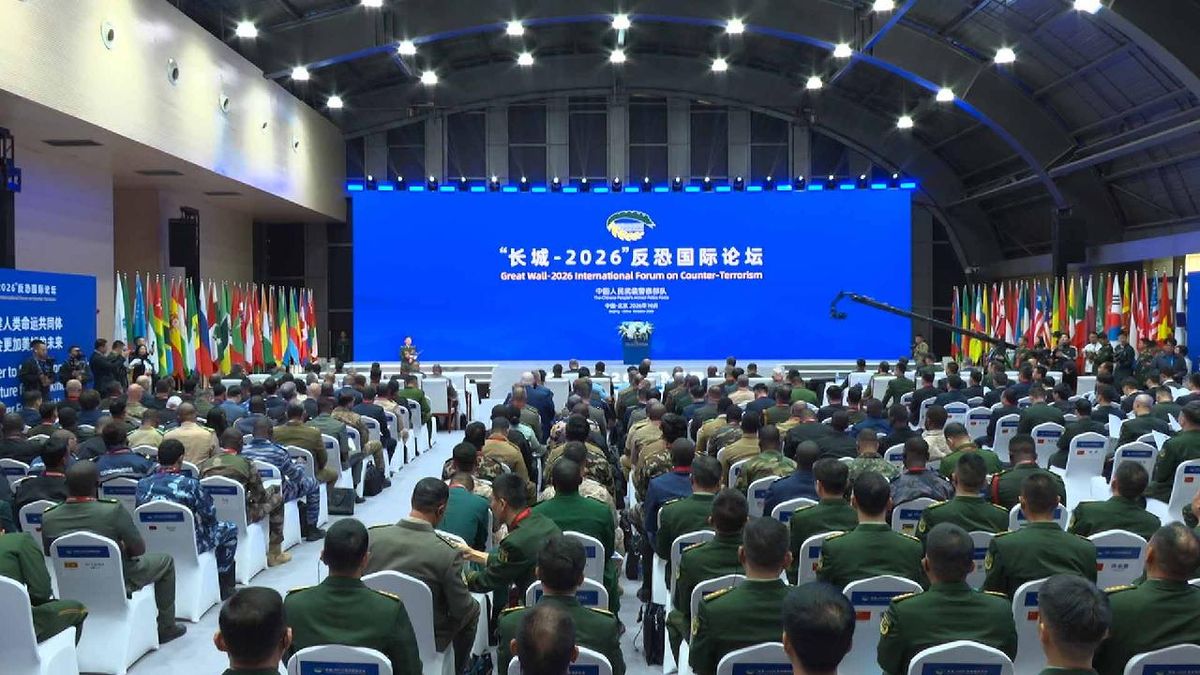
China recently hosted the Great Wall-2026 International Forum on Counter-Terrorism in Beijing, a three-day event bringing together over 320 delegates from 62 countries and various international organizations. Hosted by the Chinese People's Armed Police Force (PAP), the forum operated under the theme, "Advancing Counter-Terrorism Cooperation and Jointly Safeguarding Our Beautiful Home." Lieutenant General Zhao Dongfang, chief of staff of the PAP, delivered the keynote address, advocating for stronger international cooperation and proposing four key measures: upholding multilateralism, promoting exchanges, leveraging digital technologies, and tackling the root causes of terrorism through comprehensive measures. The discussions covered topics ranging from emerging threats like unmanned systems and artificial intelligence to preventing maritime terrorism and securing border areas.
China's hosting of the Great Wall-2026 forum is a calculated move to solidify its position as a central player in global security governance, shifting away from Western-dominated narratives. This event is far more than a mere exchange of ideas; it is a strategic exercise in norm-setting and influence projection, designed to reshape the international understanding and response to what constitutes 'terrorism.'
First, China is actively working to define the global security agenda. By hosting such a large-scale, multilateral forum, Beijing positions itself as a leader capable of convening diverse nations to discuss critical security challenges. This allows China to subtly, or not so subtly, imbue the discussion with its own domestic security priorities and definitions. The concept of "root causes" and "comprehensive measures", for instance, are terms China frequently uses to describe its policies in regions like Xinjiang, where it claims to be combating extremism. The forum provides an international platform to legitimize these broad approaches, potentially encouraging other nations to adopt similar frameworks.
Second, the forum serves as a significant soft power play. Attracting delegates from 62 countries, many of whom are from the Global South, demonstrates China's growing appeal as a security partner. These nations may be seeking alternatives to traditional Western security assistance, which often comes with human rights conditionalities or geopolitical alignments they wish to avoid. China offers an alternative model, often without such overt conditions, fostering goodwill and deepening bilateral ties that can extend beyond security into economic and political spheres.
Third, the emphasis on "digital and intelligent technologies" and "unmanned systems" highlights China's ambition to become a leading exporter of security technology. The demonstrations of counter-terrorism training and unmanned equipment are not just for observation; they are showcases for potential clients. This positions China not only as a provider of security concepts but also as a supplier of the hardware and software necessary to implement them. This creates a powerful economic incentive for participating nations to align with China's security vision, as they gain access to advanced, often cheaper, technology.
Finally, the forum is a clear attempt to counter-balance the influence of Western powers, particularly the United States, in global security discourse. By presenting its own vision of "a community with a shared future for humanity" in the context of counter-terrorism, China aims to build a parallel security architecture that reflects its own geopolitical interests and values. This allows Beijing to build consensus on issues important to its own stability, such as countering "terrorist infiltration in border areas," which can be interpreted broadly to include any cross-border movements or influences it deems destabilizing.
While the stated goal of the Great Wall-2026 forum is to enhance global security, the underlying power dynamics carry significant potential human costs, particularly for vulnerable populations and those living under increasingly securitized states.
One of the most profound human costs stems from the lack of a universally accepted definition of 'terrorism.' China's approach often conflates dissent, separatism, and religious extremism under the umbrella of 'terrorism.' If this expansive definition gains traction among the 62 participating nations, it could provide a convenient pretext for governments to crack down on legitimate political opposition, ethnic minorities, or religious groups under the guise of counter-terrorism. This could lead to arbitrary arrests, prolonged detentions, and the silencing of critical voices, effectively criminalizing fundamental freedoms.
The forum's focus on "digital and intelligent technologies" for counter-terrorism raises alarms. China has developed sophisticated surveillance systems, including facial recognition, AI-powered predictive policing, and mass data collection, which it has deployed extensively within its own borders, notably in Xinjiang. The export of these technologies, often bundled with training and ideological frameworks, could enable other authoritarian regimes to build similar pervasive surveillance states. This would lead to a dramatic erosion of privacy, freedom of movement, and the ability to organize or express dissent, turning citizens into subjects constantly monitored by the state.
The emphasis on "countering terrorist infiltration in border areas" implies increased securitization of national frontiers. While border security is a legitimate concern, such measures, when implemented without robust oversight, often disproportionately affect border communities. These populations, who frequently have cross-border ethnic, cultural, or economic ties, may face heightened scrutiny, restrictions on movement, and even forced displacement. Furthermore, stricter border controls, justified by counter-terrorism, can make it significantly harder for genuine refugees and asylum seekers fleeing conflict or persecution to find safe haven, trapping them in precarious situations.
The most concerning human cost is the potential for other nations to emulate aspects of China's policies in Xinjiang. In the name of tackling "root causes" and implementing "comprehensive measures," China has established a vast network of internment camps, euphemistically called "vocational training centers," where hundreds of thousands of Uyghurs and other ethnic minorities have been subjected to forced political indoctrination and cultural assimilation. If the forum's rhetoric legitimizes such 'comprehensive' approaches, it could embolden other states to implement similar policies against their own minority populations, leading to widespread human rights abuses on a global scale.
The official statements from the Great Wall-2026 forum, while emphasizing international cooperation and shared security, carefully omit or downplay several critical dimensions that reveal the deeper geopolitical and ideological stakes.
Perhaps the most glaring omission is any critical discussion of China's own policies in Xinjiang. The forum's theme of "tackling the root causes of terrorism through comprehensive measures" is precisely the language Beijing uses to justify its actions in the region, which have been widely condemned by international human rights organizations and several Western governments as crimes against humanity. By presenting these "comprehensive measures" as a model for global counter-terrorism, the forum implicitly seeks to normalize and legitimize the Xinjiang model on the international stage, without ever acknowledging the immense human cost or the accusations of systemic abuses. The forum's focus on "preventing and combating maritime terrorism" and "countering terrorist infiltration in border areas" also echoes China's concerns about its own periphery, without inviting scrutiny of the methods it employs there.
Governments and official statements consistently avoid the contentious issue of defining 'terrorism.' This ambiguity is not accidental. For China, a broad and flexible definition allows it to categorize a wide range of activities – from peaceful dissent and ethnic separatism to religious practices – as 'terrorism' or 'extremism.' By promoting a "community with a shared future for humanity" through a counter-terrorism lens, Beijing subtly pushes its own interpretation of security, where state stability and control often supersede individual rights. The forum, therefore, serves as a platform to build a consensus around a state-centric view of security, where the state is the ultimate arbiter of what constitutes a threat, rather than a rights-based approach that protects individuals from state overreach.
What is downplayed is the forum's role in China's broader geopolitical strategy. This event is not merely about combating terrorism; it is about building a new global security architecture that challenges the existing Western-dominated order. By fostering security cooperation with a diverse group of nations, China aims to create a bloc of like-minded states that can support its positions in international bodies, dilute Western influence, and advance its vision of a multipolar world. The forum is a clear signal that China intends to be a rule-maker, not just a rule-taker, in global security, offering an alternative to US-led alliances and security frameworks.
The forum's discussions on technology and cooperation also gloss over the significant economic dimensions. China's security partnerships often come hand-in-hand with economic incentives, infrastructure projects under the Belt and Road Initiative (BRI), and access to markets or resources. The showcasing of advanced surveillance and drone technology is not just for information sharing; it's a marketing opportunity. The "deepening friendship and trust" mentioned by China's Ministry of National Defense spokesperson, Chen Xi, often translates into lucrative contracts for Chinese state-owned enterprises in the defense and security sectors, creating a powerful feedback loop where security cooperation reinforces economic ties and political influence.
Moving forward, several key indicators will reveal the true impact and trajectory of China's expanding role in global counter-terrorism efforts.
First, observe the adoption patterns of Chinese security technologies and methodologies. Which countries, particularly in Central Asia, Africa, and Southeast Asia, begin to acquire Chinese surveillance systems, AI-powered policing tools, or drone technology for their domestic security forces? The implementation of these tools, and the legal frameworks that accompany them, will indicate the extent to which China's approach is being internalized globally.
Second, pay close attention to the language used by participating nations in their domestic counter-terrorism policies and international statements. Any shift towards China's broad definition of 'terrorism' or its emphasis on "comprehensive measures" and "root causes" that mirror Beijing's rhetoric will signal a growing alignment. This could manifest in new laws targeting dissent or specific ethnic/religious groups under the guise of preventing extremism.
Third, monitor China's influence within international bodies, particularly the United Nations Security Council. As China strengthens its network of security partners, it may leverage this growing consensus to shape UN resolutions on counter-terrorism, potentially weakening human rights protections or promoting its own state-centric security agenda on a broader scale.
Finally, watch for increased bilateral and multilateral security exercises and intelligence-sharing agreements between China and forum participants. These practical collaborations, especially those focusing on border security and maritime threats, will demonstrate the concrete operationalization of the forum's cooperative spirit and reveal the geographical areas where China's security influence is most actively expanding.
Source referenced: CGTN
This brief was synthesized by our Editorial Engine and reviewed by The Ground Narrative team.