TRENDING

Monday, 5 October 2026
----------------------
24 Rabi' Al-Thani 1448 AH
Myanmar's junta leader is pushing for full reintegration into ASEAN, leveraging bilateral ties despite ongoing internal conflict and a rejected peace plan. This diplomatic offensive highlights deep divisions within the regional bloc, prioritizing stability and economic interests over human rights and democratic principles.
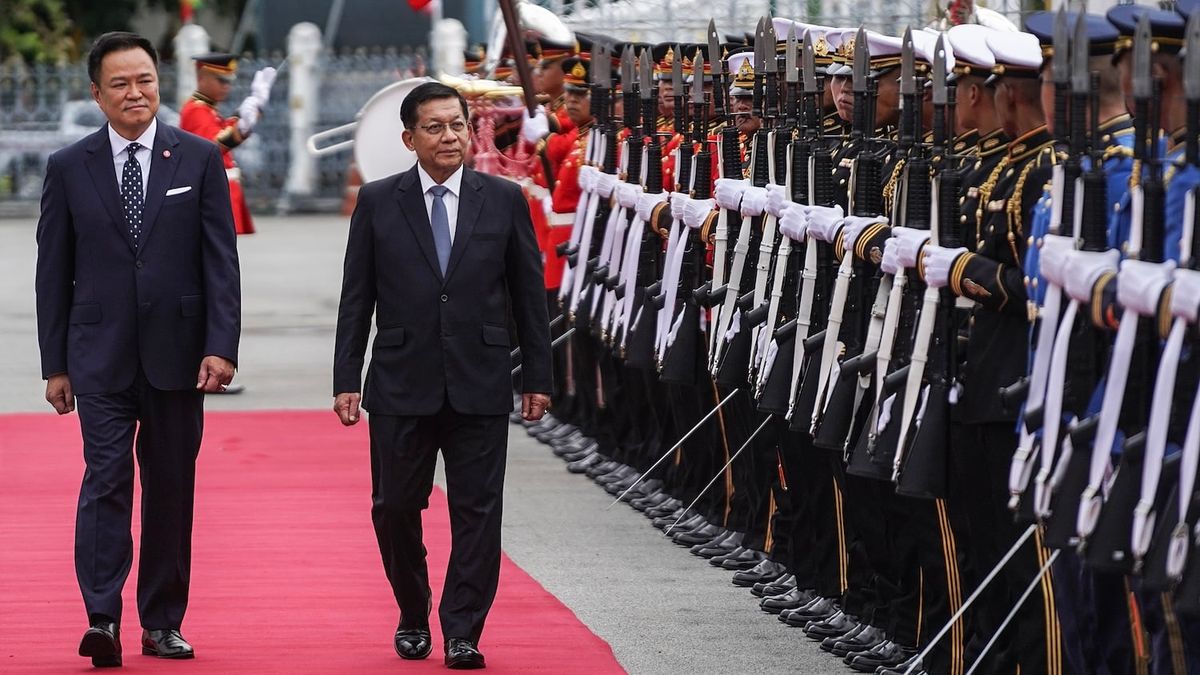
Myanmar's junta leader, Min Aung Hlaing, recently visited Bangkok as part of a broader diplomatic push following what the regime termed 'sham elections' and his inauguration as president. This visit, preceded by trips to India, China, and Laos, signals an intensified effort by the Myanmar military government to normalize relations with the Association of Southeast Asian Nations (ASEAN), which has largely excluded its leaders since the 2021 coup. Thailand, sharing a significant border, has been a key backer of this normalization, hosting informal meetings and pledging support for Myanmar's 'full and equal participation' in ASEAN. Concurrently, Myanmar's parliament formally rejected the ASEAN-brokered Five-Point Consensus, a framework for peace agreed upon post-coup, with Min Aung Hlaing labeling it 'discriminatory'.
The Myanmar junta's diplomatic offensive is a strategic maneuver to break its international isolation and secure legitimacy, both political and economic. By engaging bilaterally with key neighbors like Thailand, India, China, and Laos, the junta aims to bypass ASEAN's collective stance and chip away at the consensus that has kept it at arm's length. For Thailand, the calculus is pragmatic: a 1,500-mile shared border necessitates engagement to manage pressing issues like transnational crime, drug smuggling, environmental pollution from rare-earth mining, and the flow of Myanmar's 4 million migrant workers. Bangkok's 'realistic' approach prioritizes border stability and economic ties over ideological condemnation, creating a pathway for the junta's reintegration.
Within ASEAN, this push exposes a fundamental tension. Some members, like Thailand, lean towards a non-interference principle and pragmatic engagement, viewing the Five-Point Consensus as an impediment to stability. Others, such as the Philippines, Singapore, and East Timor, advocate for upholding the consensus and human rights, demanding the release of political prisoners like Aung San Suu Kyi. The junta's newfound confidence, bolstered by its 'sham elections' and bilateral successes, allows it to openly reject the consensus, challenging ASEAN's authority and revealing the limits of the bloc's collective leverage when faced with a determined member state and internal divisions.
The primary human cost of this diplomatic maneuvering is borne by the people of Myanmar. While the junta seeks international recognition, the country remains embroiled in a brutal civil war, with widespread displacement, violence, and a severe humanitarian crisis. The rejection of the Five-Point Consensus means that the agreed path towards ending violence and facilitating constructive dialogue remains blocked, prolonging the suffering of millions. The imprisonment of opposition leader Aung San Suu Kyi and countless other political prisoners underscores the regime's continued suppression of dissent.
Across the border, Thai citizens in border regions also pay a price. Transnational crime, including drug smuggling and sophisticated scam centers, continues to impact their safety and economic well-being. Environmental degradation, particularly water pollution linked to mining in Myanmar, directly affects Thai communities relying on shared rivers. The 4 million Myanmar citizens working in Thailand, many in precarious conditions, remain vulnerable to exploitation, their fate often tied to the fluctuating political relationship between the two nations.
What governments and official statements often downplay or omit is the foundational illegitimacy of the Myanmar junta's 'newfound confidence.' The 'sham elections' of 2025-2026, which the junta cites as a basis for its 'presidency' and diplomatic push, were widely condemned internationally as neither free nor fair. This manufactured legitimacy is the engine behind its current assertiveness, yet it is rarely challenged directly in the context of these 'normalization' discussions. Furthermore, while official statements tout cooperation on transnational crime, the reality is that many damaging activities occur in areas controlled by Myanmar's myriad armed groups, not the military government. The limited success of the Thai military's 'quiet outreach' to these groups highlights the fragmented control within Myanmar and the inherent limitations of state-to-state agreements when the state does not control its own territory.
Readers should closely watch Singapore's upcoming chairmanship of ASEAN. Its historical emphasis on rule of law and its prior opposition to the junta's actions will test its resolve to uphold the Five-Point Consensus against the backdrop of Myanmar's diplomatic momentum. The stance of East Timor, with its strong human rights focus, will also be critical. Any further weakening of ASEAN's consensus on Myanmar could embolden the junta, potentially leading to increased repression internally and a prolonged civil conflict. Conversely, a unified ASEAN front, however difficult to achieve, remains the most significant regional pressure point on the regime. The fate of Aung San Suu Kyi and other political prisoners will serve as a bellwether for any genuine shift in the junta's willingness to engage constructively, rather than merely seeking a seat at the table on its own terms.
Source referenced: FOREIGNPOLICY
This brief was synthesized by our Editorial Engine and reviewed by The Ground Narrative team.


