TRENDING

Saturday, 24 October 2026
----------------------
13 Jumada Al-Awwal 1448 AH
At the 25th COMESA summit, heads of state pressed for tighter intra‑African trade and industrial policy. The push promises new jobs but also reveals who will bear the cost of unfinished reforms.
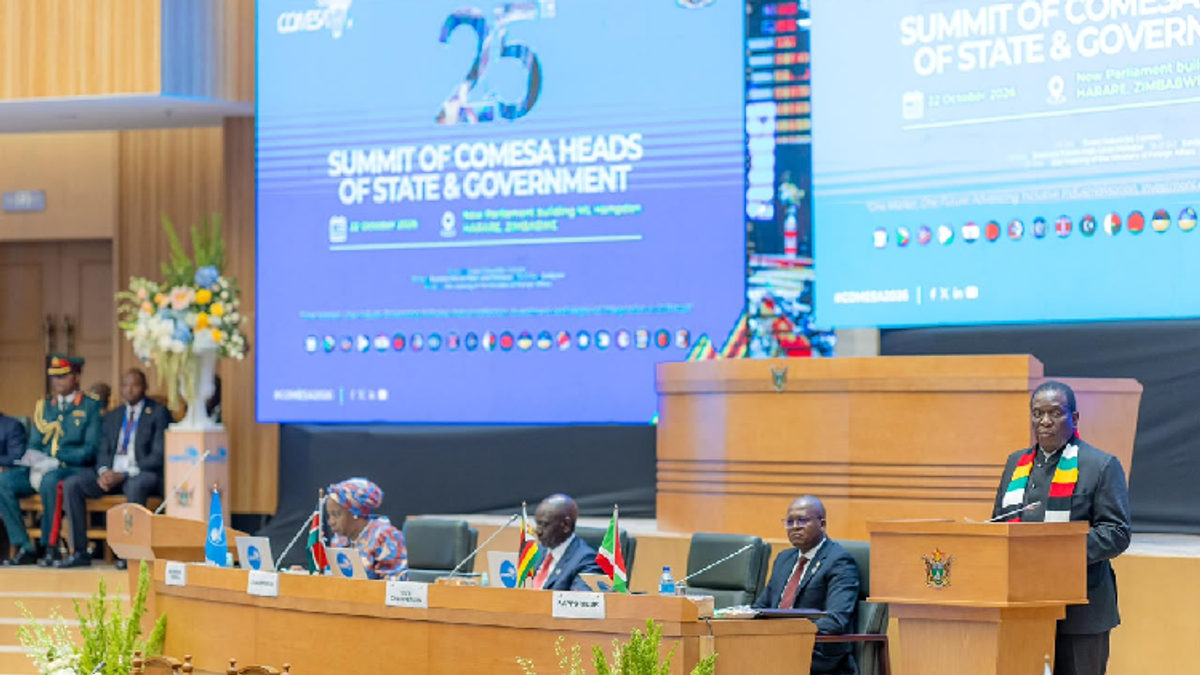
Leaders of the Common Market for Eastern and Southern Africa (COMESA) gathered in Mount Hampden, outside Harare, for the bloc’s 25th Heads of State and Government Summit. Zimbabwe’s President Emmerson Mnangagwa, newly installed as chair, called on the 21 member states to cut non‑tariff barriers, modernise border procedures and invest in local processing of natural resources. Outgoing chair Kenya’s President William Ruto warned that global supply‑chain shocks and protectionist trends make regional integration a matter of economic survival.
The summit took place as major powers vie for influence across Africa. China continues to fund railways and ports under its Belt‑and‑Road Initiative, while the United States pushes for “AfCFTA‑compatible” standards to counter Beijing’s reach. Both powers benefit from a fragmented market that leaves African states dependent on external financing. By urging a unified market, COMESA aims to rebalance that dependence, giving member states a louder voice in negotiations with donors and multinational corporations.
Intra‑African trade currently accounts for roughly 16% of the continent’s total trade, far below the 30% target set by the African Continental Free Trade Area (AfCFTA). COMESA’s push targets this gap by encouraging value‑addition: instead of exporting raw copper or tobacco, countries would develop processing plants, creating higher‑value jobs. The promise of “industrialisation” is a direct response to the “resource curse” that has kept many economies locked into low‑skill, low‑pay sectors.
COMESA’s ability to enforce policy rests on consensus among diverse economies—from oil‑rich Angola to land‑locked Uganda. Differing customs regimes, currency volatility and weak regulatory bodies make harmonisation difficult. Moreover, the bloc’s budget relies heavily on member contributions, limiting its capacity to fund large‑scale infrastructure without external loans, which often come with strings attached.
For millions of smallholder farmers in Tanzania and Malawi, the call to process resources locally could mean new processing facilities within reach of their fields. However, without affordable credit and reliable electricity, many will remain stuck selling raw produce at volatile world prices. Past attempts at agro‑industrial parks have faltered when subsidies vanished, leaving farmers with idle factories and mounting debts.
Cities such as Nairobi and Dar es Salaam stand to gain from expanded logistics networks and digital trade platforms. Yet the construction of new highways and rail links often displaces informal traders who rely on roadside stalls for income. Relocation packages are rarely sufficient, and the promised jobs in customs or warehousing may require skills that informal workers lack, pushing them into precarious informal employment.
Africa’s median age is 19, and young entrepreneurs are eager to tap into cross‑border e‑commerce. Digital trade systems championed at the summit could lower entry barriers, but only if broadband penetration improves. In many COMESA states, internet access remains under 30%, meaning a generation of tech‑savvy youths may be excluded from the very markets the summit seeks to open.
Official statements celebrate “investment‑friendly” reforms, yet many multinational firms remain wary of policy volatility. Companies like De Beers and Glencore have long lobbied for stable export corridors, but they also resist local processing that could cut their margins. Their quiet influence often shapes the pace of industrial policy, a factor rarely mentioned in summit communiqués.
While the summit highlighted African agency, it downplayed the extent of foreign financing. Chinese state‑owned banks are already underwriting several cross‑border rail projects, and European development funds are earmarked for digital customs upgrades. These loans carry repayment schedules that can strain national budgets, potentially diverting resources from social services.
COMESA’s reports cite “significant progress” on reducing non‑tariff barriers, yet independent audits reveal persistent corruption at border posts and opaque licensing processes. The lack of transparent data makes it hard for civil society to hold governments accountable, allowing officials to claim success while reforms stall on the ground.
Watch for the adoption of a COMESA‑wide digital customs platform, slated for pilot testing in Kenya and Zambia later this year. Its success—or failure—will signal whether member states can translate summit rhetoric into functional tools that actually speed trade.
Monitor the pipeline of infrastructure financing, especially loans from China’s Export‑Import Bank and the African Development Bank. Shifts toward concessional terms could indicate a strategic pivot, while a surge in commercial debt may expose member states to fiscal risk.
The summit linked trade integration with peace and good governance. Any resurgence of conflict in the Great Lakes region or renewed coups in Sudan could derail supply chains, underscoring how fragile the integration agenda remains without robust security mechanisms.
By tracing these threads, readers can see who stands to gain from a more integrated market, whose voices are muted, and what concrete steps will determine whether COMESA’s vision translates into tangible benefits for ordinary Africans.
COMESA is a regional economic bloc of 21 Eastern and Southern African countries that aims to promote trade, investment and infrastructure cooperation. Strengthening COMESA can help reduce trade barriers, create value‑adding industries and give African states a stronger collective bargaining position in global markets.
A digital customs platform could speed clearance times and lower costs, benefiting traders who move goods across borders. However, without affordable internet access and training, many small businesses may struggle to adopt the new system, limiting its inclusive impact.
Source referenced: CGTN
This brief was synthesized by our Editorial Engine and reviewed by The Ground Narrative team.