TRENDING

Thursday, 17 September 2026
----------------------
6 Rabi' Al-Thani 1448 AH
A small English village's symbolic vote to "secede" highlights the growing local resistance to the UK government's plan to house asylum seekers in remote military bases. This standoff reveals the deep friction between national migration policies and the communities tasked with bearing their immediate social and economic costs.
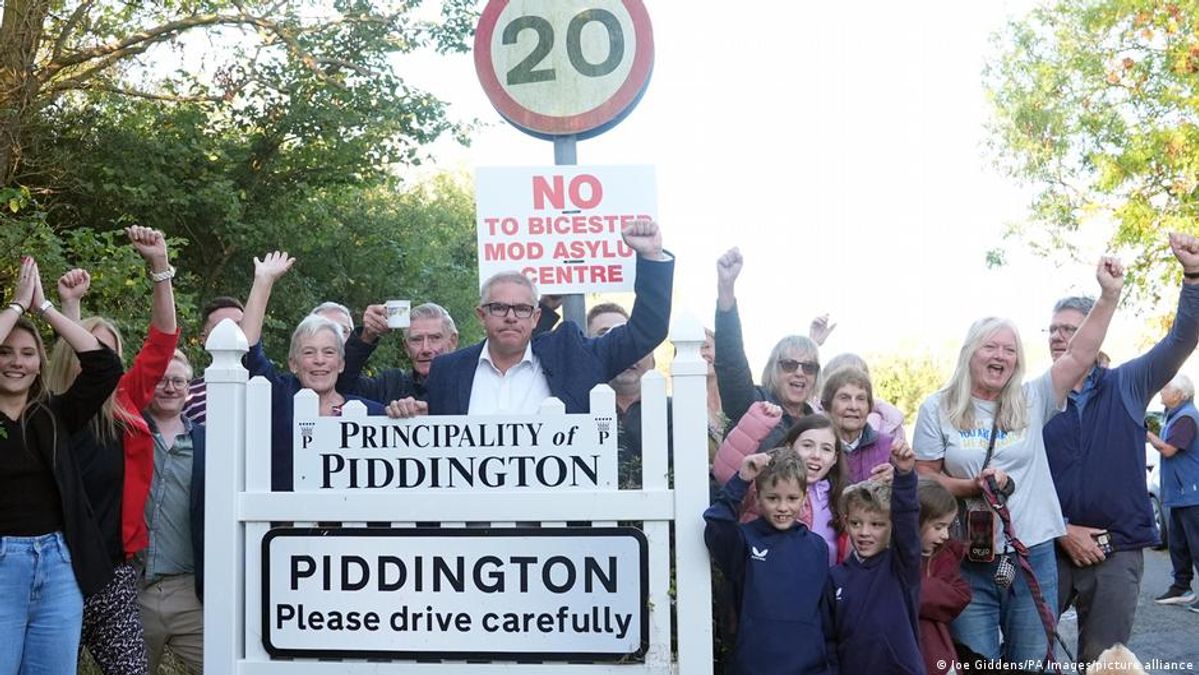
Residents of Piddington, a small village near Oxford, recently held a symbolic vote to "secede" from the United Kingdom. With a turnout of nearly 92%, 285 out of 312 voters supported the motion, declaring themselves the "Principality of Piddington." This extraordinary protest was a direct response to government plans to convert a disused military base, MoD Bicester (Site A), located nearby, into a reception center for up to 1,250 male asylum seekers, a population nearly four times the village's own.
The UK government, led by Prime Minister Andy Burnham, faces immense pressure to overhaul its asylum system. Successive administrations have grappled with the political and financial burden of housing asylum seekers in hotels, a practice that has become a lightning rod for public discontent and a significant drain on the treasury. The strategy to move asylum seekers into disused military facilities by 2029 is a direct response to this, aiming to project an image of control and fiscal responsibility. However, this national policy collides directly with local realities. For Piddington, the plan represents a sudden and disproportionate imposition, threatening to overwhelm its limited infrastructure and alter its social fabric. The village's "secession" is a desperate, symbolic act of resistance, leveraging media attention to force a dialogue that the government has largely avoided with local communities. This tension is further exacerbated by the rise of populist right-wing parties like Reform UK and Restore Britain, who capitalize on anti-migration sentiment, pushing the mainstream parties towards tougher, often less community-integrated, solutions.
The human cost of this policy is borne on multiple fronts. For the residents of Piddington, the prospect of a large, isolated facility housing a population significantly larger than their own raises immediate concerns about safety, resource strain, and the erosion of their community's character. Their protest, while symbolic, reflects a genuine fear of disruption and a feeling of powerlessness against a distant central authority. More profoundly, the asylum seekers themselves bear a heavy, often invisible, cost. Placed in remote military bases, far from urban centers and support networks, their integration into society becomes even more challenging. With limited mobility and resources, these individuals, many of whom have fled trauma, are effectively warehoused, isolated from the very society they hope to join. This approach risks creating a "lightning rod" for far-right protests, as an Oxfordshire County Council official noted, further endangering both the asylum seekers and the local community.
Official government statements often emphasize the "self-sufficiency" of these proposed centers, claiming they will minimize impact on local communities. This framing, however, downplays the fundamental challenge of integration and the long-term societal implications of such a strategy. While "self-sufficiency" might mean on-site laundry and communal spaces, it often translates to isolation, limiting asylum seekers' access to legal aid, healthcare, education, and genuine social interaction essential for rebuilding their lives. The government's focus on exiting hotels, while financially driven, often overlooks the *quality* of accommodation and the *human dignity* afforded to those seeking refuge. By placing these facilities in remote areas, the government effectively externalizes the social costs of its migration policy onto small, often unprepared, communities while simultaneously making the lives of asylum seekers more difficult and less conducive to successful integration. The narrative of "fairness" in distributing centers across the country masks the disproportionate burden placed on specific, often vulnerable, localities.
The Piddington protest is unlikely to be an isolated incident. Watch for similar local resistances as the government proceeds with its plan to convert more disused military sites. The effectiveness of these centers, both in terms of cost-saving and their impact on asylum seekers' well-being, will be under scrutiny. Pay close attention to any reports on conditions within these facilities, the mental health outcomes for residents, and the actual level of community engagement and integration. Furthermore, the political landscape will be critical: how will populist parties continue to leverage these local tensions, and how will the mainstream parties adapt their rhetoric and policy in response? The symbolic "secession" of Piddington is a stark reminder that national policies, however well-intentioned or politically expedient, ultimately play out in the lives of ordinary people and communities, often with unforeseen and significant costs.
Source referenced: DW
This brief was synthesized by our Editorial Engine and reviewed by The Ground Narrative team.