TRENDING

Sunday, 18 October 2026
----------------------
7 Jumada Al-Awwal 1448 AH
Andy Burnham has become the UK's seventh Prime Minister in a decade, following Keir Starmer's resignation, sparking widespread voter fatigue and skepticism. His agenda focuses on regional devolution and addressing the cost-of-living crisis, but he faces significant challenges in uniting a disillusioned electorate and restoring political stability.
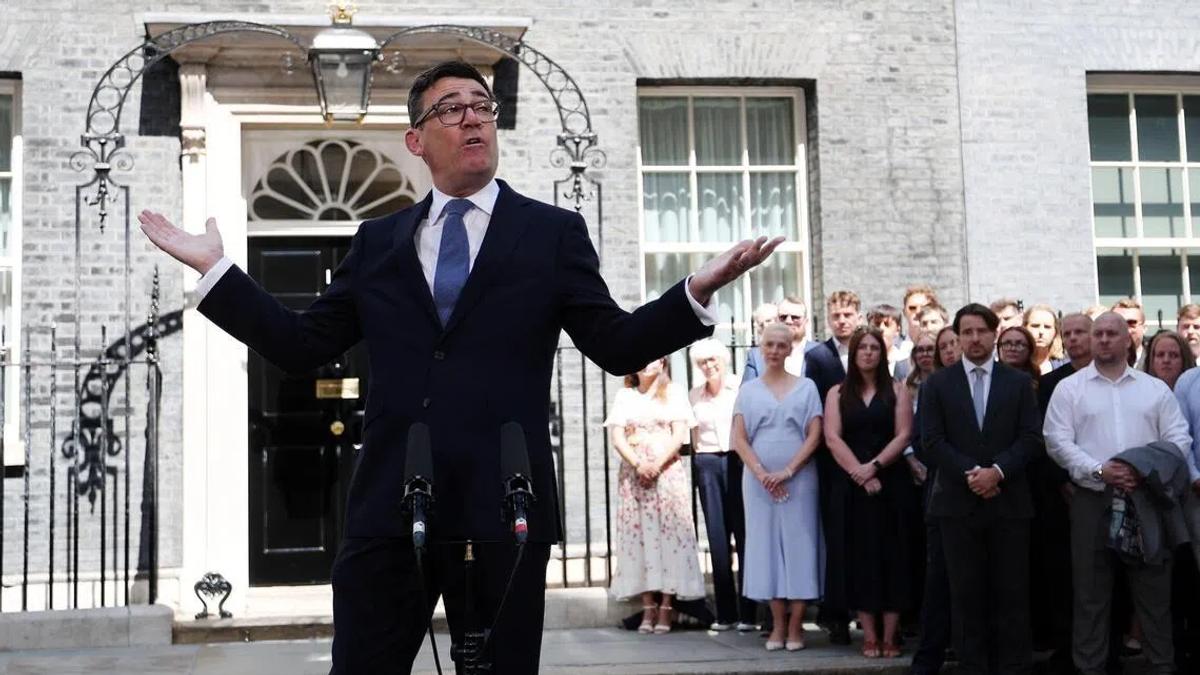
On July 20, 2026, the United Kingdom witnessed another significant shift in its political landscape as Andy Burnham was appointed its seventh Prime Minister in just ten years. This rapid succession of leadership, culminating in Burnham's ascent after Keir Starmer's unexpected resignation, has left the British electorate grappling with profound fatigue and skepticism regarding the nation's political stability. The appointment, made by King Charles, followed Starmer's departure despite having led the Labour Party to a landslide victory in the 2024 general election, underscoring a deeper malaise within British governance.
Burnham, previously the Mayor of Greater Manchester and often dubbed the 'King of the North,' was 'parachuted' into the top office by the Labour Party. This method of transition, bypassing a general election, has immediately raised questions about his mandate among some voters, who argue that he has not been directly elected by the public for the premiership. This sentiment reflects a broader concern about democratic accountability and the perceived detachment of political processes from the will of the people.
Prime Minister Burnham's immediate agenda is sharply focused on two critical domestic fronts: regional devolution and tackling the persistent cost-of-living crisis. His commitment to devolving power outside London is a strategic move aimed at addressing long-standing regional inequalities and fostering economic growth and political agency in areas historically perceived as neglected by Westminster. This policy could have significant long-term implications for the UK's internal governance structure, potentially reshaping regional identities and economic distribution. It also represents a notable shift towards a more decentralized model, which could empower local authorities and communities but also introduce new complexities in national coordination.
Simultaneously, Burnham has pledged to alleviate the cost-of-living crisis through measures such as building more social housing, reducing homelessness, and easing financial pressures on small businesses. These are direct responses to widespread public hardship and economic uncertainty that have plagued the UK for several years. The success of these policies will be crucial in restoring public confidence and demonstrating the new government's ability to deliver tangible improvements to daily life. However, the scale of these challenges, coupled with a fatigued and skeptical public, presents a formidable task for the new administration.
The public's reaction to Burnham's appointment is a complex mix of cautious optimism and deep-seated frustration. While some, particularly in his political heartland of Manchester, express hope for a 'northerner to have some actual real political say,' many Londoners and others voice exasperation. Comments like 'Not another one' and 'I’m fed up that we’ve got another PM' highlight a pervasive sense of political instability and a lack of faith in the ability of successive leaders to enact meaningful change. The perception that 'nothing’s going to be easier or cheaper' reflects a deep-seated cynicism about the efficacy of political leadership.
From a geopolitical perspective, the frequent changes in leadership within a major G7 nation like the UK carry significant implications. Such political instability can project an image of unpredictability on the international stage, potentially impacting the UK's diplomatic influence, its reliability as an ally, and its ability to pursue consistent long-term foreign policy objectives. While the article suggests Burnham is likely to steer a steady ship on foreign policy, the domestic churn inevitably draws focus inward, potentially diverting attention and resources from global engagements. Furthermore, sustained domestic political and economic uncertainty can deter foreign investment and impact the UK's standing in global financial markets, exacerbating existing economic pressures.
The rise in popularity of the anti-immigration, hard-right Reform UK party, mentioned by a voter, underscores a fragmented political landscape and the challenges facing mainstream parties. Burnham's ability to consolidate support, address the root causes of public discontent, and navigate these internal divisions will be critical not only for his premiership but also for the broader health of British democracy. His lack of a direct electoral mandate for the top job, combined with the public's 'more of the same' sentiment, means he faces an uphill battle to establish legitimacy and deliver on his ambitious agenda. The coming years will test whether this latest leadership change can finally break the cycle of political instability or merely perpetuate the public's profound fatigue.
Source referenced: STRAITSTIMES
This brief was synthesized by our Editorial Engine and reviewed by The Ground Narrative team.