TRENDING

Friday, 23 October 2026
----------------------
12 Jumada Al-Awwal 1448 AH
As conflict engulfs Lebanon, Sudanese mothers who fled their country's civil war are struggling to rebuild their lives, facing displacement and uncertainty once again.
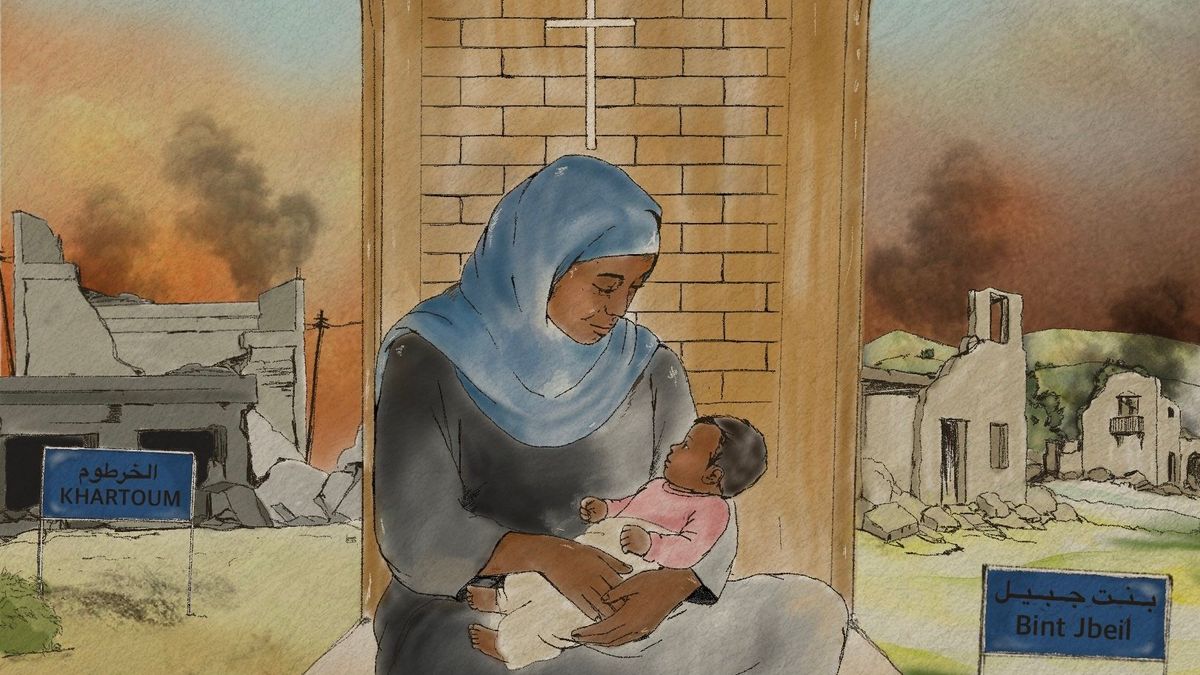
In the midst of Lebanon's ongoing conflict, a lesser-known crisis is unfolding. Sudanese mothers who fled their country's civil war are now facing displacement and uncertainty once again, as they struggle to rebuild their lives in a foreign land.
Rufaida, a 28-year-old Sudanese mother, is one of the many refugees who have been uprooted by war. She fled Sudan's civil war, only to find herself displaced once again in Lebanon. Her story is a testament to the resilience of those who have been forced to flee their homes in search of safety.
Rufaida's journey began in Khartoum, where fighting destroyed her family home and killed her father. She was forced to move in with her paternal uncle, the only close family member she had left. It was through him that she met her husband, Mohammad, who had already spent eight years in Lebanon.
The couple's relationship deepened, and they began to make plans for a new life together. Rufaida promised to complete her pharmaceutical studies at the University of Khartoum before joining Mohammad in Lebanon. However, getting there proved far harder than they anticipated.
Rufaida spent three months navigating a country fractured by conflict, traveling between cities in search of the documents and permissions she needed to leave. Her process was difficult due to the war, and she had to go to many cities to try and arrange her papers and passport.
Rufaida and her husband eventually made it to Lebanon, where they were united in Bint Jbeil, a city in the country's deep south. They married in a simple ceremony and began building a life together. Mohammad worked as a concierge in a residential building, a job that came with a small private room where the couple could live.
However, their life was short-lived. When the war reached southern Lebanon, nearby air strikes shattered the night's silence and forced the young family from their home. The building where they lived has since been destroyed as part of Israel's campaign of domicide in south Lebanon.
Rufaida and her husband were forced to flee, embarking on a grueling 12-hour journey across Beirut in search of somewhere safe to stay. They eventually found shelter at St Joseph Church, a sanctuary for migrants that has been a refuge for decades.
St Joseph Church has a long history of providing a safe haven for migrant workers. Before the conflict, the church grounds were transformed into a lively cricket pitch, where Indian and Pakistani migrant workers would play softball cricket while families sat on the sidelines sharing home-cooked food.
Today, the atmosphere is very different. Rows of mattresses line the floors, and laundry hangs from railings. Men slouch on plastic chairs, scrolling through their phones, while women carry blankets and washed clothes in plastic tubs. Only the children seem able to break the subdued mood, darting between adults and filling the space with bursts of laughter.
The conflict in Lebanon has led to a humanitarian crisis, with 1.5 million people internally displaced. For families like Rufaida's, St Joseph Church has become a refuge, a community center, and one of the few places in Beirut where they know they will be welcomed.
However, the church's role as a sanctuary for migrants stretches back decades. It was originally intended to be the chapel for St Joseph University, which was opened by French Jesuits as part of France's colonial-era "civilising mission".
The story of Rufaida and her husband is a testament to the resilience of those who have been forced to flee their homes in search of safety. However, their story also highlights the humanitarian crisis unfolding in Lebanon, where Sudanese mothers who fled their country's civil war are struggling to rebuild their lives.
As the conflict continues, it is essential to remember the forgotten refugees of Lebanon, who are in dire need of support and protection. The international community must come together to provide aid and assistance to those affected by the conflict, ensuring that they receive the support they need to rebuild their lives.
Editor's Note: This analysis is based on the provided article and may not reflect the full scope of the humanitarian crisis unfolding in Lebanon. Further research and investigation are necessary to fully understand the situation and provide a more comprehensive analysis.
Source referenced: ALJAZEERA
This brief was synthesized by our Editorial Engine and reviewed by The Ground Narrative team.