TRENDING

Thursday, 15 October 2026
----------------------
4 Jumada Al-Awwal 1448 AH
A recent Soyuz mission to the International Space Station, carrying a joint US-Russian crew, highlights a rare but critical area of sustained international collaboration between Washington and Moscow. This launch reaffirms the 2022 seat-exchange agreement, ensuring the continuous operation and safety of the orbiting laboratory despite broader global geopolitical fragmentation.
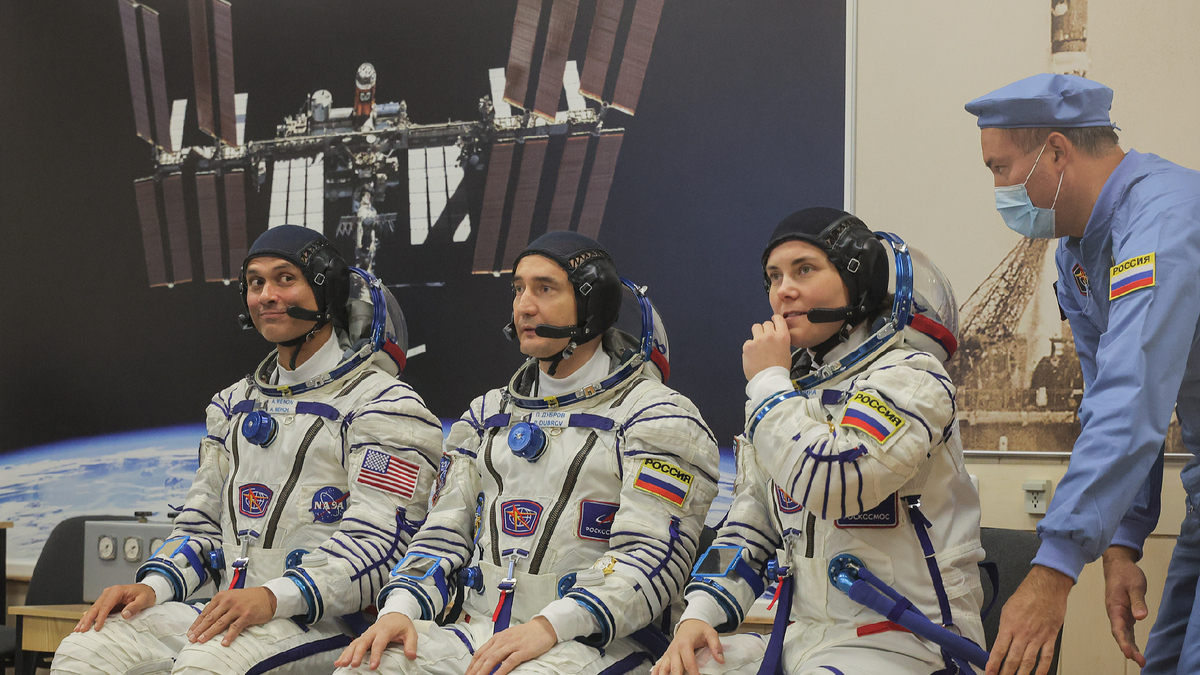
The successful launch of the Soyuz MS-29 crewed spacecraft on July 14, 2026, from Kazakhstan's Baikonur Cosmodrome, carrying a multinational crew to the International Space Station (ISS), serves as a potent symbol of enduring, albeit increasingly rare, international cooperation in an era of heightened geopolitical friction. The mission, which saw Russian cosmonauts Pyotr Dubrov and Anna Kikina, alongside NASA astronaut Anil Menon, embark on Expedition 75, underscores the unique diplomatic and scientific role of the ISS as a platform for collaboration between the United States and Russia.
The Soyuz MS-29, propelled by a Soyuz-2.1a carrier rocket, lifted off at 5:48 p.m. Moscow time, destined for an automatic docking with the ISS. This mission is not merely a routine crew rotation but a tangible manifestation of a critical seat-exchange agreement signed between Russia's state space corporation Roscosmos and NASA in July 2022. This arrangement, which allows Russian cosmonauts to fly on US spacecraft and NASA astronauts on Russian Soyuz missions, is designed to ensure a continuous presence of both nations' crew members on their respective segments of the ISS. The primary motivation behind this pragmatic cooperation is the imperative to support the station's safe and uninterrupted operation, a complex endeavor that necessitates mutual reliance and shared responsibility. The three crew members are slated to spend approximately 261 days aboard the ISS, engaging in scientific research, technology demonstrations, and essential station maintenance, with the Russian cosmonauts specifically tasked with 38 scientific experiments and two spacewalks.
In a global landscape marked by significant geopolitical divergence, particularly between Russia and Western nations, the continued operational partnership on the ISS stands out as an anomaly. The launch event itself carried considerable diplomatic weight, with Russian First Deputy Prime Minister Denis Manturov, Roscosmos Director General Dmitry Bakanov, and NASA Administrator Jared Isaacman in attendance. Notably, this marked the first visit by a NASA administrator to the Baikonur Cosmodrome in eight years, a period that has seen a substantial deterioration in US-Russia relations across various domains. This high-level presence signals a mutual, albeit narrowly defined, commitment to preserving this specific channel of cooperation. It suggests that despite profound disagreements on Earth, both nations recognize the strategic importance of maintaining a functional and safe orbital laboratory, which represents decades of shared investment and scientific pursuit. The Baikonur Cosmodrome in Kazakhstan, from which this mission launched, also highlights Kazakhstan's enduring strategic importance as a key space launch hub for Russia, further embedding the mission within a broader regional geopolitical context.
The International Space Station has historically served as a cornerstone of post-Cold War international collaboration, fostering trust and shared objectives between former adversaries. The persistence of this cooperation, even as other avenues of dialogue and partnership have diminished, underscores the unique nature of space exploration as a domain that can, at times, transcend terrestrial politics. The seat-exchange agreement, in particular, reflects a pragmatic recognition that the technical and operational complexities of the ISS necessitate continued interdependence. Without such an agreement, the risk of operational disruptions or even safety concerns for the station would significantly increase, potentially jeopardizing a multi-billion-dollar international asset. While the ISS is projected to be deorbited around 2030, the lessons learned from this sustained collaboration, particularly in navigating complex geopolitical environments, could inform future international space endeavors. The ability of the US and Russia to maintain this critical scientific and operational partnership, even amidst profound political differences, offers a template for how limited, high-stakes cooperation can be sustained when mutual interests align on a specific, vital project.
The Soyuz MS-29 mission is more than just a routine space launch; it is a powerful reaffirmation of a vital, albeit fragile, diplomatic bridge. It demonstrates that even in times of global fragmentation, shared scientific goals and the imperative of maintaining critical infrastructure can compel nations to find common ground. The continued operation of the ISS, facilitated by missions like Soyuz MS-29, remains a testament to the potential for international collaboration, offering a glimmer of shared purpose in an otherwise turbulent geopolitical landscape.
Source referenced: CGTN
This brief was synthesized by our Editorial Engine and reviewed by The Ground Narrative team.


