TRENDING

Sunday, 27 September 2026
----------------------
16 Rabi' Al-Thani 1448 AH
Russian forces are intensifying their offensive on Kostiantynivka, a pivotal stronghold in Ukraine's eastern 'fortress belt,' signaling Moscow's determination to secure the entire Donetsk region. This strategic push, marked by close-quarters fighting and pincer movements, tests Ukraine's defensive capabilities amidst ongoing logistical challenges for both sides.
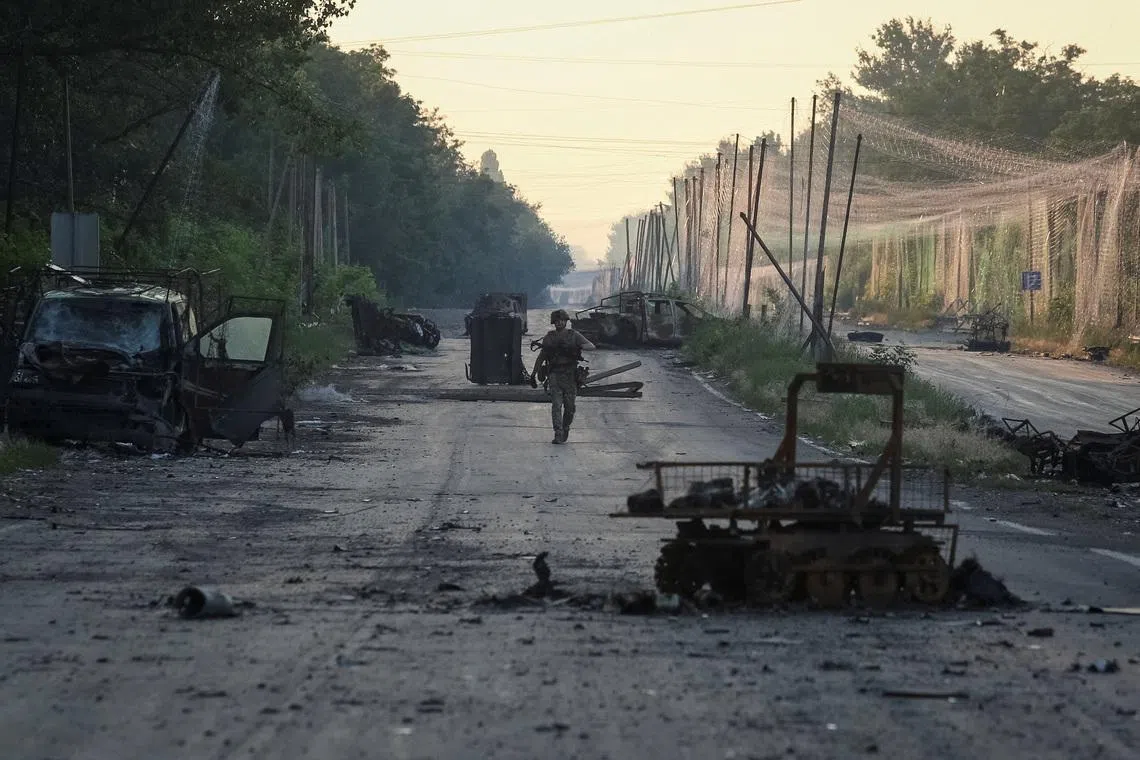
As of late June 2026, Russian forces are reportedly intensifying their offensive operations around Kostiantynivka, a strategically vital city in Ukraine's eastern Donetsk region. This renewed push represents a significant development in the protracted conflict, as Moscow seeks to breach a critical defensive line that Kyiv has maintained for over four years. The fighting has reportedly begun to seep into the city's outskirts, with small groups of Russian soldiers attempting infiltrations, according to senior Ukrainian commanders.
Kostiantynivka's Strategic Significance
Kostiantynivka is the southernmost of four key settlements that form a robust defensive line, often referred to as Ukraine's "fortress belt." This belt is central to Ukraine's efforts to hold the heavily industrialized Donetsk region, a primary objective for President Vladimir Putin, who has repeatedly stated Russia's intent to control the entire area. Currently, Ukraine retains control over approximately one-fifth of Donetsk. The capture of Kostiantynivka would provide Russian forces with a crucial foothold, enabling them to potentially advance northward along this defensive axis, threatening other key cities such as Sloviansk and Kramatorsk, which are already experiencing frequent air and drone attacks from Russian positions around 15km away.
The current Russian strategy appears to leverage its enduring manpower advantage, despite Ukrainian mid-range drone strikes on Russian logistics that have aimed to weaken its fighting capabilities. Emil Kastehelmi of the Black Bird conflict analysis team noted that while Russia has incurred heavy losses in the rear, these have not been sufficient to halt their offensives in specific sectors. This suggests a sustained, albeit costly, commitment by Moscow to achieve its territorial objectives in the east.
The nature of the fighting around Kostiantynivka is characterized by close-quarters assaults and persistent pressure. Ukrainian analyst Ruslan Mykula of the DeepState open-source mapping group highlighted that Russian efforts to envelop the city through pincer movements are steadily increasing the cost for Kyiv to defend it. This tactical approach forces Ukraine into a difficult dilemma: either commit more resources to defend the city or consider a strategic withdrawal. Mykula suggested that "the stakes are rising with each passing day," a sentiment echoed by Kastehelmi, who believes the city's fall "seems to be more of a question of time."
While Ukrainian commanders, such as Major-General Viktor Nikoliuk, head of Ukraine’s eastern operational command, expressed confidence that Kostiantynivka could hold out with current manpower and resources, the US-based Institute for the Study of War (ISW) assessed on June 23 that while Russian infiltrations were not enough for a "rapid operational breakthrough," the tactical situation for Ukraine was worsening. This indicates a grinding, attritional battle where incremental gains by Russia are slowly eroding Ukrainian defenses.
The intensified fighting in Donetsk occurs against a backdrop of broader strains on Russia's war effort. Ukrainian attacks on supply lines to and from Crimea, as well as longer-range strikes on Russia's oil sector, have reportedly led to economic issues in occupied territories, with Russian-installed authorities in Crimea imposing a state of emergency and halting fuel sales. Despite these challenges, Denis Pushilin, the Kremlin-installed head of Ukraine’s eastern Donetsk region, affirmed that Russia’s campaign to capture more cities is continuing, downplaying the pace of advances.
On the Ukrainian side, the logistical challenges are also severe. Supply routes to Kostiantynivka are under sustained pressure from Russian artillery, drones, and guided bombs. Troops in the area report that the route is too dangerous for standard vehicle evacuation of the wounded and dead, forcing everything to happen "on foot." The skies are described as "drone-infested," necessitating anti-drone netting and the use of ground robots for delivering essential supplies within the "kill zone."
The human cost of this escalation is profound. Civilian life in nearby areas, such as Druzhkivka, approximately 12km north of Kostiantynivka, is collapsing under the pressure. Residents are being forced to evacuate, with tragic incidents like a civilian van, marked with white ribbons, being struck by a Russian drone, resulting in fatalities. The displacement of civilians, like Larysa Sereda, underscores the devastating impact of the conflict on ordinary lives, even as many express a desire to return home once the war concludes.
The battle for Kostiantynivka is more than a localized engagement; it is a critical barometer of the ongoing conflict's trajectory. A successful Russian capture would represent a significant strategic victory, potentially unraveling a key part of Ukraine's eastern defenses and bringing Moscow closer to its stated goal of controlling the entire Donetsk region. Such an outcome would likely be long and bloody, echoing the costly sieges of other eastern cities like Pokrovsk and Avdiivka.
Conversely, Ukraine's ability to hold Kostiantynivka, even under immense pressure, would demonstrate its continued resilience and capacity to defend critical strongholds. The conflict highlights the evolving nature of modern warfare, with both sides heavily relying on drone technology for reconnaissance, strikes, and logistics. The geopolitical implications extend beyond the immediate battlefield, influencing international support for Ukraine, the dynamics of potential peace negotiations, and the long-term stability of the region. The "stakes rising with each passing day" in Kostiantynivka underscore the enduring intensity and strategic importance of the eastern front in the broader Russia-Ukraine war.