TRENDING

Monday, 12 October 2026
----------------------
1 Jumada Al-Awwal 1448 AH
An impending International Court of Justice ruling on Myanmar's alleged genocide against the Rohingya will test the resolve of international bodies, particularly the Organisation of Islamic Cooperation. Despite years of advocacy, hundreds of thousands of Rohingya remain stateless and vulnerable, highlighting a stark gap between global rhetoric and concrete action.
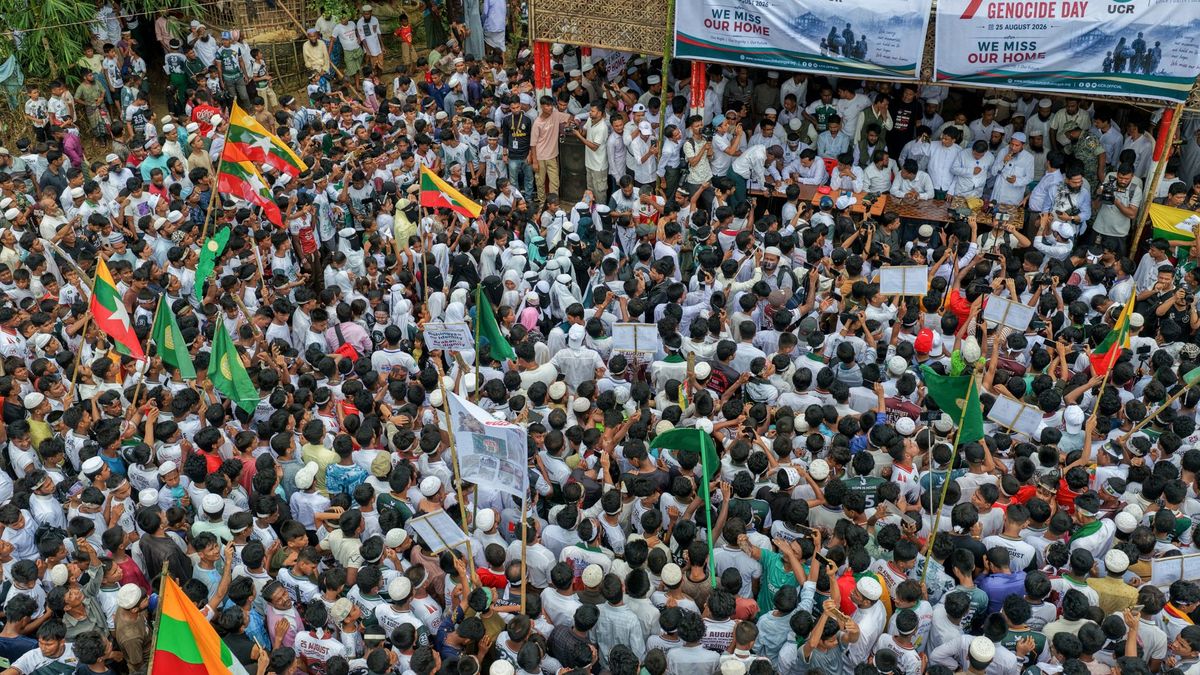
Later this year, the International Court of Justice (ICJ) is expected to deliver a landmark ruling on whether Myanmar's actions against the Rohingya constituted genocide. This decision follows years of meticulous evidence gathering by human rights networks and survivor testimonies presented in The Hague, detailing massacres, systematic village destruction, denial of citizenship, and deliberate starvation. The case, strongly backed by the Organisation of Islamic Cooperation (OIC), comes nearly a decade after Myanmar's military launched its brutal crackdown, driving hundreds of thousands of Rohingya from their homes into neighboring Bangladesh, where 1.2 million now live in precarious refugee camps.
The impending ICJ ruling exposes a complex web of power dynamics, revealing the limitations of international law and the often-conflicting interests of states. At its core, the case pits the legal authority of the world court against the sovereign impunity often claimed by powerful nations and the geopolitical calculus of regional and global actors.
Myanmar's military junta, which seized power in a 2021 coup, operates with a deep-seated sense of impunity, rooted in decades of authoritarian rule and a nationalist ideology that often demonizes minority groups like the Rohingya. For the junta, the ICJ case is an external imposition, an attempt to interfere with internal affairs. Their power stems from absolute control over state apparatus, a willingness to use brutal force, and strategic alliances with nations like China and Russia that provide diplomatic cover at the UN Security Council, effectively neutralizing potential enforcement mechanisms of international rulings. The military's survival hinges on maintaining its narrative of national security and ethnic purity, making any admission of genocide a direct threat to its legitimacy.
The OIC, a bloc of 57 Muslim-majority states, has championed the Rohingya's cause, framing it as a matter of Islamic solidarity. This public stance serves a crucial purpose: it bolsters the OIC's image as a defender of Muslim rights globally and provides a unifying narrative for its diverse membership. However, the true test of the OIC's power lies not in its resolutions but in its collective action. Individual member states often prioritize national interests—economic ties with Myanmar, domestic political stability, or concerns about refugee influxes—over the moral imperative of protecting the Rohingya. The power of the OIC is thus fragmented, diluted by the divergent agendas of its members, making coordinated, impactful diplomatic or economic pressure difficult to sustain.
An ICJ ruling, while legally binding, is not self-enforcing. The court lacks its own police force or army. Its power relies on the willingness of states to comply and the international community, particularly the UN Security Council, to enforce its decisions. This reliance on political will is a significant vulnerability. Historically, states found guilty of grave international crimes have often defied rulings, especially if they have powerful protectors or if the political cost of compliance is deemed too high. The Rohingya case will highlight whether the international legal framework can truly hold powerful states accountable, or if it remains largely a moral and symbolic instrument.
Bangladesh bears the immediate and immense burden of hosting 1.2 million Rohingya refugees. This humanitarian crisis strains its resources, infrastructure, and social fabric. The country faces constant pressure to repatriate the refugees, often from within its own borders, but also from international actors who see it as a temporary solution. Bangladesh's power is limited; it cannot compel Myanmar to accept the refugees back safely, nor can it indefinitely absorb such a large population without significant international support. The actions of other regional players, such as India's reported forced returns of Rohingya into the Andaman Sea, further complicate the situation, demonstrating how national security concerns or domestic political narratives can override humanitarian obligations.
The human cost of the Rohingya crisis is immeasurable, borne almost entirely by a stateless population caught between a genocidal regime and an often-indifferent world. For the Rohingya, the impending ICJ ruling is not an abstract legal concept but a desperate plea for recognition and a pathway to a life free from persecution.
Over a million Rohingya remain trapped in sprawling, overcrowded camps in Cox's Bazar, Bangladesh. They are stateless, denied basic rights, and live in a state of perpetual limbo. Their existence is entirely dependent on humanitarian aid, which, for many, amounts to a mere $7 per person per month for food assistance. This meager sum underscores the extreme poverty and lack of self-sufficiency forced upon them, stripping individuals of dignity and agency. The camps, while offering a fragile sanctuary, are not a permanent solution, and the psychological toll of this protracted displacement is profound.
With no clear path to repatriation or integration, many Rohingya embark on perilous sea crossings in search of safety and a better life. These journeys are fraught with danger; last year alone, one in every seven Rohingya attempting such crossings was reported dead or missing. They face exploitation by human traffickers, starvation, and the constant threat of pushbacks from national navies, including incidents like the reported forced return of 40 Rohingya by Indian authorities into the Andaman Sea in 2025. Each desperate journey represents a failure of the international system to provide safe and legal pathways for those fleeing persecution.
The survivors who testified before the ICJ relived the worst moments of their lives, recounting atrocities that left deep psychological scars. For a people whose villages were systematically destroyed and whose citizenship was revoked, the trauma is collective and intergenerational. Children born in the camps grow up without a homeland, without legal identity, and with severely limited access to education or opportunities. Their future remains uncertain, hostage to geopolitical maneuvering and the slow grind of international justice. The human cost is not just about lives lost, but about lives unlived, potential unrealized, and a community's identity under constant assault.
Beyond the official statements and legal pronouncements, several critical narratives are often downplayed or omitted by powerful actors, revealing the deeper machinations of global power and selective accountability.
The OIC's vocal support for the ICJ case against Myanmar is a powerful display of Muslim solidarity on the international stage. However, the untold story lies in the stark contrast between this rhetoric and the actions of some OIC member states closer to home. While demanding accountability from Myanmar, some of these same governments have been criticized for refusing asylum to Rohingya refugees reaching their borders or even engaging in pushbacks, sending vulnerable individuals back into danger. This selective application of humanitarian principles highlights a political calculation: public condemnation of distant atrocities is easier than bearing the immediate economic and social costs of protecting refugees within one's own territory. The
The upcoming ICJ ruling could be the first time in the court's history that a state is held responsible for genocide. While legally binding, its enforcement depends on the political will of international actors and the UN Security Council.
The Organisation of Islamic Cooperation (OIC) has publicly championed the Rohingya's cause and backed the ICJ case. However, the ruling will test whether its stated solidarity translates into concrete diplomatic and economic actions by its member states.
Rohingya refugees face statelessness, extreme poverty, precarious living conditions in camps, and dangerous sea crossings. They lack basic rights and face an uncertain future without a clear path to safe repatriation or integration.
Editor's Note: Analysis is based on factual reporting of the ICJ case, the OIC's involvement, and the ongoing humanitarian situation, interpreted through The Ground Narrative's editorial doctrine.
Source referenced: ALJAZEERA
This brief was synthesized by our Editorial Engine and reviewed by The Ground Narrative team.