TRENDING

Monday, 12 October 2026
----------------------
1 Jumada Al-Awwal 1448 AH
An alleged Egyptian airstrike on a Sudanese gold mine killed at least 72 workers, laying bare a lawless border and a war of external interests. The tragedy reveals who wields power and who bears the cost.
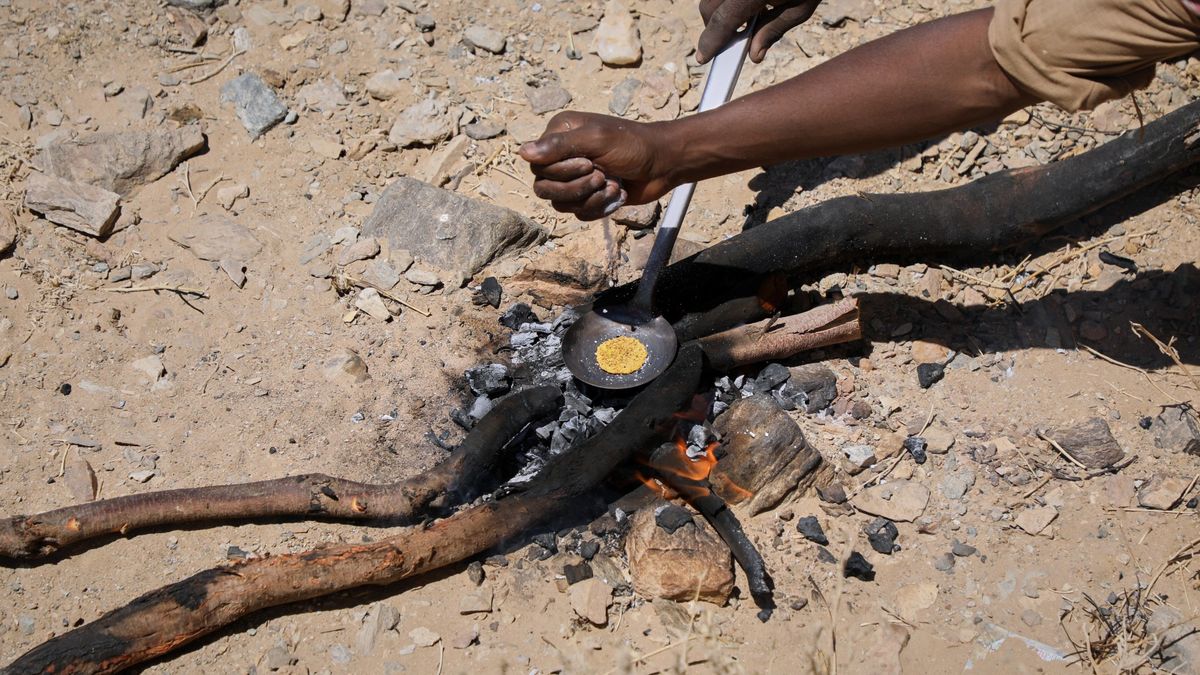
An airstrike on a makeshift gold‑processing camp in the North Wadi area of Jabal al‑Uqaydat on 12 October 2026 killed at least 72 Sudanese miners, according to the rights group Emergency Lawyers. The group blames the Egyptian military, which has not issued an official comment. Images released by monitors show bodies wrapped in shrouds amid the charred remains of open‑fire furnaces. This is the latest in a series of attacks on informal mining sites that sit along a porous, poorly demarcated frontier between Sudan and Egypt.
The 22nd parallel north was drawn by Britain and Egypt in 1899 as a paper line, but no physical markers ever followed. Decades of neglect left the border a legal gray zone, fertile with gold deposits that attract itinerant miners and illicit traders.
Gold has become a lifeline for both warring factions in Sudan’s civil war that erupted in April 2023. While the Sudanese Armed Forces and the Rapid Support Forces each tap mining revenues, the wealth also draws neighboring states that see the frontier as a buffer for smuggling routes, drug flows, and undocumented migration.
Egypt maintains a permanent Border Guard presence on its side of the line, citing security concerns over illegal migration and contraband. At the same time, the Egyptian military has historically backed the Sudanese Armed Forces, hoping to secure a friendly regime and keep the Red Sea corridor stable for its own trade interests. The airstrike, framed by Cairo as an operation “within Egyptian territory,” signals a willingness to project force beyond its borders when perceived threats—or opportunities—arise.
The miners were largely young men from impoverished villages in Sudan’s Northern State. Their deaths plunged dozens of households into deeper poverty, stripping families of the modest income that gold extraction provided. Widows now face the dual burden of mourning and finding alternative work in an economy crippled by war.
Beyond the immediate loss, the attack sowed fear across informal mining camps that dot the border. Miners, already operating without safety equipment, now confront the specter of aerial bombardment, prompting many to abandon the sites altogether. This exodus threatens to push vulnerable workers into even more precarious, unregulated mining pits deeper in the desert.
Gold from the border region once fed local markets and, indirectly, the war‑economy of Sudan. With the camps shuttered, smuggling networks lose a key node, potentially driving up illicit trade prices and encouraging criminal groups to fill the vacuum with more dangerous activities such as human trafficking.
Cairo’s refusal to comment allows the narrative to stay within the realm of “security operations,” obscuring the fact that the target was a civilian labor site. By avoiding acknowledgment, Egypt sidesteps international scrutiny over the proportionality of force and the legality of striking a non‑military target.
Egyptian authorities routinely label border incursions as anti‑migration sweeps, a framing that diverts attention from the strategic value of controlling gold‑rich terrain. This discourse downplays the economic motive and paints the miners as illegal entrants rather than victims of a resource‑driven power play.
While both Sudanese factions rely on gold to fund their campaigns, the strike did not benefit either side directly. Yet the broader pattern of external interference—whether from Egypt, Gulf investors, or private security firms—continues to fuel the conflict by keeping the border economy unregulated and profitable for third‑party actors.
The next weeks will reveal whether Sudan can leverage diplomatic channels, perhaps at the United Nations, to demand a physical demarcation of the 22nd parallel. International observers may also push for a joint border‑monitoring mechanism, but such efforts will clash with Egypt’s desire to retain unilateral control over security operations. Meanwhile, satellite imagery will likely track any further aerial activity, and human‑rights groups will monitor the response of the mining communities. The evolution of this border dispute will be a litmus test for how regional powers balance resource extraction, security narratives, and the lives of ordinary people caught in the crossfire.
Human rights monitors allege the **Egyptian** military carried out the strike, though Cairo has not officially confirmed involvement.
The border lacks physical demarcation, is sparsely monitored, and sits in a lawless zone where illegal mining, smuggling, and armed groups operate with little state oversight.
Any attempt by Sudan to formalise the border without Egyptian consent, or renewed military operations framed as anti‑migration sweeps, could spark additional strikes and deepen the humanitarian crisis.
Source referenced: ALJAZEERA
This brief was synthesized by our Editorial Engine and reviewed by The Ground Narrative team.