TRENDING

Saturday, 24 October 2026
----------------------
13 Jumada Al-Awwal 1448 AH
Four nations recently launched their 170th joint patrol on the Mekong River, ostensibly to combat crime. This recurring operation highlights China's expanding influence and the intricate power dynamics shaping the lives of millions along the vital waterway.
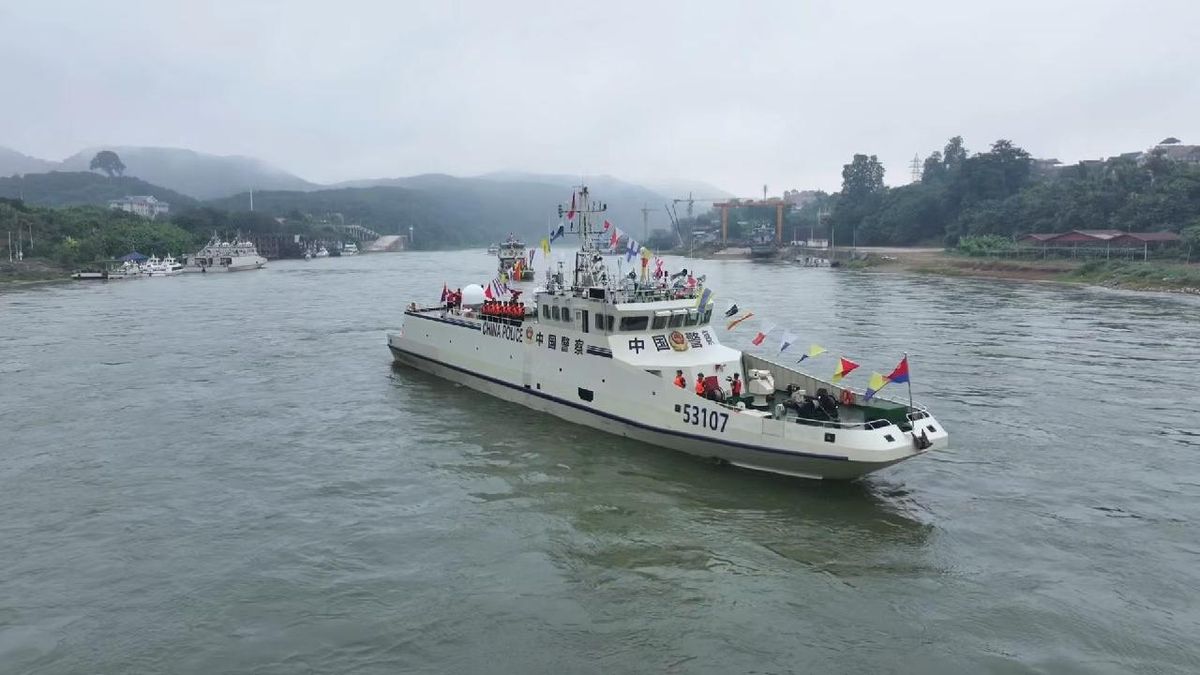
China, Laos, Myanmar, and Thailand recently concluded their 170th joint patrol and law enforcement operation along the Mekong River. The coordinated effort, launched from Xishuangbanna, China's Yunnan Province, involved over a hundred law enforcement officers. Their stated mission included segmented patrols, river-wide enforcement, and joint land-water operations targeting transnational crimes such as drug trafficking, illegal border crossings, and smuggling. Additionally, the operation focused on inspecting navigation hazards and mitigating security risks across the Mekong Basin, aiming to safeguard the lives and property of residents and vessel crews. A notable detail was a cultural exchange event preceding the patrol, where officers from all four nations attended an outdoor screening of a Chinese space documentary, Shenzhou 13, in Jinghong.
The regular joint patrols on the Mekong River are a visible manifestation of a deeper, asymmetric power dynamic at play in Southeast Asia. At its core, this mechanism, now marking its 15th anniversary, was catalyzed by the brutal 2011 Mekong River massacre, where 13 Chinese sailors were killed by a drug cartel linked to the Golden Triangle. This event provided China with a legitimate pretext to extend its law enforcement presence and influence downstream, transforming a shared security concern into a significant projection of its regional power.
China, as the upstream riparian state, holds immense leverage over the Mekong River, which it calls the Lancang River. Its extensive network of large-scale hydropower dams on the upper Lancang allows it to control the river's flow, directly impacting water levels, sediment, and fish migration downstream. This hydrological control is a silent, yet potent, form of power, creating a dependency among the downstream nations of Laos, Myanmar, Thailand, Cambodia, and Vietnam. The joint patrols, while framed as cooperative, reinforce China's role as the primary security guarantor and operational leader in the basin.
For Laos and Myanmar, participation in these patrols is a pragmatic necessity. Both nations share long, porous borders with China and are deeply integrated into China's economic orbit through initiatives like the Belt and Road Initiative (BRI). Laos, landlocked and heavily reliant on Chinese investment, has little choice but to align with Beijing's security agenda. Myanmar, grappling with severe internal conflicts and international isolation, finds a crucial partner in China for both economic and security support, even as it navigates complex domestic challenges. The patrols offer a veneer of multilateralism, allowing these smaller nations to benefit from enhanced security against transnational crime, while simultaneously cementing China's influence.
Thailand, while economically more robust and having a more diversified foreign policy, also participates due to shared concerns over drug trafficking emanating from the Golden Triangle and the practical benefits of coordinated riverine security. However, its participation is also a recognition of China's undeniable gravitational pull in the region. The patrols, therefore, serve multiple purposes: combating crime, projecting China's security leadership, and fostering a regional order where Beijing's interests are paramount.
The constant flux of power dynamics along the Mekong River translates directly into tangible costs for the millions of people who depend on its waters for their livelihoods and way of life.
The most profound human cost stems from the ecological changes driven by upstream hydropower development, primarily by China. The construction and operation of large dams alter the natural flood-pulse cycle of the Mekong, reducing sediment flow and disrupting fish migration patterns. This directly impacts the traditional fishing communities and subsistence farmers in Laos, Cambodia, and Vietnam, who rely on the river's natural rhythms for their food security and income. Reduced fish stocks mean less protein for local diets and diminished earnings, pushing vulnerable populations further into poverty. The altered water levels also affect agricultural productivity, as traditional irrigation methods and fertile floodplains are disrupted.
While the joint patrols aim to enhance security against transnational crime, particularly drug trafficking from the Golden Triangle, the increased presence of law enforcement can also create unintended consequences for local populations. Border communities, often marginalized and ethnically diverse, can find themselves caught between competing authorities or subjected to heightened surveillance and scrutiny. In regions like the Shan State of Myanmar, where internal conflicts are rampant, the lines between criminal activity and political insurgency are often blurred, potentially leading to human rights abuses or the targeting of innocent civilians under the guise of anti-crime operations. The focus on interdiction, while necessary, often fails to address the root causes of drug production and trafficking, leaving local populations vulnerable to exploitation by criminal networks or heavy-handed state responses.
The persistent instability in Myanmar, a key riparian state and a hub for illicit activities in the Golden Triangle, places an immense burden on its own citizens and spills over into neighboring countries. The ongoing civil conflict disrupts trade, displaces communities, and creates fertile ground for organized crime to flourish, undermining the very security the patrols aim to achieve. Refugees and internally displaced persons face immense hardship, and their movements can be exploited by traffickers. The human cost here is a cycle of violence, poverty, and displacement, exacerbated by the region's complex geopolitical landscape.
Beneath the official narrative of cooperative law enforcement and shared security, several critical aspects of the Mekong River's power dynamics are consistently downplayed or omitted by the participating governments, especially China.
The most significant untold story is the profound, irreversible impact of China's upstream dams on the Mekong River's ecology and the livelihoods of millions downstream. While official statements focus on crime and navigation, the reality is that China's control over the Lancang River's flow is the ultimate power lever. The Mekong River Commission (MRC), established to promote regional cooperation on water management, has repeatedly highlighted the lack of transparent data sharing from China regarding its dam operations. This opacity means downstream nations are often left guessing about water releases or retentions, making it impossible for them to plan for agriculture, fishing, or disaster mitigation. The narrative of
Source referenced: CGTN
This brief was synthesized by our Editorial Engine and reviewed by The Ground Narrative team.