TRENDING

Sunday, 4 October 2026
----------------------
23 Rabi' Al-Thani 1448 AH
A massive statue of the Virgin Mary has been erected in a small Polish village, sparking debate about the role of Catholicism in modern Poland. As the country grapples with declining church attendance and trust, the statue's impact on secularization remains uncertain. The project, financed by one of Poland's wealthiest individuals, highlights the complex relationship between faith, identity, and power in Poland.
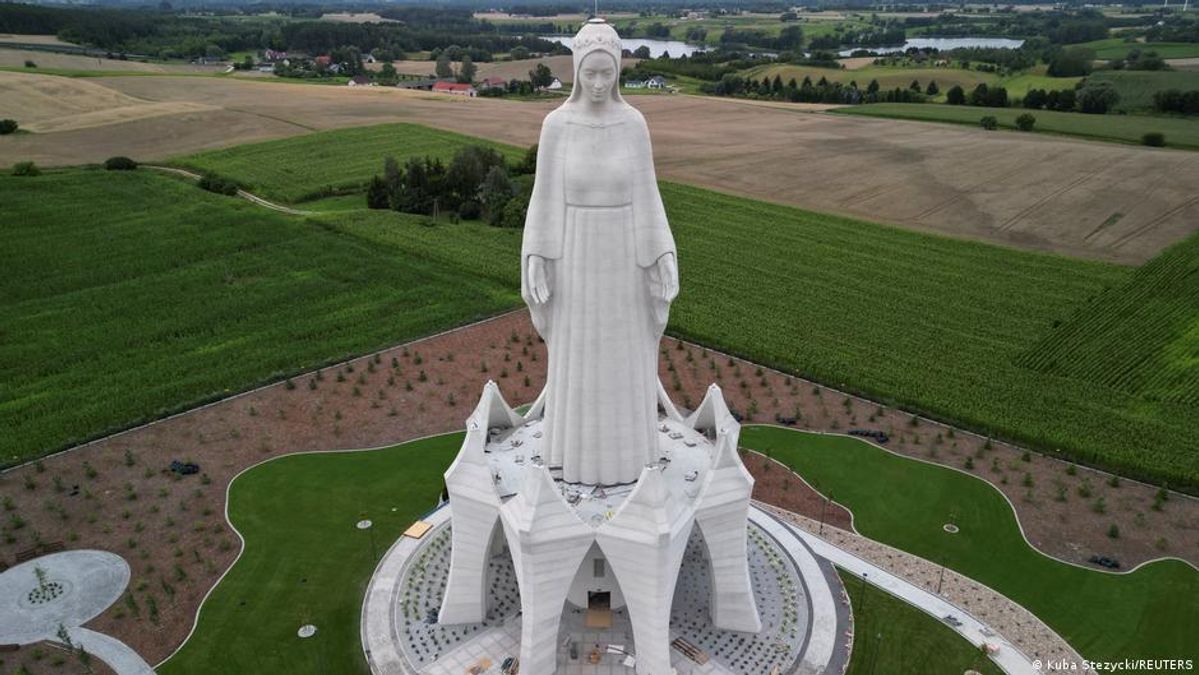
In the small village of Konotopie, Poland, a gigantic statue of the Virgin Mary has been constructed, standing over 55 meters tall. The statue, financed by Roman Karkosik, one of Poland's wealthiest individuals, is set to be officially inaugurated on the Feast of the Assumption of Mary. The project has sparked intense debate, with some hailing it as a spiritual landmark and others criticizing it as a waste of resources.
The construction of the statue is not just a matter of personal devotion, but also a reflection of the complex power dynamics at play in Poland. The Catholic Church has long been a dominant force in Polish society, and the statue can be seen as an attempt to reassert its influence in the face of declining church attendance and trust. Karkosik's involvement in the project highlights the role of wealthy individuals in shaping public discourse and cultural narratives. The Polish government's support for the project also underscores the close ties between the Church and the state.
As Poland grapples with secularization, the human cost of this trend is becoming increasingly apparent. Church attendance has been steadily declining, especially among young people, and the number of priests being ordained has fallen below 200 for the first time since 2000. The decline of Catholicism in Poland has significant implications for the country's identity and sense of community. The statue, while intended to inspire devotion, may ultimately serve as a symbol of a fading faith.
What is being downplayed in the discussion surrounding the statue is the extent to which the Catholic Church's decline in Poland is driven by its own internal crises, including allegations of corruption and abuse. The Church's response to these scandals has been criticized as inadequate, further eroding trust among the Polish people. The statue, while a grand gesture, may be seen as a distraction from the Church's deeper problems. Additionally, the involvement of wealthy individuals like Karkosik in shaping the country's cultural narrative raises questions about the influence of money in Polish politics and society.
As the statue is officially inaugurated, it will be important to watch how the Polish people respond to this new landmark. Will it inspire a renewed sense of devotion, or will it be seen as a symbol of a bygone era? The impact of the statue on Poland's secularization trend will be closely watched, and its success or failure may have significant implications for the country's identity and sense of community. Additionally, the role of wealthy individuals in shaping Poland's cultural narrative will continue to be a topic of debate, highlighting the complex interplay between faith, power, and identity in modern Poland.
Editor's Note: The analysis is based on publicly available information and may not reflect the full complexity of the situation on the ground.
Source referenced: DW
This brief was synthesized by our Editorial Engine and reviewed by The Ground Narrative team.