TRENDING

Tuesday, 6 October 2026
----------------------
25 Rabi' Al-Thani 1448 AH
One thousand days after the October 7 Hamas attack, Israelis held widespread protests and memorials, demanding a state commission of inquiry into government failures and accountability for the ongoing conflict. This surge of public discontent highlights deep internal divisions and exerts significant pressure on the Netanyahu government amidst the protracted war in Gaza.
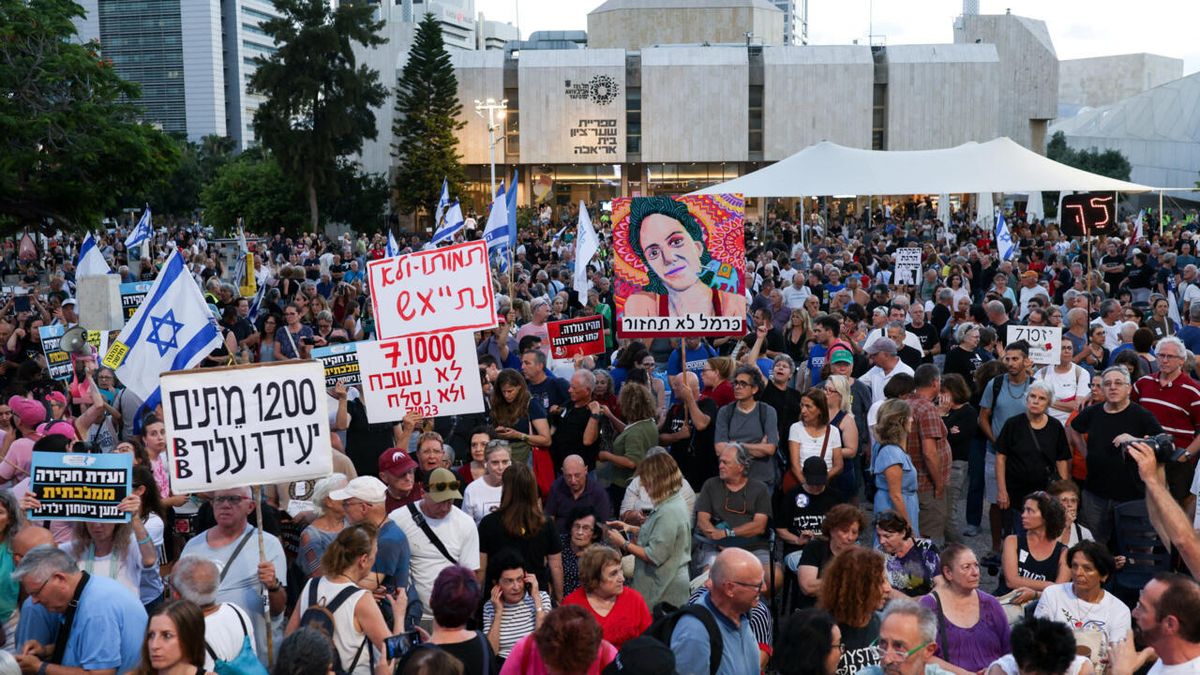
On Thursday, July 2, 2026, Israelis across the nation marked 1,000 days since the devastating October 7, 2023, Hamas attack, an event that irrevocably altered the country's security landscape and triggered the ongoing war in Gaza. The day was characterized by a somber blend of memorials for the 1,221 victims and 251 hostages, alongside widespread protests demanding accountability from the government for its perceived failures leading up to and following the assault. These demonstrations, particularly prominent in Tel Aviv's 'Hostages Square' (renamed 'Memory Square' for the day) and along the Ayalon highway, underscore a profound crisis of confidence in the nation's leadership and its handling of the protracted conflict.
The central demand articulated by thousands of protesters, including families of victims and hostages organized under the 'October Council,' is the establishment of a state commission of inquiry. Such a body, historically convened in Israel to investigate major national failings, is seen by many as crucial for understanding the intelligence and operational lapses that allowed the October 7 attack to occur, and for scrutinizing the government's subsequent response, including its management of the hostage crisis. Public sentiment, as reflected in polls, indicates broad support for such an independent investigation across the political spectrum. Critics, including opposition leaders and figures like Eyal Eshel, father of a soldier killed on October 7, argue that the current government's refusal to establish a truly independent commission—offering instead a 'political' commission with partisan appointments—is an attempt to evade genuine responsibility and transparency.
Prime Minister Benjamin Netanyahu's government has consistently resisted calls for a full state inquiry, a stance that has further fueled public anger and accusations of political self-preservation. This resistance is not merely a domestic political issue; it carries significant geopolitical weight. A government perceived as unwilling to confront its own failures can project an image of instability and internal division, potentially impacting its diplomatic leverage and strategic decision-making in the ongoing conflict and future peace negotiations. The lack of closure and accountability, as expressed by citizens like Dina Hertz, contributes to a sense of national trauma that remains unaddressed, hindering societal healing and unity.
The protests on the 1,000-day mark are not isolated incidents but rather a continuation of a broader anti-government movement that has gained momentum since the war began. The demonstrations, which saw arrests on the Ayalon highway, reflect deep frustration with the government's overall performance. This domestic pressure is inextricably linked to the geopolitical realities of the Gaza war. The conflict, which has resulted in over 73,000 Palestinian casualties according to the Gaza health ministry, continues without a clear resolution, with Israeli forces controlling nearly 70 percent of the territory and ceasefire talks stalled. The perception among many Israelis that the nation 'hasn't won anything' despite the immense cost, as noted by observers, intensifies the calls for leadership change.
This internal political turmoil has direct implications for Israel's military strategy and diplomatic efforts. A government facing significant domestic opposition may find its capacity for decisive action or long-term strategic planning constrained. Furthermore, the international community continues to scrutinize Israel's conduct in Gaza, with a UN probe, for instance, raising concerns about 'genocidal intent.' While not directly linked to the protests, this international pressure adds another layer of complexity to the government's challenges, making domestic stability even more critical.
The protests and the demand for accountability are set against the backdrop of upcoming elections, anticipated in October. Figures like Gadi Eisenkot, a former army chief and a leading candidate to succeed Netanyahu, have seized upon the public's desire for change, promising to 'rebuild ourselves as a society and as a nation.' The outcome of these political shifts could profoundly influence Israel's future trajectory, including its approach to the Gaza conflict, its relations with regional and international partners, and its internal social cohesion.
How these domestic pressures will ultimately shape Israel's geopolitical stance remains to be seen. However, the 1,000-day mark serves as a stark reminder that the consequences of the October 7 attack extend far beyond the immediate battlefield, deeply impacting Israel's internal political landscape and its standing on the global stage. The ongoing struggle for accountability and closure within Israel is a critical factor that will continue to influence the broader dynamics of the Middle East. The nation stands at a crossroads, grappling with the trauma of the past while navigating a complex and uncertain future, both domestically and internationally. The calls for inquiry and change are not just about justice; they are about the very definition of Israel's national security and democratic resilience in a volatile region.
Source referenced: FRANCE24
This brief was synthesized by our Editorial Engine and reviewed by The Ground Narrative team.