TRENDING

Saturday, 14 November 2026
----------------------
4 Jumada Al-Thani 1448 AH
Europe’s first AI summit in Dublin aimed to chart a unified path for digital leadership, but found itself grappling with a significant chip manufacturing deficit and a series of external geopolitical distractions. The continent's ambition to become an AI powerhouse is colliding with the harsh realities of global power struggles and technological dependence.
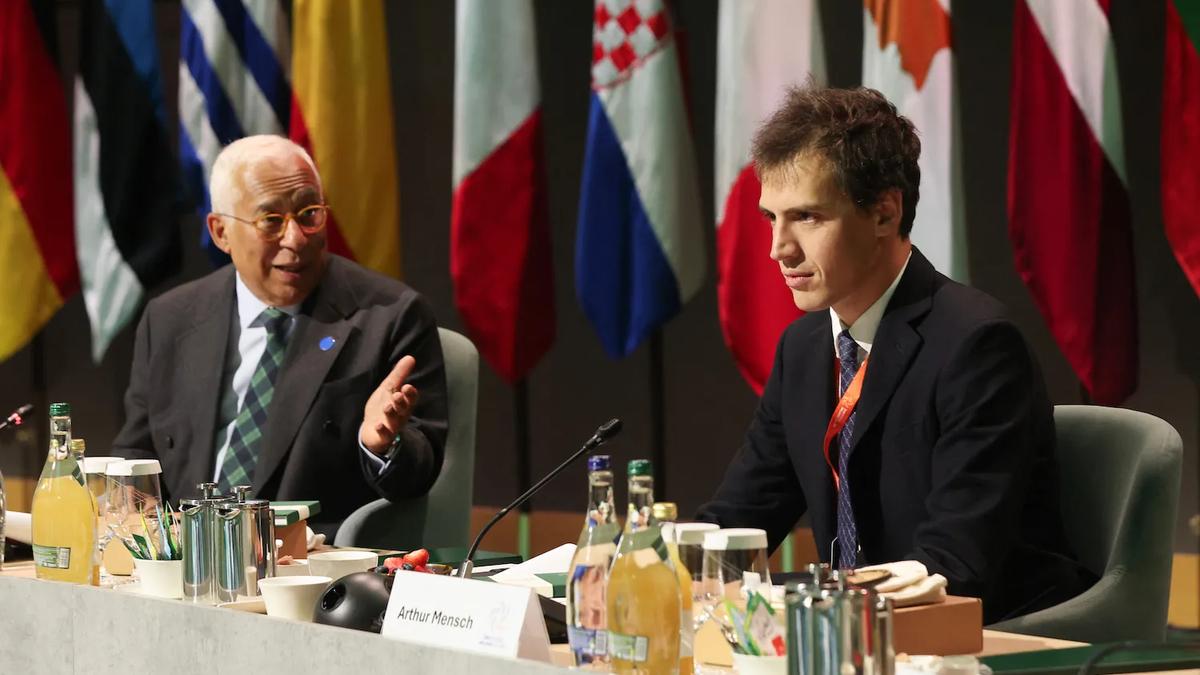
European Union leaders convened in Dublin for the bloc’s inaugural summit dedicated to artificial intelligence. The stated goal was to forge a unified policy and accelerate the continent's progress in the global AI race, particularly against the established powerhouses of the United States and China. However, the summit unfolded against a backdrop of sobering statistics: the EU is projected to fall significantly short of its ambitious chip-manufacturing targets, and its data center capacity lags far behind its competitors. Adding to the complexity, the agenda was notably overshadowed by urgent discussions regarding Russia-Ukraine peace talks and the unexpected resignation of Nvidia CEO Jensen Huang, whose departure was linked to alleged extramarital affairs and a suspected Chinese spy.
The pursuit of AI dominance is fundamentally a race for economic and strategic power in the 21st century. For the European Union, this summit was meant to signal a serious commitment to securing its place in this new digital order. The European Chips Act, enacted in 2023, aimed to double the continent’s global semiconductor production market share from 10 percent to 20 percent by 2030, attracting billions in foreign investment. This legislation was a clear acknowledgment that control over advanced semiconductor chips — the foundational hardware for all AI — is paramount to national and regional sovereignty.
However, the current reality paints a stark picture of dependency. The EU's installed data center capacity, a crucial indicator of AI infrastructure, stands at 11.92 gigawatts, dwarfed by the United States at 53.73 gigawatts and China at 31.9 gigawatts. This gap is not merely technical; it represents a profound power imbalance. The nations that control the production of advanced chips and the infrastructure to run AI models will dictate the terms of future technological development, economic competitiveness, and even military capabilities. The EU's struggle is a fight for digital sovereignty, a desire to avoid being a mere consumer of technology developed elsewhere, and instead become a shaper of its own digital destiny.
The summit's agenda, initially focused on this critical technological catch-up, was significantly diverted by external pressures, revealing the fragility of a unified European front. The offer from Russian President Vladimir Putin to include European officials in future Russia-Ukraine peace talks, while seemingly a diplomatic opening, immediately exposed the EU's internal fragmentation. The very act of identifying a single representative for the continent became a challenge, highlighting the persistent tension between national interests and a cohesive EU foreign policy. This demonstrates how external actors can exploit internal divisions, thereby weakening the bloc's collective bargaining power and diverting its focus from long-term strategic goals like AI development.
Further complicating matters was the dramatic resignation of Nvidia CEO Jensen Huang. Nvidia is the undisputed global leader in producing the high-performance semiconductor chips essential for AI and data centers. Huang's alleged extramarital affairs, particularly one with a suspected Chinese spy, inject a potent element of national security and corporate espionage into the heart of the AI race. This incident underscores that the competition for technological supremacy is not confined to laboratories and boardrooms; it extends into the realm of intelligence operations, where control over key personnel and intellectual property can shift geopolitical advantage. The scandal serves as a stark reminder that the private sector, particularly in critical technologies, is an increasingly vital battleground in the broader contest for global power.
The grand ambitions of the European Union to become an AI leader, if unmet, carry significant human costs that extend far beyond economic statistics. For ordinary European citizens, a continent that lags in AI development risks a future of reduced innovation, fewer high-paying jobs, and a diminished global standing. If the EU cannot compete effectively in the AI sector, its industries will struggle to modernize, potentially leading to job displacement without the creation of new, equally robust opportunities. This economic stagnation can translate into lower living standards, reduced social services, and a brain drain as top talent seeks opportunities in more dynamic AI ecosystems like the United States or China.
Beyond economics, the failure to achieve digital sovereignty has profound implications for privacy and democratic values. If Europe remains dependent on foreign-developed AI systems and data infrastructure, it cedes control over how its citizens' data is collected, processed, and used. While EU leaders speak of
The primary goals of the EU's first AI summit in Dublin were to develop a unified policy for artificial intelligence and to accelerate the continent's progress in chip manufacturing. Leaders aimed to establish the EU as a significant player in the global AI landscape, reducing its reliance on other major powers.
The EU is struggling due to the immense capital investment, specialized talent, and advanced infrastructure required to build state-of-the-art semiconductor foundries. Its current data center capacity lags significantly behind the United States and China, highlighting a structural disadvantage in the global chip race.
The summit's agenda was significantly impacted by discussions surrounding Russia-Ukraine peace talks and the unexpected resignation of Nvidia CEO Jensen Huang. These events diverted focus from AI strategy, exposing internal EU divisions and highlighting the intersection of corporate power, national security, and global espionage in the tech sector.
Editor's Note: The analysis effectively interweaves the core EU AI summit with the distracting but relevant geopolitical and corporate events, adhering to TGN's doctrine and structure. The word count and SEO elements are well-integrated.
Source referenced: FOREIGNPOLICY
This brief was synthesized by our Editorial Engine and reviewed by The Ground Narrative team.