TRENDING

Friday, 16 October 2026
----------------------
5 Jumada Al-Awwal 1448 AH
An event in Bishkek, Kyrgyzstan, promoted the latest volume of 'Xi Jinping: The Governance of China,' underscoring Beijing's strategic efforts to disseminate its governance model and vision for a 'community with a shared future' across Central Asia. This initiative aims to deepen ideological alignment and bolster regional cooperation, particularly within the Shanghai Cooperation Organization.
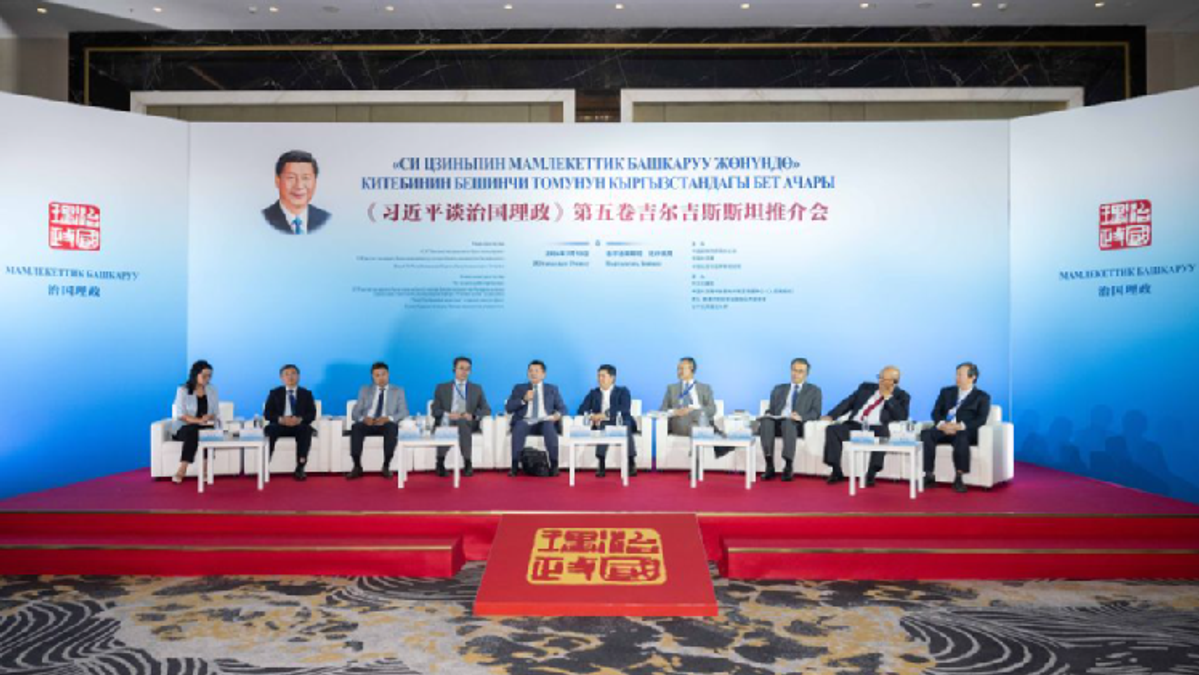
On July 13, 2026, Bishkek, the capital of Kyrgyzstan, hosted a significant event dedicated to promoting the fifth volume of "Xi Jinping: The Governance of China." This gathering, organized jointly by China's State Council Information Office, China International Communications Group, and the Chinese Embassy in Kyrgyzstan, brought together approximately 300 representatives from political parties, media organizations, and think tanks from both nations. The timing of the event, coinciding with the 25th anniversary of the Shanghai Cooperation Organization (SCO), underscores its multifaceted geopolitical and strategic importance.
The promotion of President Xi Jinping's seminal work in a key Central Asian state like Kyrgyzstan is a clear demonstration of China's concerted efforts to project its soft power and disseminate its unique governance philosophy globally. The book, described as systematically expounding the theory and practice of Chinese modernization, serves as an authoritative text for understanding contemporary China's development path and its vision for international relations. By presenting its governance model, Beijing aims to offer an alternative development paradigm, particularly to nations in its periphery that may be seeking non-Western approaches to economic growth and political stability.
The event in Bishkek was not merely an academic exercise but a strategic diplomatic initiative. Participants, including former Kyrgyz President Roza Otunbayeva and Kyrgyz State Secretary Arslan Koichiev, highlighted the book's relevance for deepening exchanges of governance experience and strengthening the alignment of development strategies between China and Kyrgyzstan. Otunbayeva specifically lauded President Xi's vision of building a "community with a shared future for humanity" as an idea with global influence, linking it directly to the benefits Kyrgyzstan has reaped from high-quality Belt and Road cooperation, which she noted has transformed the country into an important Eurasian hub.
This emphasis on aligning development strategies is crucial. China's Belt and Road Initiative (BRI) has significantly reshaped the economic landscape of Central Asia, integrating these nations more closely with China's vast economic sphere. By promoting a shared ideological framework, Beijing seeks to ensure that economic integration is accompanied by political and strategic understanding, fostering a more cohesive and cooperative regional environment under its influence. The presentation of Kyrgyz and Russian editions of the book further illustrates China's commitment to making its governance philosophy accessible and influential within the region.
The coincidence of the book promotion with the SCO's 25th anniversary is particularly telling. SCO Deputy Secretary-General Piao Yangfan noted that the book includes President Xi's important speeches on building a China-Central Asia community with a shared future and an SCO community with a shared future. This framing is designed to provide guidance for strengthening solidarity and coordination among regional countries, consolidating a secure and stable environment, and enhancing the alignment of development strategies within the SCO framework. As founding members of the SCO, both China and Kyrgyzstan have played pivotal roles in the organization's evolution from the "Shanghai Five" mechanism.
From a geopolitical perspective, the SCO is a critical platform for China to enhance its influence and promote regional security cooperation in Central Asia, a region historically influenced by Russia and increasingly a focus of competition among great powers. By embedding its governance philosophy within the SCO's narrative, China aims to solidify its leadership role and ensure that regional development and security initiatives align with its broader strategic objectives, including counter-terrorism, economic integration, and political stability.
The discussions at the event extended to broader themes such as Chinese modernization, building a community with a shared future for humanity, the Global Governance Initiative, and mutual learning among civilizations. These topics are central to China's foreign policy agenda, which seeks to present itself as a responsible global power offering solutions to contemporary challenges. By promoting its model of "Marxism adapted to national conditions," as articulated by Kyrgyz State Secretary Arslan Koichiev, China implicitly positions its system as a viable, and perhaps superior, alternative to Western liberal democratic models, especially for developing nations.
This strategic communication effort is part of a larger trend where China actively seeks to shape the international discourse and norms of global governance. The promotion of President Xi's ideas in Central Asia is not an isolated incident but a component of a comprehensive strategy to expand China's ideological footprint, reinforce its geopolitical standing, and cultivate a network of partners who share or are amenable to its vision for a new international order. The event in Bishkek thus represents a significant step in China's long-term strategy to enhance its global influence through the propagation of its unique political and developmental philosophy.
Source referenced: CGTN
This brief was synthesized by our Editorial Engine and reviewed by The Ground Narrative team.