TRENDING

Monday, 26 October 2026
----------------------
15 Jumada Al-Awwal 1448 AH
China's top diplomat Wang Yi championed the Global Governance Initiative (GGI), positioning it as a solution to global deficits. This move signals Beijing's intent to reshape international norms and institutions, particularly for the Global South.
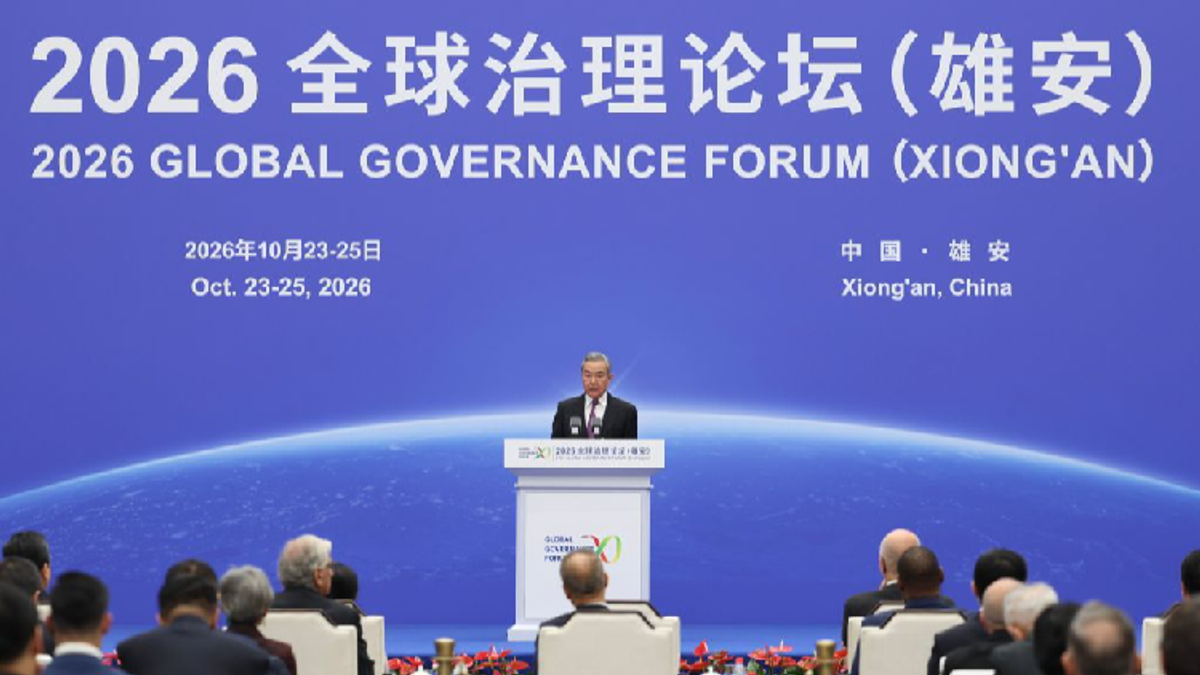
Chinese Foreign Minister Wang Yi recently delivered a keynote speech at the 2026 Global Governance Forum in Xiongan New Area, Hebei Province, asserting that China's proposed Global Governance Initiative (GGI) has gained significant relevance one year after its launch. He called for concerted efforts to translate its vision into reality, presenting the GGI as Beijing's solution to what it perceives as a deficit in global governance. Wang emphasized the need for nations to uphold the central role of the United Nations, enhance the Security Council's responsiveness, and address the legitimate concerns of developing countries. He also highlighted the importance of major powers setting an example in upholding equality, credibility, and cooperation, advocating for peaceful dispute resolution and a vision of common, comprehensive, cooperative, and sustainable security.
China's promotion of the Global Governance Initiative (GGI) is a clear articulation of its ambition to reshape the international order, moving beyond merely participating in existing structures to actively leading their reform. For decades, the global governance framework has largely been a product of post-World War II Western powers, centered around institutions like the United Nations, the World Bank, and the International Monetary Fund. Beijing views many of these institutions as reflecting outdated power dynamics and failing to adequately represent the interests of the Global South or accommodate the rise of new economic powers like itself. The GGI, therefore, is not just a policy proposal; it is a strategic blueprint for a China-centric vision of multilateralism.
At its core, the GGI seeks to address what China terms the "global governance deficit." This deficit, from Beijing's perspective, manifests in several ways: the perceived dominance of Western norms and values, the slow pace of reform in institutions like the UN Security Council, and the insufficient voice given to developing nations. By advocating for an enhanced role for the Global South, increasing representation in international financial systems, and promoting emerging multilateral mechanisms such as BRICS and the Shanghai Cooperation Organization (SCO), China is systematically building parallel or alternative structures and norms that align with its own interests and worldview. This strategy allows Beijing to project its influence without directly challenging the existence of established institutions, instead seeking to "reform" them from within or create viable alternatives that eventually diminish the relative power of the existing order.
The emphasis on "common, comprehensive, cooperative, and sustainable security" is a direct counterpoint to traditional alliance-based security doctrines, particularly those championed by the United States and its allies. It subtly critiques military blocs and instead promotes a more inclusive, albeit less defined, security architecture where China can play a central role as a mediator and convener. Similarly, the call for an AI governance framework based on broad consensus and the improvement of global human rights governance, placing the "right to development" in a prominent position, are strategic moves. These positions allow China to frame its own approach to technology and human rights, which often differs significantly from Western liberal democratic norms, as a legitimate and globally acceptable alternative. The "right to development" often serves as a rhetorical shield against criticisms of human rights abuses, prioritizing economic growth and stability over individual freedoms.
China's economic heft is the primary engine behind its ability to propose and advance such initiatives. Through the Belt and Road Initiative (BRI) and extensive trade and investment ties, Beijing has cultivated deep relationships with numerous developing countries, particularly in Africa, Asia, and Latin America. These relationships provide a ready audience and potential partners for the GGI, offering China a platform to build consensus and legitimacy for its alternative vision. The forum in Xiongan, attended by nearly 400 representatives from over 90 countries, underscores China's concerted effort to gather international buy-in and demonstrate broad support for its leadership in global affairs. The participation of the UN and other international organizations, even if in a limited capacity, lends a veneer of mainstream acceptance to China's proposals.
Ultimately, the power mechanics at play involve a deliberate and long-term strategy by China to gradually shift the global balance of power and influence. It is not an overnight revolution but an incremental reorientation of international norms, institutions, and relationships, designed to create a multipolar world where China's voice carries commensurate weight with its economic and military strength. This initiative seeks to normalize China's rise as a responsible, yet alternative, global leader, offering solutions that resonate with countries that feel marginalized by the existing order.
While initiatives like the Global Governance Initiative (GGI) are framed in terms of global benefit and collective future, the reordering of international norms and power dynamics inevitably carries significant human costs, often borne by those with the least agency. For ordinary citizens, particularly in developing nations, the shift in global governance could mean a change in the fundamental principles that underpin their rights, economic opportunities, and even their daily security.
One of the most significant potential costs is the erosion of universally accepted human rights norms. While China advocates for "improving global human rights governance" and placing the "right to development in a prominent position," this often comes at the expense of civil and political rights. For populations living under authoritarian regimes or in countries heavily reliant on Chinese investment, the emphasis on development over individual freedoms could legitimize state actions that suppress dissent, restrict free speech, or overlook abuses in the name of economic stability. This redefinition could make it harder for activists, journalists, and ordinary citizens to appeal to international bodies for protection when their fundamental rights are violated, as the very definition of those rights becomes subject to reinterpretation by powerful states.
For many Global South nations, engaging with China's vision of global governance often involves accepting significant Chinese investment and development aid, frequently tied to projects under the Belt and Road Initiative (BRI). While these projects can bring much-needed infrastructure and economic growth, they can also lead to debt traps, environmental degradation, and a loss of economic sovereignty. Local communities may find their lands appropriated for projects with little consultation, their labor exploited, or their natural resources extracted with minimal benefit to them. The terms of these agreements, often opaque, can leave countries beholden to Beijing, limiting their policy choices and making them vulnerable to political pressure. The promise of a "better future for all" can, in practice, translate into increased dependence on a single powerful actor, with ordinary people bearing the brunt of unfavorable economic terms or environmental damage.
The GGI's push to enhance the representation and voice of the Global South and emerging multilateral mechanisms like BRICS and the SCO could, paradoxically, weaken democratic accountability. Many of the nations within these blocs, including China itself, are not liberal democracies. As these bodies gain more influence, the international system could shift towards a model where state sovereignty and non-interference are prioritized over internal governance and human rights. This could provide cover for regimes to suppress internal dissent without fear of international condemnation or intervention, leaving their populations with fewer avenues for redress. Citizens in countries that align with China's vision might find their governments less responsive to their demands for transparency, good governance, and democratic participation, as the international consensus shifts away from these principles.
A world with competing visions of global governance risks fragmentation and increased instability. If the existing Western-led order and the emerging China-led order diverge significantly, it could lead to parallel institutions, conflicting norms, and a breakdown in international cooperation on critical global challenges like climate change, pandemics, and nuclear proliferation. For ordinary people, this fragmentation could mean less effective global responses to crises, increased geopolitical tensions that spill over into local conflicts, and a more unpredictable world where international law and norms are selectively applied based on power interests rather than universal principles. The promise of "coexistence in harmony" might be overshadowed by the reality of a world divided, with ordinary citizens caught in the crossfire of great power competition.
Behind the rhetoric of "global governance deficit" and "common future," powerful actors, particularly China, are carefully curating a narrative that downplays several critical aspects of their initiative. What is often omitted or subtly reframed are the underlying motivations, the potential for a less inclusive future, and the selective application of principles.
China's call for "reform of the international financial system" and increased representation for developing countries is presented as a benevolent effort to correct historical injustices. However, the untold story is that these reforms are primarily designed to create space for China's own ascent and to legitimize its unique political and economic model on the global stage. While developing countries genuinely seek a stronger voice, Beijing's vision of reform is not about empowering all nations equally within a truly democratic multilateral framework. Instead, it seeks to rebalance power away from traditional Western dominance towards a multipolar system where China is undeniably one of the poles, if not the primary one. The "legitimate concerns of developing countries" are often aligned with China's own desire to dilute Western influence, creating a convenient alliance of interests rather than a purely altruistic endeavor.
When Wang Yi speaks of upholding equality, credibility, and moral principles, he is not necessarily advocating for the universal application of liberal democratic values. Instead, China's vision of "equality" often translates to state sovereignty and non-interference in internal affairs, which can be interpreted as a shield against criticism of its own human rights record in Xinjiang, Tibet, or Hong Kong. The "moral principles" are often those that prioritize collective stability and economic development over individual freedoms, a direct challenge to the Western concept of universal human rights. The untold story is that the GGI isn't just seeking to end Western hegemony; it's seeking to replace it with an alternative universalism that aligns with Beijing's authoritarian-capitalist model, potentially undermining the very concept of internationally recognized individual rights and freedoms.
China's consistent emphasis on enhancing the "representation and voice of the Global South" is a powerful rhetorical tool. It positions Beijing as the champion of developing nations, a leader against perceived Western exploitation. However, the Global South is not a monolithic entity. It comprises diverse nations with varied interests, political systems, and relationships with both China and the West. The untold story is that China strategically leverages the grievances and aspirations of these nations to build a formidable voting bloc and diplomatic coalition that supports its foreign policy objectives. While some Global South countries genuinely benefit from Chinese investment and find common cause in challenging Western dominance, others are wary of becoming too dependent on Beijing or find themselves caught between competing great powers. The GGI's narrative often obscures these internal divisions and the transactional nature of some of these relationships, presenting a unified front where none truly exists.
Wang Yi's call for improving governance rules in "emerging fields" like the deep sea, polar regions, outer space, and AI is framed as a proactive step towards responsible global management. However, the untold story is that China is often playing catch-up or seeking to establish norms that favor its own technological and strategic advancements. For instance, in AI governance, while advocating for "broad consensus," China's domestic AI development is deeply intertwined with state surveillance and censorship. Its proposed global framework might seek to legitimize or normalize these practices on an international scale, or at least prevent other nations from imposing stricter ethical or regulatory standards that could hinder Chinese technological expansion. Similarly, in outer space, China's rapid advancements in space technology mean it has a vested interest in shaping governance rules that accommodate its growing capabilities and strategic ambitions, potentially at the expense of transparency or equitable access for smaller nations.
The Global Governance Initiative (GGI) is not a static document but a dynamic and evolving framework that China will continue to promote and refine. Observers should look beyond the diplomatic rhetoric and focus on concrete actions and their real-world consequences.
First, pay close attention to the specific reforms China pushes within existing international bodies, particularly the United Nations and the World Trade Organization (WTO). Will Beijing's proposals genuinely democratize these institutions, or will they primarily serve to shift influence towards itself and its allies? The details of any proposed "timetable and roadmap" for international financial system reform, as mentioned by Wang Yi, will reveal the true extent of China's ambition and willingness to compromise.
Second, monitor the growth and influence of China-led or China-aligned multilateral mechanisms such as BRICS and the Shanghai Cooperation Organization (SCO). Are these organizations developing their own financial instruments, security frameworks, or dispute resolution mechanisms that could rival or bypass existing Western-led institutions? The expansion of membership and the nature of their joint statements will indicate their increasing geopolitical weight and their capacity to offer a genuine alternative to the established order.
Third, watch for the development of governance rules in emerging fields. The "position paper on strengthening outer space governance" and the proposed AI governance framework will be crucial. Analyze whether these frameworks prioritize universal ethical standards, transparency, and equitable access, or if they subtly legitimize state control, surveillance, or the dominance of technologically advanced powers. The establishment of a "global governance research center" in China will also be a key institution to observe, as it will likely shape the intellectual discourse around these new norms.
Finally, and most importantly, observe the impact on human rights and democratic principles in countries that align closely with the GGI. Will the emphasis on the "right to development" continue to overshadow civil and political rights? Are citizens in these nations experiencing greater economic prosperity alongside increasing restrictions on their freedoms? The lived experiences of ordinary people in the Global South will be the ultimate barometer of whether China's vision of global governance truly creates a "better future for all" or merely reconfigures power in a new, albeit different, hierarchical structure. The subtle shifts in international discourse and the practical implementation of these initiatives will reveal the true trajectory of global power dynamics.
The GGI is a framework proposed by China to reform existing international institutions and create new norms, particularly emphasizing the voice of developing countries. It aims to address perceived deficits in global governance and reshape the international order towards a more multipolar system.
The GGI challenges the Western-led post-WWII international system by advocating for increased representation for the Global South, promoting alternative multilateral mechanisms like BRICS, and redefining universal norms such as human rights to prioritize state sovereignty and economic development over individual freedoms.
Potential human costs include the erosion of universally accepted human rights norms, increased economic dependence and potential debt traps for developing nations, and a weakening of democratic accountability as non-democratic states gain more influence in international forums.
Source referenced: CGTN
This brief was synthesized by our Editorial Engine and reviewed by The Ground Narrative team.