TRENDING

Wednesday, 21 October 2026
----------------------
10 Jumada Al-Awwal 1448 AH
Chinese Foreign Minister Wang Yi and Canadian Foreign Minister Anita Anand met in Manila, signaling a concerted effort to stabilize and enhance bilateral ties after years of strain. The meeting underscored mutual economic interests and a desire for diplomatic engagement, even as underlying differences persist.
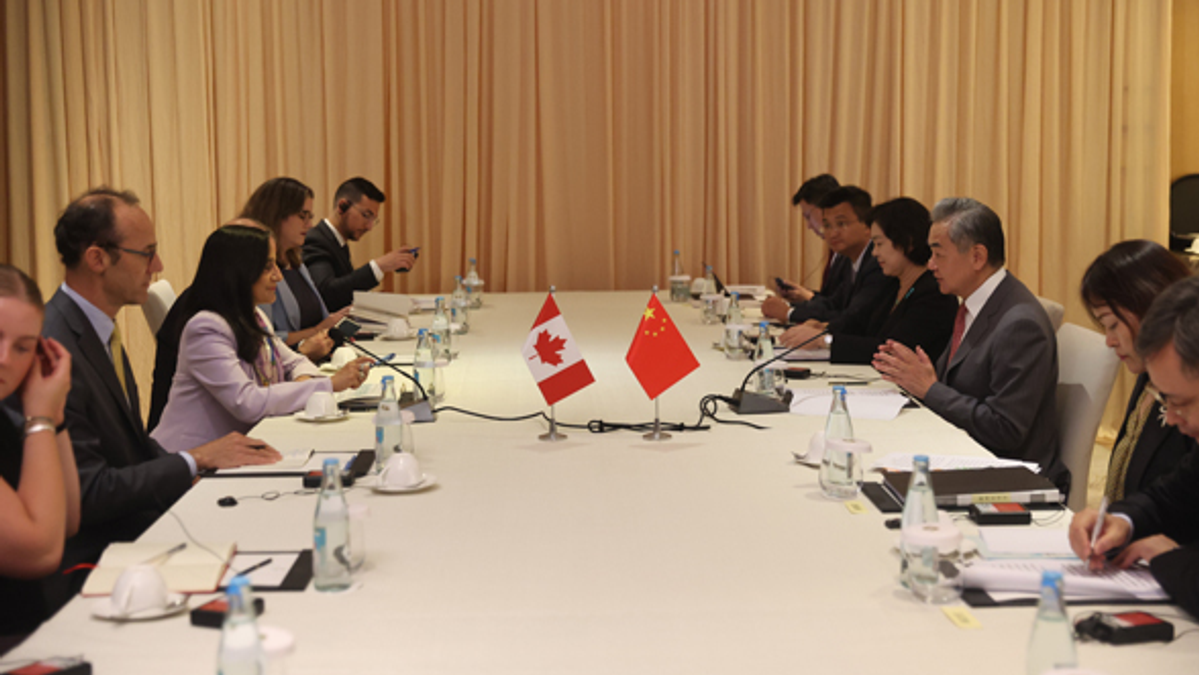
On Tuesday, July 22, 2026, Chinese Foreign Minister Wang Yi held a significant bilateral meeting with Canadian Foreign Minister Anita Anand in Manila, the Philippines. This high-level diplomatic engagement marks a notable effort by both nations to recalibrate and improve their often-strained relationship, emphasizing a pragmatic approach to shared interests amidst a complex global landscape. The meeting, likely held on the sidelines of a broader regional forum, provided a platform for both ministers to articulate their respective visions for the future of China-Canada relations.
The encounter between Wang Yi and Anita Anand signals a deliberate move towards normalizing and strengthening ties that have experienced considerable turbulence in recent years. Chinese Foreign Minister Wang Yi characterized the improvement and development of relations as serving the shared interests of both countries, welcomed by their peoples, and constituting a "right historical choice." This framing suggests China's strategic intent to stabilize its relationships with key global partners, particularly amidst broader geopolitical competition.
Evidence of this positive trajectory was highlighted by Wang Yi, who noted a 16% year-on-year growth in bilateral trade volume during the first half of 2026, with Canadian exports to China increasing by an even more robust 23.3%. The return of Canadian agricultural products, such as canola and beef, to the Chinese market, alongside the entry of Chinese electric vehicles into Canada, underscores a tangible economic thawing. These developments indicate a mutual recognition of the substantial economic benefits derived from a stable trade relationship, moving past previous trade disputes that had impacted sectors like Canadian agriculture.
For China, the motivation appears multi-faceted. Economically, Canada represents a significant market and a source of natural resources, while also offering a destination for Chinese exports and investment. Diplomatically, stabilizing relations with a G7 nation like Canada can contribute to China's broader strategy of fostering diverse international partnerships and projecting an image of a responsible global actor. Wang Yi's call for enhanced coordination on multilateral issues such as global governance and artificial intelligence further illustrates China's desire to engage on critical global challenges and shape international norms.
For Canada, the engagement with China is driven by a pragmatic recognition of China's immense economic power and its pivotal role in global affairs. Foreign Minister Anand affirmed that relations with China are "among Canada's most valued bilateral ties," a statement that underscores the economic imperative despite existing political and human rights concerns. Canada's reaffirmation of the "one-China policy" signals its adherence to established diplomatic protocols, aiming to create a stable foundation for dialogue. Anand's emphasis on deepening mutually beneficial cooperation in areas like energy, trade, finance, and counter-narcotics, alongside promoting people-to-people exchanges, reflects a comprehensive approach to managing a complex relationship. The explicit mention of bridging differences through dialogue suggests Canada's intent to address contentious issues through diplomatic channels rather than confrontation.
The recent history of China-Canada relations has been marked by significant strain, particularly following the 2018 arrest of Huawei CFO Meng Wanzhou in Vancouver and China's subsequent detention of two Canadians, Michael Kovrig and Michael Spavor. These events led to a severe downturn in diplomatic and economic ties, including trade restrictions. The current meeting, therefore, represents a concerted effort to move beyond this difficult period and rebuild trust. The reference to an "important consensus reached by the two leaders" implies that the groundwork for this ministerial meeting was laid at the highest levels, indicating a strategic decision by both governments to de-escalate tensions and seek common ground.
Despite the positive rhetoric and economic indicators, underlying differences and sensitive issues undoubtedly persist. While both sides expressed a desire to "properly handle differences," the specifics of these disagreements were not detailed in the public statement. These likely include concerns over human rights, alleged foreign interference, and broader geopolitical alignments, particularly given Canada's close ties with the United States and its allies. The challenge for both nations will be to sustain economic cooperation and diplomatic engagement while navigating these sensitive areas without allowing them to derail the broader relationship.
The meeting in Manila carries broader geopolitical implications. As Canada, a key member of the G7 and NATO, seeks to balance its economic interests with China against its security and values alignment with Western partners, this engagement reflects a nuanced foreign policy approach. For China, engaging with middle powers like Canada is part of a wider diplomatic strategy to diversify its international relationships and mitigate the impact of competition with the United States. The venue in Manila, a significant hub in the Indo-Pacific, further contextualizes this bilateral engagement within the region's evolving security and economic architecture.
Looking ahead, both ministers expressed readiness to prepare for the next phase of high-level exchanges and to continuously enrich the connotations of a "new strategic partnership." This suggests a long-term vision for a more structured and stable relationship. While the path forward will likely involve continued careful diplomacy to manage differences, the recent meeting in Manila signals a clear intent from both China and Canada to prioritize stability and mutual benefit, injecting a degree of certainty into an increasingly turbulent world. The success of this re-engagement will depend on the ability of both nations to translate diplomatic rhetoric into sustained cooperation and effective management of their enduring disagreements. The trajectory of this relationship will be closely watched as a barometer of how major global powers and their allies navigate complex interdependencies in the 21st century.
Source referenced: CGTN
This brief was synthesized by our Editorial Engine and reviewed by The Ground Narrative team.