TRENDING

Monday, 19 October 2026
----------------------
8 Jumada Al-Awwal 1448 AH
China's launch of the World Artificial Intelligence Cooperation Organization (WAICO) signals its ambition to lead global AI governance, prompting varied strategic responses across Southeast Asia. Concurrently, deepening Sino-Thai ties, Myanmar's border instability, and domestic governance challenges underscore the region's complex geopolitical landscape.
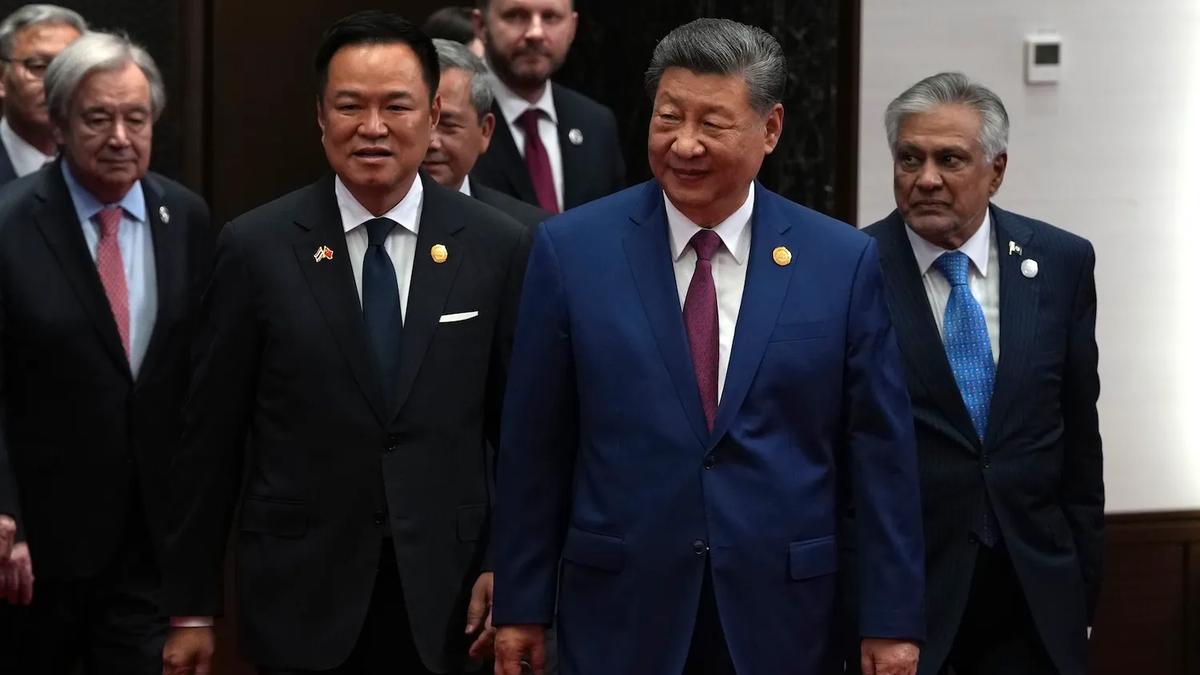
The recent launch of the World Artificial Intelligence Cooperation Organization (WAICO) in Shanghai, spearheaded by China, marks a significant geopolitical maneuver by Beijing to assert its leadership in the rapidly evolving domain of artificial intelligence. On July 17, Chinese President Xi Jinping, alongside high-profile figures including U.N. Secretary-General António Guterres and Thai Prime Minister Anutin Charnvirakul, inaugurated WAICO, followed by a four-day conference. This initiative, which includes 29 founding members, five of which are from Southeast Asia, underscores China's ambition to shape global AI governance and standards, potentially contrasting its "open-source" models with what it perceives as the United States' more "closed" approach.
For Southeast Asian nations, the engagement with WAICO reflects a complex strategic calculus. Countries like Cambodia, Laos, and Myanmar, which generally maintain closer ties with Beijing, joined the organization, though their direct contributions to advanced AI development are considered peripheral. Their membership is more indicative of political alignment within China's expanding sphere of influence. Indonesia, a regional heavyweight, also joined, consistent with its broader foreign policy of engaging with numerous international bodies without exclusive alignment. Malaysia, a critical player in global semiconductor supply chains, became a founding member but refrained from issuing an official statement, signaling a cautious approach that balances economic opportunities with its independent foreign policy.
Notably, Singapore, despite its alignment with open-source AI principles, opted not to join WAICO, demonstrating its consistent wariness of becoming too closely tied to any single superpower. Similarly, Thai Prime Minister Anutin Charnvirakul, while attending as a guest of honor and emphasizing Thailand's close relationship with China, did not commit to WAICO membership. Instead, Anutin articulated Thailand's own vision for AI governance, centered on "protection, potential, and prosperity," with a particular emphasis on mitigating risks such as fake news and scams. This nuanced engagement from key Southeast Asian states highlights the region's ongoing efforts to maintain strategic autonomy amidst intensifying great power competition, leveraging economic ties while safeguarding national interests and independent policy frameworks.
Beyond the AI discussions, Prime Minister Anutin Charnvirakul's visit to China facilitated significant bilateral advancements, particularly in diplomatic and security cooperation. Thailand and China agreed to establish a "2+2" dialogue mechanism, involving their foreign affairs and defense ministers, signaling a deepening strategic partnership. This enhanced coordination extends to a range of issues, from combating scams to advancing the long-stalled Thailand-China railroad project, reflecting a continuity of engagement from previous Thai administrations.
China also positioned itself as a regional mediator during Anutin's visit, addressing the ongoing border dispute between Thailand and Cambodia. Chinese President Xi Jinping urged both nations to settle their differences and offered China's facilitation for talks. Furthermore, Xi reportedly assured Anutin that Chinese tanks supplied to Cambodia would not be used against Thailand, a significant gesture aimed at alleviating regional security concerns. This diplomatic intervention underscores China's growing role in managing regional stability, potentially enhancing its influence as a constructive power.
However, Cambodia's close alignment with China during these meetings came with diplomatic repercussions. Cambodian Prime Minister Hun Manet's reiteration of support for China's "One China" policy regarding Taiwan led Taipei to revoke Cambodia's visa-free status. This incident illustrates the potential costs for nations that align too closely with Beijing on sensitive geopolitical issues. Concurrently, the ongoing detention in Thailand of Bai Zhaodong, a dissident Chinese journalist whose extradition China has requested, casts a shadow over the deepening security cooperation, raising concerns about human rights and the rule of law.
The volatile situation in Myanmar continues to generate significant cross-border challenges for its neighbors, as evidenced by Bangladesh's decision to construct a 108-kilometer fence along nearly 40 percent of its border with Myanmar. This initiative, publicly discussed since June, is a direct response to the escalating instability in Myanmar's Rakhine State, where the insurgent Arakan Army (AA) has consolidated control following the 2021 coup.
Bangladeshi officials report that traditional border management mechanisms have become ineffective due to the AA's dominance in the region since 2024. The proposed barrier aims to curb the two-way flow of recruits joining the AA and the smuggling of drugs and weapons out of Myanmar, particularly through the Chittagong Hill Tracts. The AA's involvement in kidnapping Bangladeshis and cross-border violence further exacerbates the security situation. While the fence is intended to enhance border security, some analysts caution that it may not be a standalone solution, advocating for a broader strategy that addresses the underlying drivers of instability and poverty along the frontier. The humanitarian implications, particularly for the Rohingya population who have faced atrocities from both the Myanmar military and, allegedly, the AA, remain a critical concern in this volatile border region.
Malaysia's firm stance on its non-recognition of Israel recently manifested in a public outcry and government action concerning a tech co-living space, Network School, in Forest City, Johor. Allegations by an activist group, Malaysian Protest 4 Palestine, claimed the presence of Israeli citizens at the facility, sparking widespread public concern. Malaysia prohibits Israeli citizens from entering the country without special permission, reflecting its strong diplomatic position on the Israeli-Palestinian conflict.
The incident quickly escalated, with critics raising fears of Israeli influence or subversion of Malaysian sovereignty, partly fueled by the "network states" ideology espoused by the school's American founder, Balaji Srinivasan. Malaysian Prime Minister Anwar Ibrahim responded decisively, ordering the expulsion of any Israelis found. Although immigration inspections have not confirmed the presence of Israeli citizens, the Johor authorities ordered the school's closure over alleged business license breaches. Srinivasan, denying the claims, has paused investment and threatened to relocate, highlighting the potential economic repercussions of such politically charged incidents on Malaysia's attractiveness for international tech investment.
Amidst these regional and international engagements, Thailand is grappling with a significant domestic governance crisis: a widespread civil service exam cheating scandal. The government announced that nearly 6,000 civil servants could face suspension following revelations of altered exam results in exchange for payments of up to 800,000 baht (approximately $24,000). The scandal, which first emerged in February, led to arrests by the National Anti-Corruption Commission in June, with further arrests of suspected ringleaders and civil servants following.
Prime Minister Anutin Charnvirakul has publicly condemned the scandal as a "betrayal of the nation," underscoring the severity of the issue. This widespread corruption within the civil service undermines public trust in government institutions, compromises meritocracy, and poses a significant challenge to the integrity and efficiency of public administration. While primarily a domestic issue, such large-scale corruption can indirectly impact investor confidence and the perceived stability and reliability of the state, with potential long-term implications for national development and international standing.
This confluence of events across Southeast Asia—from China's assertive tech diplomacy and deepening bilateral ties to regional security challenges and domestic governance issues—illustrates a dynamic and complex geopolitical landscape where nations navigate great power competition, internal conflicts, and the imperative for stable, transparent governance.
Source referenced: FOREIGNPOLICY
This brief was synthesized by our Editorial Engine and reviewed by The Ground Narrative team.