TRENDING

Monday, 19 October 2026
----------------------
8 Jumada Al-Awwal 1448 AH
China's rapid advancements in artificial intelligence (AI) have narrowed the gap with the United States, prompting Beijing to promote a narrative centered on 'open source' and 'inclusive AI' as an argument for its vision of global governance.
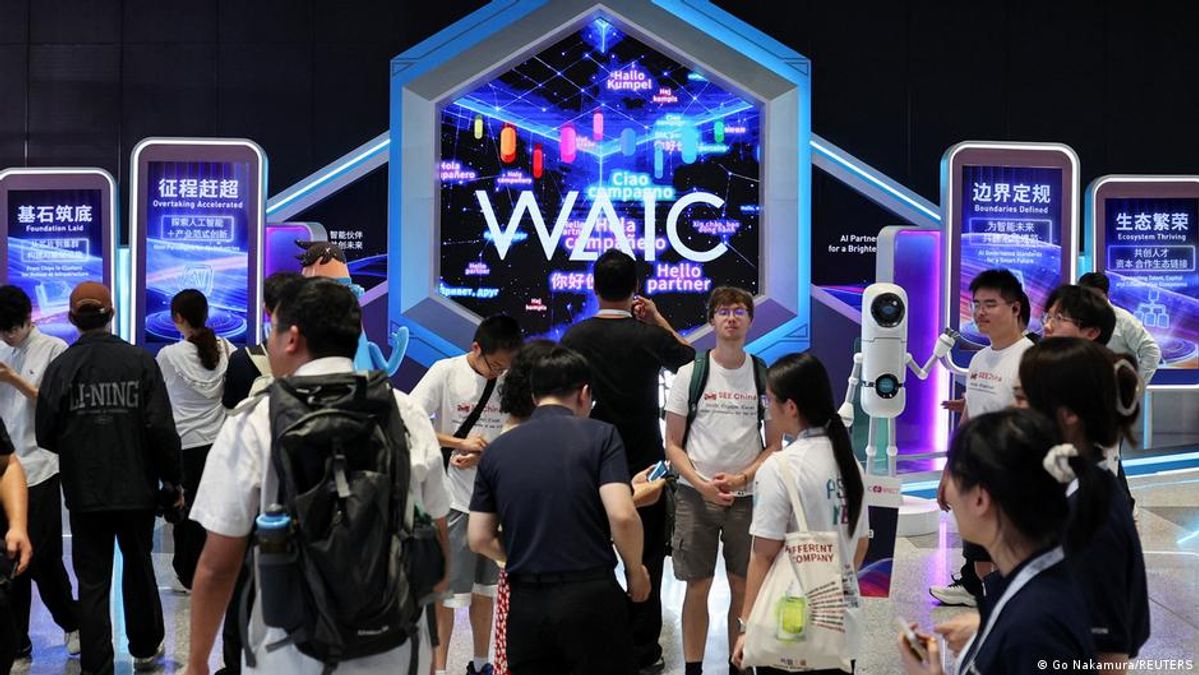
China's rapid advancements in artificial intelligence (AI) have narrowed the gap with the United States, prompting Beijing to promote a narrative centered on 'open source' and 'inclusive AI' as an argument for its vision of global governance.
The World Artificial Intelligence Conference (WAIC) in Shanghai, attended by over 1,000 representatives of China's tech firms, officials, researchers, and industry figures, marked a significant milestone in China's AI development. Chinese President Xi Jinping emphasized the importance of 'encouraging open-source development' and criticized the 'overextension of the concept of national security.' While Xi did not directly reference the United States, Beijing's effort to position itself as an advocate of a new AI order and challenge US dominance was unmistakable.
China has steadily narrowed the gap with the United States in AI model development, with its efforts at AI application in industrial processes slowly maturing. Chinese AI model developers have kept pace on the global stage by training open-weight models on limited but advanced computer hardware. Deployment of AI across Chinese enterprises may be progressing faster than in the United States, with less fear of AI among the Chinese population facilitating more rapid uptake of AI applications at the consumer level.
The US Commerce Department's expanded AI-related export controls through its 'Framework for Artificial Intelligence Diffusion' have impacted China's ability to manufacture chips domestically, cheaply, and at scale. However, export controls on advanced AI chips have failed to prevent a significant amount of chips from entering China through the gray market, while Chinese firms can still access computing resources through overseas cloud services.
Beijing is increasingly framing 'open source' and 'inclusive AI' as its own narrative to counter the United States' largely closed-source AI ecosystem. Chinese AI models are largely open-weight, with leading offerings released under MIT licenses that allow users to download, deploy, modify, distribute, and commercialize them. China hopes to encourage the rest of the world to adopt Chinese AI models, thereby creating overseas markets for Chinese technology and ensuring that China remains part of the next wave of technological development.
The World AI Cooperation Organization (WAICO), an initiative launched by China, has attracted 29 member countries. Xi described WAICO as 'an important milestone in the history of AI development' and said it responds to calls from Global South countries for a greater role in AI governance. WAICO is seen as an initiative to counter the US-led Pax Silica international initiative, which aims to secure global AI and critical mineral supply chains.
Experts believe that the US will continue to lead in AI hardware design and compute capacity, while China could seize the lead on model innovation and will come to lead on AI diffusion. China's biggest structural disadvantage remains the lack of trust from countries in the Global North. At the same time, US export controls continue to leave Chinese companies facing shortages of advanced AI computing hardware, limiting their ability to rapidly scale inference capacity to meet growing demand.
China's rapid advancements in AI have narrowed the gap with the United States, prompting Beijing to promote a narrative centered on 'open source' and 'inclusive AI' as an argument for its vision of global governance. The rise of China's AI sector represents a broader historical shift, marking the first time in modern history that a non-Western technological superpower has emerged. The future will be defined by a complex of overlapping technological networks and processes, rather than a singular global technological sphere.
Editor's Note: While China's AI advancements are significant, the US still maintains a lead in AI hardware design and compute capacity.
Source referenced: DW
This brief was synthesized by our Editorial Engine and reviewed by The Ground Narrative team.