TRENDING

Monday, 5 October 2026
----------------------
24 Rabi' Al-Thani 1448 AH
Ballot boxes have reached remote Indigenous communities in Brazil, underscoring the high stakes of an election where Amazon conservation is a central battleground. This vote is a fight for the future of the rainforest and the survival of its traditional guardians.
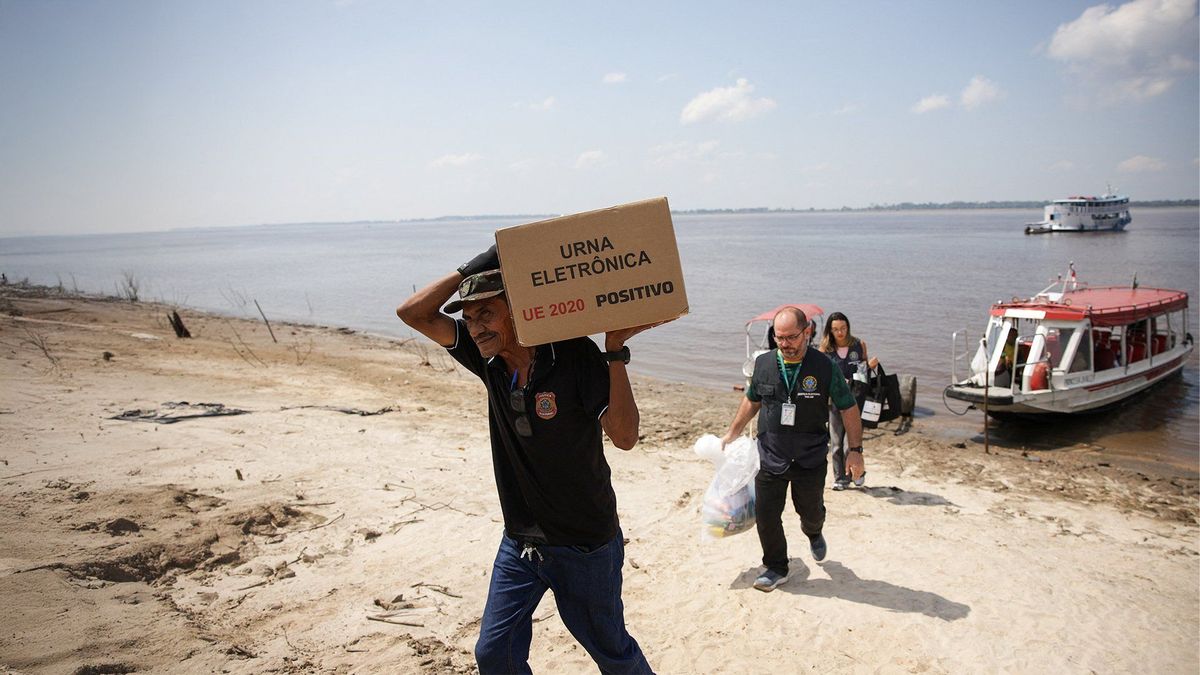
In a significant logistical undertaking, ballot boxes have been successfully delivered to remote Indigenous communities across Brazil, ensuring their participation in the country's upcoming presidential election. This electoral effort highlights the critical importance of these communities' voices in a contest where the fate of the Amazon rainforest is a defining issue. The election pits incumbent President Lula against challenger Flavio Bolsonaro, with their differing stances on environmental protection and resource management setting the stage for a pivotal moment in Brazil's history and for the global climate.
The act of delivering ballots to isolated communities, often deep within the Amazon, is more than just a logistical feat; it's a symbolic acknowledgment of their citizenship and a practical step towards their political empowerment. However, the true power mechanics extend far beyond the ballot box. Historically, Indigenous peoples in Brazil have been caught in a relentless struggle to defend their ancestral lands against encroaching economic interests. Their votes are cast in a context where the very definition of 'development' is fiercely contested.
On one side, the vision often promoted by figures like Bolsonaro (and his father, Jair Bolsonaro, whose previous administration championed similar policies) prioritizes agribusiness, mining, and infrastructure projects in the Amazon. This approach views the rainforest as a resource to be exploited for national economic gain, often downplaying the environmental consequences and the rights of its traditional inhabitants. The power of the ruralista lobby – a formidable bloc of large landowners and agricultural businesses – is immense in Brazilian politics, consistently pushing for deregulation and the opening of Indigenous territories to commercial exploitation. Their financial and political influence can shape legislation and enforcement, often to the detriment of environmental protections and Indigenous land claims.
Conversely, President Lula's administration has generally adopted a more conservation-oriented stance, emphasizing the protection of the Amazon and the demarcation of Indigenous lands. This aligns with international pressure and the growing global awareness of climate change. However, even under Lula, the complexities of balancing economic growth with environmental preservation remain. The state itself, with its various ministries and agencies, often struggles with internal contradictions, where one department might promote conservation while another facilitates infrastructure projects that impact the forest.
The Amazon is not just a Brazilian asset; it is a global climate regulator, a vast carbon sink, and a biodiversity hotspot. Its fate is therefore subject to international scrutiny and pressure from entities like the European Union and the United States, who often link trade agreements and financial aid to Brazil's environmental performance. This external pressure adds another layer to the power dynamics, influencing domestic policy decisions and sometimes providing leverage for environmental advocates and Indigenous rights groups.
Ultimately, the votes of Indigenous communities, while numerically smaller than the urban or rural populations, hold disproportionate significance. In a closely contested election, their collective voice can sway outcomes in states with significant Amazonian territories. More importantly, their participation legitimizes their claims to land and sovereignty, challenging the historical marginalization that has often rendered them invisible in the national political discourse. Their struggle is not merely about electing a president, but about asserting their fundamental right to exist and thrive on their ancestral territories, which are simultaneously critical to global ecological balance.
The political battles fought over the Amazon and its resources translate directly into a profound human cost, borne disproportionately by the Indigenous communities who call the rainforest home. These communities are on the front lines, facing the immediate and often brutal consequences of deforestation, illegal mining, and land grabbing. The very act of voting, for many, is a desperate plea for survival.
The most immediate and tragic cost is the violence and displacement Indigenous peoples endure. Illegal loggers, gold miners, and land grabbers frequently invade Indigenous territories, often with impunity. This leads to direct confrontations, threats, and assassinations of Indigenous leaders and environmental defenders who stand in their way. Homes are destroyed, sacred sites are desecrated, and entire communities are forced to abandon their ancestral lands, severing their deep cultural and spiritual ties to the forest. The loss of land is not just an economic hardship; it is an existential crisis, eroding identity and traditional ways of life that have sustained these communities for millennia.
Beyond direct violence, the destruction of the Amazon devastates the health and livelihoods of its inhabitants. Deforestation leads to the loss of traditional food sources – game, fish, and forest fruits – pushing communities into food insecurity. Rivers, vital for transport, drinking water, and fishing, are frequently contaminated by mercury from illegal gold mining, leading to severe health problems, birth defects, and long-term neurological damage. The introduction of diseases from outsiders, against which Indigenous populations have little immunity, further exacerbates their vulnerability. The disruption of the forest ecosystem also alters rainfall patterns and local climates, impacting agriculture and traditional resource gathering.
As lands are lost and traditional ways of life become unsustainable, the rich cultural heritage of Indigenous communities faces erosion. Languages, oral histories, traditional knowledge of medicinal plants, and spiritual practices intricately linked to the forest begin to disappear. The forced integration into a dominant, often hostile, society can lead to a loss of self-determination and a diminished sense of cultural pride, impacting the mental health and well-being of individuals and communities alike. The vibrant tapestry of unique cultures that has thrived in the Amazon for centuries is slowly unravelling under the relentless pressure of external forces.
The narrative often pushed by powerful economic interests frames the exploitation of the Amazon as
Indigenous communities are on the front lines of environmental protection in the Amazon. Their votes can significantly influence policies regarding land demarcation, resource extraction, and conservation, directly impacting the future of the rainforest and their ancestral lands.
Major threats include illegal logging, mining, and agricultural expansion, which lead to deforestation, land invasion, and violence. These activities also cause environmental degradation, impacting health and traditional livelihoods.
The Amazon rainforest is a critical carbon sink and biodiversity hotspot. The outcome of Brazil's election, particularly regarding policies on deforestation and conservation, has direct implications for global climate change mitigation and biodiversity preservation efforts.
Source referenced: ALJAZEERA
This brief was synthesized by our Editorial Engine and reviewed by The Ground Narrative team.


