TRENDING

Monday, 19 October 2026
----------------------
8 Jumada Al-Awwal 1448 AH
Armenia's recent parliamentary elections highlight a critical struggle between democratic consolidation and persistent Russian influence. Despite Prime Minister Pashinyan's victory, Moscow's support for opposition forces and its 'geopolitical binary' strategy continue to challenge Yerevan's efforts to diversify its foreign policy and strengthen its sovereignty.
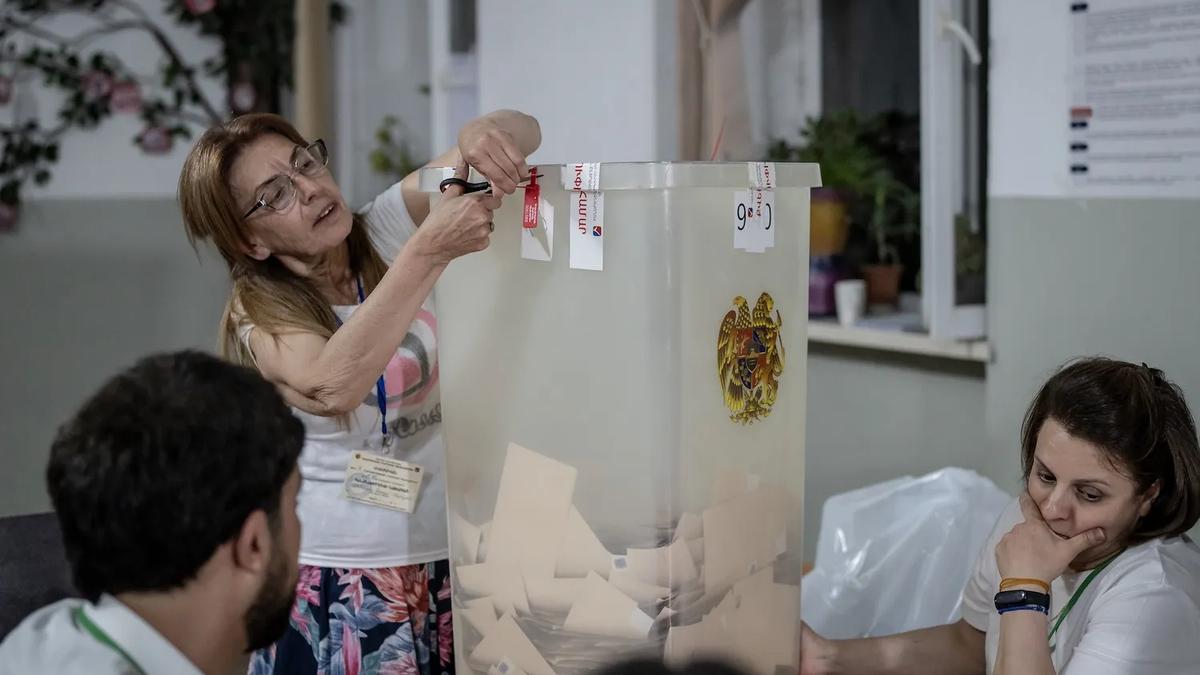
Armenia finds itself at a critical juncture, grappling with internal democratic vulnerabilities exacerbated by persistent external pressures, primarily from Russia. Recent parliamentary elections, which saw Prime Minister Nikol Pashinyan's Civil Contract party secure a majority, have highlighted Armenia's complex geopolitical balancing act. While the outcome denied Russia-linked opposition parties a direct path to power, it simultaneously underscored Moscow's enduring influence and its strategic efforts to maintain control over its post-Soviet periphery. This dynamic illustrates a broader challenge for nascent democracies in Russia's neighborhood: how to consolidate democratic institutions while resisting external interference and integrating entrenched, often externally supported, illiberal forces.
The strategic tension came into sharp focus on April 1, two months prior to Armenia's parliamentary elections, when Russian President Vladimir Putin hosted Prime Minister Pashinyan in Moscow for bilateral talks. During their conversation, Putin reportedly pressed Pashinyan to make an unequivocal geopolitical choice between Russia's Eurasian Economic Union (EAEU) and the European Union (EU). Citing Russia's experience with Ukraine, Putin argued that dual membership was untenable. Pashinyan, however, adeptly countered this "geopolitical binary," asserting that Armenia's EAEU membership was fully compatible with deepening and diversifying relations with the EU. He emphasized the legal and administrative feasibility of this joint engagement, framing it as a "fact" and highlighting Armenia's commitment to strong ties with Russia while simultaneously expanding its relationships with other international partners. Pashinyan's approach, described as "geopolitical jujitsu," sought to leverage mutual interests and Armenia's continued participation in Russia-centric institutions, arguing that a more stable and regionally integrated South Caucasus would ultimately strengthen Armenia-Russia relations. This exchange dramatically encapsulated the clash between Moscow's desire to dictate Armenia's foreign policy trajectory and Yerevan's pursuit of a "balanced and balancing" international posture.
The parliamentary elections on June 7 delivered a majority to Pashinyan's party, a result that was swiftly congratulated by many international actors. However, Russia notably withheld recognition of the outcome. Instead, Russia-linked parties within Armenia challenged the election results, hinting at the potential for social unrest. Even after the Constitutional Court upheld the results earlier this month, a bloc of opposition parties, including two that cleared the electoral threshold, announced their intention to remove "the current regime" and initiate a "new, more systematic, institutional and large-scale phase of political resistance." This reaction underscores that while Armenia may have partially resisted Putin's immediate demand for a geopolitical choice, the election outcome is not a simple "pivot" away from Russia. Instead, it reveals the Kremlin's continued strategy of managing and controlling states in its periphery by maintaining pressure on state institutions both before and after elections.
Russia's influence operations in Armenia, and indeed across other post-Soviet states like Georgia, Moldova, and Kazakhstan, employ a multifaceted toolkit designed to foster instability and maintain leverage. One primary strategy involves polarization through supporting unaccountable economic elite patronage networks. These networks, often comprising former authoritarian elites from the post-Soviet era, are incentivized by Moscow to challenge democratic institutions, delegitimize electoral outcomes, and obstruct the emergence of a robust, accountable opposition. Rather than adapting to democratic competition, these entrenched interests, bolstered by Russian support, actively work to undermine parliamentary integrity. This dynamic is particularly challenging for nascent democracies like Armenia, which struggle to integrate these powerful, often externally linked, illiberal forces into a functioning democratic system while safeguarding liberal principles.
A second crucial strategy is the generation of perennial insecurity, both economic and strategic. Historically, Russia has cultivated a "rescue narrative" positioning itself as the primary security guarantor in the Caucasus. However, the fall of Nagorno-Karabakh in 2023, despite the presence of Russian peacekeepers, and Azerbaijan's attacks on Armenia's internationally recognized borders in 2021 and 2022—to which the Russia-centric Collective Security Treaty Organization (CSTO) failed to respond—have exposed the limitations and hollowness of Russia's security guarantees. Despite this, Moscow continues to fuel anxieties, for instance, by criticizing the Washington accords signed between Armenia, Azerbaijan, and the United States last August, and U.S. support for regional connectivity projects. Concurrently, Russia has engaged in economic warfare, threatening to increase energy prices, thereby heightening Armenia's economic vulnerabilities and anxieties.
Armenia's democratic challenges are not solely a product of Russia's "perpetual geopolitics" but are also shaped by the broader regional environment. The highly personalized authoritarian system in neighboring Azerbaijan, for example, presents its own set of incentives and constraints. While regional openness and increased connectivity, potentially boosted by Armenia's recent elections, could offer economic diversification for Azerbaijan, it also poses a threat to the political insulation that underpins President Ilham Aliyev's rule. Personalized autocracies often view trade and regional integration less as a public good and more as a tool for political control, making them wary of initiatives that could reduce state control over information, movement, and economic actors.
The ongoing struggle in Armenia serves as a critical case study for understanding the complex interplay between internal democratic development and external geopolitical pressures in the post-Soviet space. While Prime Minister Pashinyan has demonstrated a clear intent to diversify Armenia's foreign policy and strengthen its democratic institutions, the Kremlin's persistent efforts to maintain influence through hybrid tactics, support for opposition proxies, and the generation of insecurity pose significant and enduring challenges. The future of Armenian democracy, and indeed regional stability, will largely depend on its ability to navigate this intricate geopolitical landscape while simultaneously building robust, resilient internal institutions capable of resisting both internal subversion and external coercion.
Source referenced: FOREIGNPOLICY
This brief was synthesized by our Editorial Engine and reviewed by The Ground Narrative team.


