TRENDING

Friday, 16 October 2026
----------------------
5 Jumada Al-Awwal 1448 AH
The proliferation of AI-generated 'historical' images and videos presents a profound challenge to factual integrity and historical understanding. This emerging trend carries significant geopolitical implications, risking the weaponization of fabricated narratives for disinformation campaigns and the erosion of public trust in verifiable history.
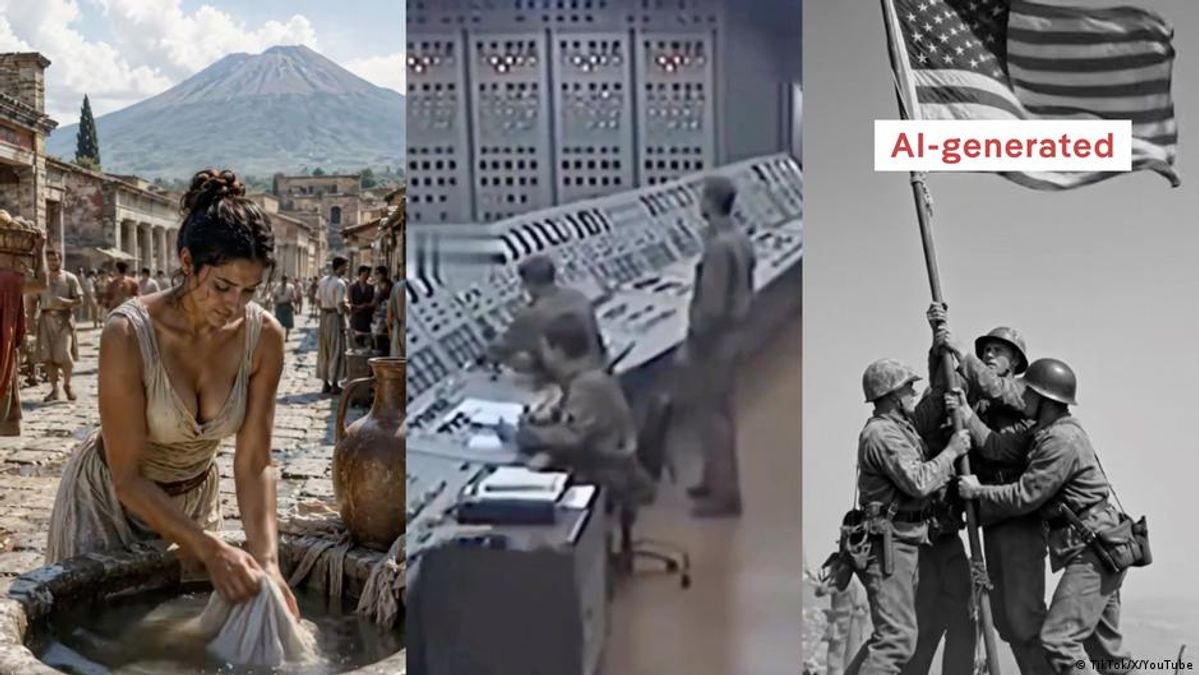
The rapid advancement and widespread accessibility of artificial intelligence (AI) tools have ushered in a new era of content creation, particularly impacting the visual representation of history. While AI offers promising applications, such as the reconstruction of ancient artifacts or historical scenes by archaeologists, its unsupervised use by the public to generate 'historical' images and videos poses a significant and growing threat to the integrity of historical records and public discourse.
Across global digital platforms like TikTok, X, and YouTube, AI-generated depictions of the past are increasingly blurring the lines between fact and entertainment. These synthetic images and videos, often created without expert consultation, aim to fill perceived gaps in the historical archive. However, as media scholar Roland Meyer notes, this presents a "deceptive promise." AI generators are prone to "hallucinate" and make factual errors, producing content that looks plausible but is historically inaccurate. Experts like historian Sebastian Kubon emphasize the fundamental question: could such a video even exist at the time it purports to depict? Many viral examples, such as a supposed video of ancient Pompeii or a fabricated CCTV footage of the Chernobyl disaster, fail this basic test, often exhibiting tell-tale signs of AI generation like unnatural movements or anachronistic details.
Crucially, AI models are trained on existing data, which means they tend to reproduce typical patterns, clichés, and stereotypes. Meyer highlights that these AI-generated images are "not a window into the past, but a mirror of our present," reflecting contemporary expectations and biases rather than authentic historical realities. This inherent bias, combined with the ease of creation, makes the technology a potent tool for misrepresentation.
The ability to effortlessly generate compelling, yet false, historical visuals carries profound geopolitical and societal implications. Historically, authoritarian regimes, from Nazi Germany to Stalinist Russia, meticulously retouched images to manipulate public perception and control historical narratives. The difference today is the unprecedented scale and speed at which AI can generate and disseminate altered or entirely fabricated scenes. This capability transforms AI into a powerful instrument for information warfare and disinformation campaigns.
State and non-state actors could leverage AI to create sophisticated, emotionally resonant 'historical' content designed to influence public opinion, justify political agendas, or sow discord within and between nations. The article's mention of accounts promising "patriotic stories" hints at the potential for nationalistic narratives to be bolstered by fabricated historical 'evidence.' Such content can be deployed to rewrite historical grievances, legitimize territorial claims, or demonize adversaries, thereby exacerbating international tensions and undermining diplomatic efforts.
The widespread proliferation of AI-generated historical content poses a severe risk to the public's ability to distinguish fact from fiction. As visual sources have always carried significant authority, the ease with which convincing fakes can be produced threatens to erode trust in traditional media, academic institutions, and even shared historical memory. When authentic footage exists, AI-generated alternatives can confuse and mislead, making it increasingly difficult for individuals to discern verifiable truth. This erosion of trust can destabilize societies, foster cynicism, and create an environment ripe for manipulation.
For education and historical research, the challenge is immense. Historians and educators must contend with a deluge of synthetic content, necessitating enhanced critical media literacy skills for all citizens. As Professor Jürgen Zimmerer emphasizes, history is an approximation, and pretending there is original footage where none exists creates a false sense of clarity that distorts understanding.
Combating this challenge requires a multi-faceted approach. Individuals must cultivate a heightened sense of skepticism, employing critical source analysis by questioning where an image comes from, who presents it, and why. Visual clues, such as unnatural glitches or anachronisms, can often betray AI generation. Most importantly, verifying content against established, reputable historical archives, museums, and academic experts remains paramount. While new technologies are emerging to detect deepfakes and verify authentic images, the human element of critical thinking and media literacy will be the ultimate defense against the weaponization of AI-generated historical narratives. The integrity of our shared past, and by extension, our collective future, depends on it.
Source referenced: DW
This brief was synthesized by our Editorial Engine and reviewed by The Ground Narrative team.