TRENDING

Tuesday, 27 October 2026
----------------------
16 Jumada Al-Awwal 1448 AH
A US strike in Venezuela has reportedly killed Hector Rusthenford Guerrero Flores, leader of the transnational Tren de Aragua gang, a development confirmed by both Washington and Caracas. This unusual cooperation against a shared security threat highlights the complex interplay of counter-narcotics efforts and strained diplomatic relations in Latin America.
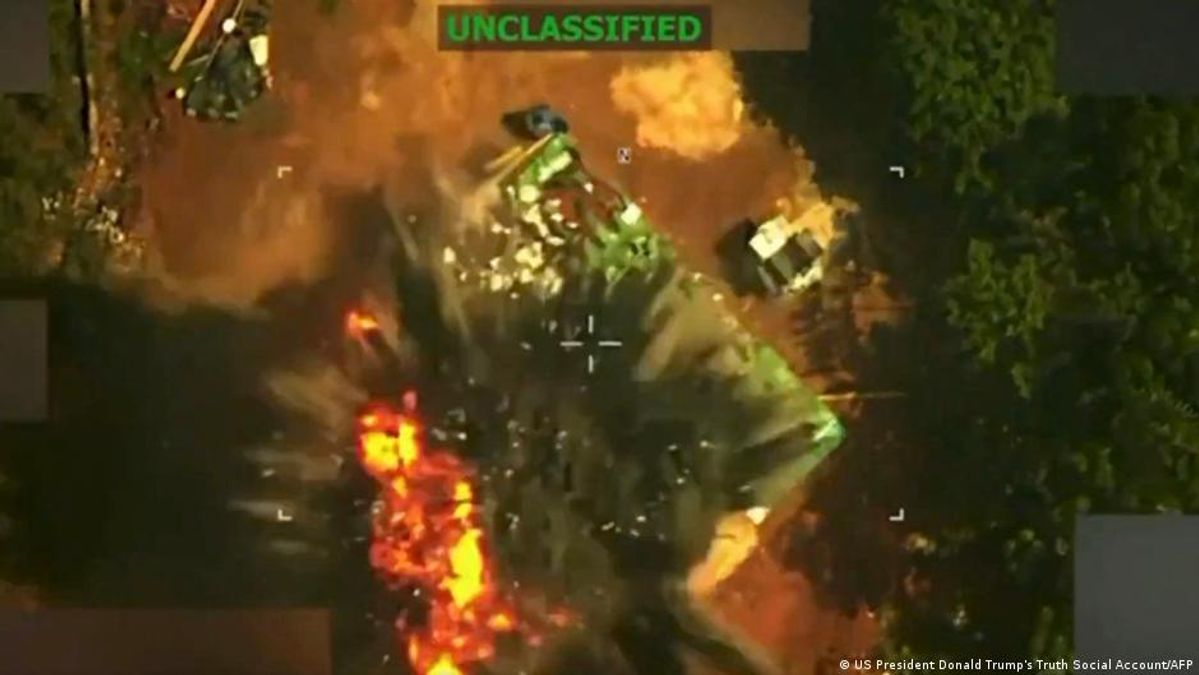
In a significant development underscoring the evolving landscape of international security and counter-narcotics efforts, Hector Rusthenford Guerrero Flores, the notorious leader of the Venezuelan criminal organization Tren de Aragua, was reportedly killed in a US strike within Venezuela. The operation, confirmed by both the United States and Venezuela, marks a rare instance of apparent, albeit limited, convergence between two nations with deeply adversarial diplomatic ties.
US President Donald Trump announced on Friday that a "swift and lethal kinetic" strike had neutralized Guerrero Flores, whom he characterized as an "infamous leader" responsible for violence and drug trafficking in US cities. Defense Secretary Pete Hegseth further elaborated that the strike occurred earlier in the week at one of the gang's compounds in Venezuela's southeastern state of Bolivar. The US State Department had previously offered rewards of up to $5 million for information leading to Guerrero Flores's arrest, underscoring the high priority placed on his capture or neutralization.
Remarkably, Venezuela's Ministry of Communications corroborated the death, stating that Guerrero Flores, also known as 'Nino Guerrero,' was "neutralized" during "clashes with members of these criminal structures" in what it described as a "joint operation" with the US. This characterization by Caracas is particularly noteworthy given the profound political and diplomatic estrangement between the two countries, which have seen the US impose extensive sanctions on Venezuela and openly support opposition movements.
The Tren de Aragua emerged over a decade ago from the confines of a Venezuelan prison in the central state of Aragua. Amidst Venezuela's severe economic crisis and the subsequent neglect of its correctional facilities, Guerrero Flores and other inmates seized control, transforming the prison into a self-governing complex complete with illicit amenities. This initial consolidation of power provided the foundation for the gang's rapid and brutal expansion.
As millions of Venezuelans emigrated in search of better economic opportunities and stability, Tren de Aragua capitalized on these migratory flows, extending its operations transnationally. The gang established a formidable presence across several Latin American countries, including Peru and Colombia, where it has been accused of fueling rising violence, extortion, human trafficking, and drug smuggling. Its reach reportedly extended into the United States, with Guerrero Flores himself facing racketeering, drug, and firearms charges in New York as of December. The gang's ability to leverage the Venezuelan diaspora and exploit regional vulnerabilities highlights the profound impact of internal crises on broader regional security.
The strike against Guerrero Flores carries significant geopolitical implications. For the United States, the operation underscores a proactive and kinetic approach to combating transnational organized crime perceived as a direct threat to domestic security. President Trump's strong rhetoric, labeling the gang's members as "terrorists" and vowing to pursue them "anytime, anyplace," serves both a domestic political agenda focused on law and order and signals a robust stance against international criminal networks.
The Venezuelan government's confirmation of the death, and particularly its reference to a "joint operation," is perhaps the most intriguing aspect of this event. Despite the US having previously indicted Venezuelan President Nicolás Maduro on drug charges and maintaining a policy of regime change, the shared interest in dismantling a powerful criminal entity like Tren de Aragua appears to have created a narrow, tactical window for cooperation. This suggests that even deeply antagonistic states can find common ground when confronted with immediate, mutually threatening security challenges, particularly those that destabilize their respective territories or undermine state authority.
However, this limited cooperation does not necessarily signal a broader thaw in US-Venezuela relations. It is more likely an isolated incident driven by pragmatic security concerns rather than a shift in diplomatic policy. The US has consistently accused the Maduro government of complicity in drug trafficking, a claim that a declassified US intelligence assessment has previously contradicted regarding Tren de Aragua's direct control by Maduro. Nevertheless, the gang's origins and unchecked growth within Venezuela's borders have long been a point of international concern.
The neutralization of Guerrero Flores could disrupt Tren de Aragua's command structure and operational capabilities, at least in the short term. However, the resilience and adaptability of transnational criminal organizations mean that new leadership often emerges, and the underlying conditions that allowed the gang to flourish—such as state weakness, economic instability, and migratory crises—persist. Therefore, while a significant blow, this strike alone is unlikely to eradicate the broader threat posed by Tren de Aragua or similar groups.
Regionally, the event may prompt other Latin American nations grappling with Tren de Aragua's presence to reassess their strategies for combating transnational crime. It also highlights the complex challenges of addressing criminal networks that exploit porous borders and vulnerable populations. The incident serves as a stark reminder that the intersection of internal governance failures, economic hardship, and international criminal enterprise poses a persistent and evolving threat to global stability and security, demanding multifaceted and often unconventional responses from state actors.
Ultimately, the strike against Hector Rusthenford Guerrero Flores is a testament to the US's willingness to employ kinetic force against transnational criminal targets and a rare glimpse into potential, albeit highly constrained, security cooperation between the US and Venezuela, driven by the imperative to counter a shared and destabilizing threat.
Source referenced: DW
This brief was synthesized by our Editorial Engine and reviewed by The Ground Narrative team.