TRENDING

Monday, 5 October 2026
----------------------
24 Rabi' Al-Thani 1448 AH
A US-mediated framework agreement between Lebanon and Israel, intended to stabilize the volatile border region, has drawn sharp criticism from human rights organizations over clauses that allegedly undermine international justice and accountability for war crimes. The deal highlights the complex interplay of regional stability, national sovereignty, and the imperative of international law.
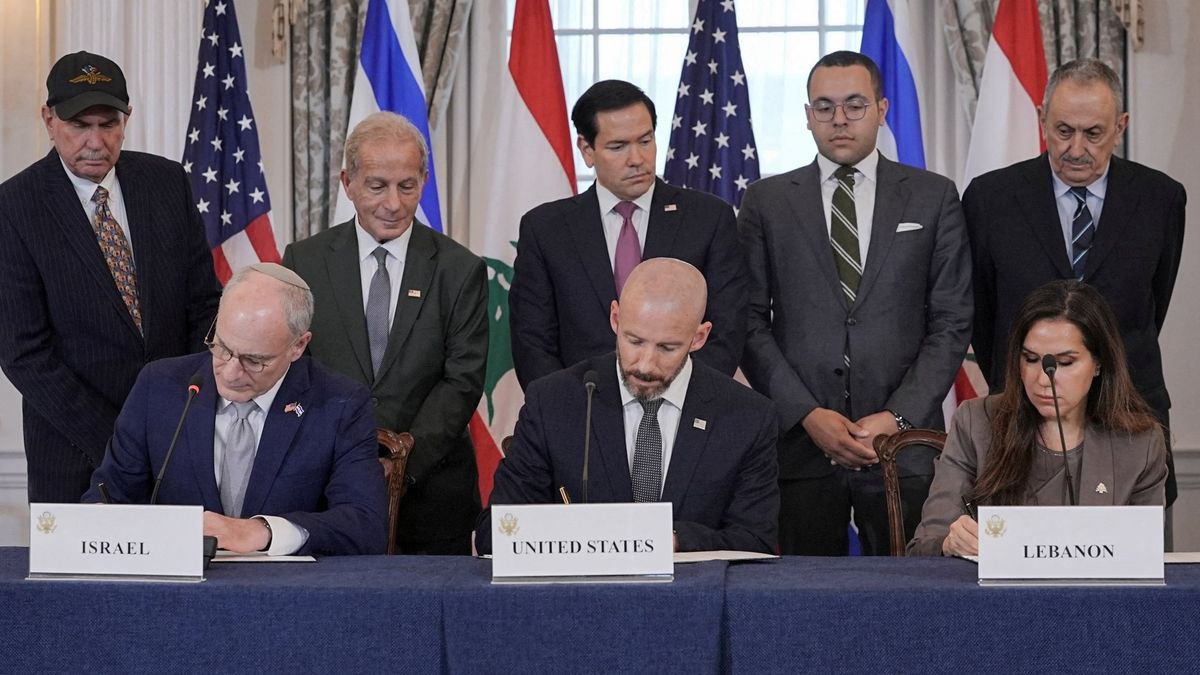
On June 26, 2026, a significant US-mediated framework agreement was signed in Washington D.C. between Israel and Lebanon. The accord, signed by Israel's Ambassador to the US, Yechiel Leiter, and Lebanon's Ambassador to the US, Nada Hamadeh, aims to establish a new operational understanding along their shared border, following months of intense hostilities. This diplomatic initiative emerged five days after a broader ceasefire was agreed upon between Iran and the United States on June 21, suggesting a wider regional de-escalation effort.
The immediate impact of the agreement has been the return of hundreds of thousands of internally displaced persons (IDPs) to southern Lebanon, a region heavily affected by the recent conflict. The International Organisation for Migration (IOM) reported that over 646,000 IDPs have begun returning, although approximately 500,000 remain displaced, many finding their homes and villages destroyed. This humanitarian aspect underscores the urgent need for stability in the region.
Despite the immediate de-escalation, the agreement has been met with strong condemnation from a coalition of six prominent human rights and media freedom organizations, including Amnesty International, Human Rights Watch, and Reporters Without Borders. In a joint statement, these groups warned that specific clauses within the agreement, particularly Clauses 3 and 13, threaten to "betray the victims of war crimes" and undermine the pursuit of justice.
Their primary concern revolves around provisions that appear to prevent both Lebanon and Israel from seeking recourse in international courts, including the International Criminal Court (ICC) and the International Court of Justice (ICJ). Clause 13, in particular, is criticized for preventing civilians from initiating "actions in international political or legal fora." This comes after a period of conflict that resulted in immense civilian harm, including alleged war crimes and violations of international humanitarian law.
Furthermore, Clause 3 is deemed problematic for conditioning the return of residents to specified border zones on the "successful disarmament of non-state armed groups and dismantlement of their infrastructure." Human rights groups argue that this violates international humanitarian law, which mandates the right of return for displaced persons once hostilities cease or the reasons for displacement no longer exist. They contend that accountability for serious international crimes is a non-negotiable legal obligation, not a bargaining chip in diplomatic negotiations.
The agreement exposes the complex and often conflicting strategic motivations of the key actors involved. For the United States, mediating this deal is a clear effort to de-escalate tensions in a perennially volatile region, potentially as part of a broader diplomatic strategy involving Iran. Stabilizing the Israel-Lebanon border is crucial for broader regional security.
Lebanon's President Joseph Aoun defended the agreement, asserting that it does not legitimize Israeli occupation but rather empowers the Lebanese army to extend its authority across the country. Aoun framed the decision as a sovereign act, separating Lebanon's trajectory from the "Iranian-US track," suggesting an attempt to reduce external influence and strengthen state institutions against non-state actors. The return of IDPs is also a critical domestic concern for the Lebanese government.
Conversely, Israeli Prime Minister Benjamin Netanyahu has maintained that the Israeli military "will not leave" southern Lebanon as long as Hezbollah remains a "threat." This stance highlights Israel's primary security concern regarding Hezbollah's military capabilities and presence near its border. The agreement, from Israel's perspective, likely aims to achieve a degree of security and de-escalation, though the long-term presence of Hezbollah remains a significant challenge.
Hezbollah, a powerful non-state actor in Lebanon with significant political and military influence, has rejected the deal as "null and void." It views any attempt to link an Israeli withdrawal to its disarmament as crossing "all red lines." This rejection underscores Hezbollah's continued assertion of its armed status as a core component of its identity and strategy, complicating efforts to establish full Lebanese state sovereignty over its territory.
The US-brokered agreement represents a delicate balance between achieving immediate stability and upholding international legal principles. While it has facilitated a ceasefire and the return of some displaced populations, the concerns raised by human rights organizations are profound. If the agreement indeed curtails avenues for justice for victims of war crimes, it could set a dangerous precedent, potentially undermining the international legal framework for accountability in conflict zones.
Geopolitically, the deal reflects the ongoing struggle for influence in the Middle East, with the US attempting to manage regional conflicts and Iran's role through various diplomatic channels. Internally, Lebanon faces the perennial challenge of asserting state authority over non-state actors like Hezbollah, whose rejection of the deal highlights the limits of the Lebanese government's control and the deep divisions within the country.
The long-term success of this framework agreement hinges on its ability to address not only immediate security concerns but also the fundamental issues of justice, accountability, and the full restoration of sovereignty. Without a clear path for victims to seek redress and a comprehensive strategy for the disarmament of non-state armed groups, the peace achieved through this agreement may remain fragile, susceptible to renewed instability and conflict.
Source referenced: ALJAZEERA
This brief was synthesized by our Editorial Engine and reviewed by The Ground Narrative team.


