TRENDING

Thursday, 12 November 2026
----------------------
2 Jumada Al-Thani 1448 AH
A year after a disputed vote, Tanzania’s president has turned legal tools into a cage for dissent. The sentencing of Tundu Lissu reveals how power, profit, and repression intertwine.
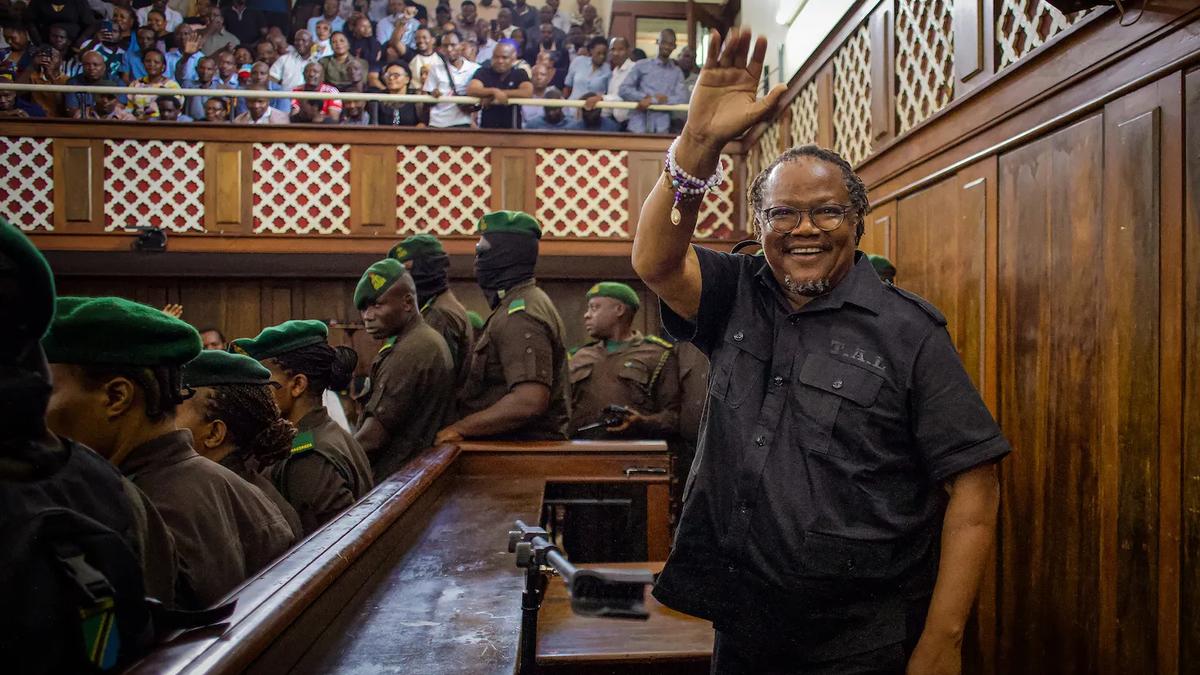
On 6 November 2026, Tanzania’s High Court handed Tundu Lissu, leader of the opposition Chadema, a four‑year prison term for “incitement” while acquitting him of treason. The verdict follows a cascade of arrests, bans on political rallies, and a series of security‑force crackdowns that began after the October 2025 presidential election, in which incumbent Samia Suluhu Hassan was declared winner with 98 percent of the vote after the electoral commission disqualified her main rivals.
The 2025 election was reshaped by legal maneuvers that stripped the opposition of ballot access. By invoking vague “national security” clauses, the electoral body barred Chadema candidates, effectively guaranteeing Hassan’s landslide. This pre‑emptive exclusion turned the vote into a referendum on the incumbent rather than a genuine contest, cementing her political survival.
State security forces were redeployed from conventional policing to a quasi‑military role. The post‑election violence that claimed over 1,000 lives—according to rights groups—was framed as a protest‑driven crisis, justifying a surge in arrests, prolonged detentions without trial, and alleged torture. The judiciary, staffed by appointees loyal to the presidency, provided the legal veneer for what analysts describe as a “law‑of‑the‑land” strategy: criminalize dissent, then use the courts to legitimize imprisonment.
While the crackdown deepened, Tanzania simultaneously courted foreign capital for its newly discovered natural‑gas fields and a massive nickel project. A U.S.‑backed consortium is negotiating a $500 million nickel investment, and a $42 billion gas deal with Equinor, Shell, and ExxonMobil is nearing completion. These deals are structured to lock in long‑term revenue streams, making the regime less vulnerable to Western diplomatic pressure on human‑rights abuses. In effect, economic incentives are being weaponized to mute criticism.
Young Tanzanians, many of whom rely on social media platforms like TikTok for political expression, now face intimidation, abductions, and the threat of disappearance. Content creator Gasper Kagonda warned that “young people are wandering around with no place where they feel they can speak out.” The climate of fear has driven a generation of activists underground, eroding the space for civic engagement.
The crackdown has disrupted informal economies that depend on street markets and small‑scale trade. Frequent security sweeps and arbitrary arrests have led to loss of income for vendors, while the lingering uncertainty over the true death toll—official figures cite 518 deaths, rights groups estimate well over 1,000—has strained community cohesion and mental health services. Families of the disappeared receive no compensation, and the state’s refusal to release the full commission report fuels ongoing trauma.
Neighboring countries monitor Tanzania’s turn toward authoritarianism as a cautionary tale. Refugee flows from border regions have risen modestly, as activists seek safety in Kenya and Uganda. The broader East African Community faces pressure to address democratic backsliding, yet the bloc’s own leadership remains hesitant, fearing economic retaliation.
Official statements celebrate the gas and nickel projects as milestones for national development, yet they omit the clauses that grant foreign firms extensive control over extraction sites and export routes. These contracts often include “stability clauses” that allow investors to demand government action against perceived threats—including political dissent—under the pretext of protecting investments.
The court’s decision to downgrade treason to incitement for Lissu illustrates a strategic use of the legal system: keep the opposition leader incarcerated while avoiding the international backlash that a treason conviction would provoke. Simultaneously, dozens of Chadema members remain detained without charge, a fact rarely highlighted in diplomatic briefings.
Western governments have issued muted statements calling for “respect for human rights,” but have not linked aid or trade agreements to concrete reforms. The United Nations Human Rights Office has condemned the lack of accountability, yet the Security Council has not prioritized the issue, reflecting a broader pattern where strategic mineral interests eclipse human‑rights advocacy.
The 2027 Tanzanian parliamentary elections will test whether Hassan can translate her presidential mandate into legislative dominance. Opposition parties, though weakened, may attempt coordinated candidate nominations to force a coalition, a scenario that could reignite international scrutiny.
Watch the finalization of the nickel and gas contracts. Any amendment that introduces stricter “human‑rights due‑diligence” provisions could pressure the regime, while the absence of such clauses would signal continued tolerance of repression.
A new UN‑mandated inquiry into post‑election violence is slated for early 2027. Its findings, if made public, could either empower Tanzanian civil society or be buried again, depending on diplomatic leverage. Meanwhile, grassroots digital campaigns continue to document abuses; their virality may force a recalibration of the government’s narrative.
Ethiopia, Kenya, and the Southern African Development Community (SADC) are all monitoring Tanzania’s trajectory. Any shift toward collective pressure—perhaps through trade sanctions or suspension of development loans—could alter the cost‑benefit calculus for Hassan’s administration.
In sum, the sentencing of Tundu Lissu is not an isolated courtroom drama; it is a flashpoint where domestic power consolidation, foreign investment interests, and the erosion of civic space intersect. The next months will reveal whether the regime’s gamble on economic patronage can outlast the growing impatience of a silenced populace.
Lissu faced treason and incitement charges after the 2025 election. He was acquitted of treason but convicted of incitement, resulting in a four‑year prison sentence.
Large‑scale gas and nickel deals with U.S., Norwegian, and British firms provide the regime with revenue and geopolitical leverage, reducing the incentive for Western governments to pressure Tanzania on human‑rights abuses.
Editor's Note: Analysis based on publicly available reports and expert commentary; on‑the‑ground conditions may evolve.
Source referenced: FOREIGNPOLICY
This brief was synthesized by our Editorial Engine and reviewed by The Ground Narrative team.


